home/products/5 best garage door seals – bottom, side & threshold
5 Best Garage Door Seals – Bottom, Side & Threshold
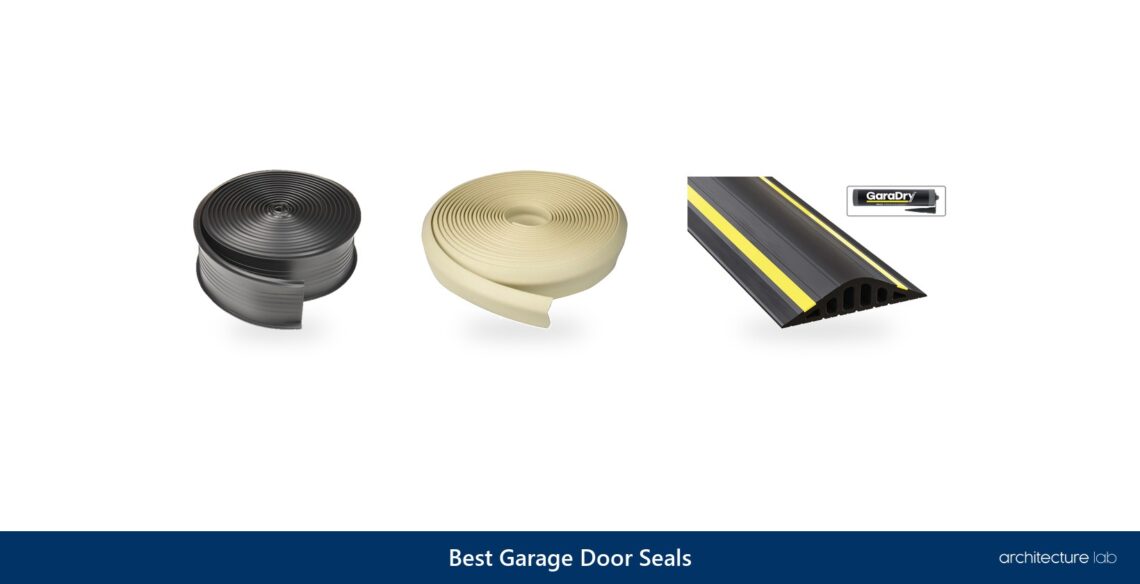
Garage door seals close the gaps around a shut garage door, and the bottom seal, the one most doors need first, has to match the aluminum retainer it slides into. The retainer's profile decides the insert, down to the size of the T on its edges, since a 5/16-inch seal will not slide into a 1/4-inch retainer. For a metal overhead door with a sound retainer, the Frost King RV18 renews the vinyl insert, and a wooden door with no retainer takes the Frost King G16H, nailed to its bottom edge. Where the retainer is bent or corroded, the Xcluder X2 Sectional-Door Kit replaces it along with the seal, because a new seal in a crushed retainer seals no better than the old one. The top and both sides take the Frost King SG30WH, and water standing at the door line calls for a floor threshold, the GaraDry WS013-250. Daylight under a closed door does not always mean a worn seal, since an opener with its down limit set short leaves the same gap.
Review
Garage door seals close the gaps around a shut garage door, and the bottom seal, the one most doors need first, has to match the aluminum retainer it slides into. The retainer's profile decides the insert, down to the size of the T on its edges, since a 5/16-inch seal will not slide into a 1/4-inch retainer. For a metal overhead door with a sound retainer, the Frost King RV18 renews the vinyl insert, and a wooden door with no retainer takes the Frost King G16H, nailed to its bottom edge. Where the retainer is bent or corroded, the Xcluder X2 Sectional-Door Kit replaces it along with the seal, because a new seal in a crushed retainer seals no better than the old one. The top and both sides take the Frost King SG30WH, and water standing at the door line calls for a floor threshold, the GaraDry WS013-250. Daylight under a closed door does not always mean a worn seal, since an opener with its down limit set short leaves the same gap.
| Seal | Best for | Seals | Needs retainer | Mounting | Material |
|---|---|---|---|---|---|
| Frost King RV18 | Metal-door retainer | Door bottom | Yes | Slide-in | Vinyl |
| Frost King G16H | Wooden door bottom | Door bottom | No | Nail on | EPDM rubber |
| Frost King SG30WH | Top and side perimeter | Top and sides | No | Nail on | Vinyl |
| Xcluder X2 Sectional-Door Kit | Damaged retainer | Door bottom | Supplied | Screw-on kit | Rubber, fabric, brush |
| GaraDry WS013-250 | Floor water barrier | Floor line | No | Adhesive | PVC |
1. Frost King RV18 – Best Replacement Insert for Metal Overhead Garage Doors
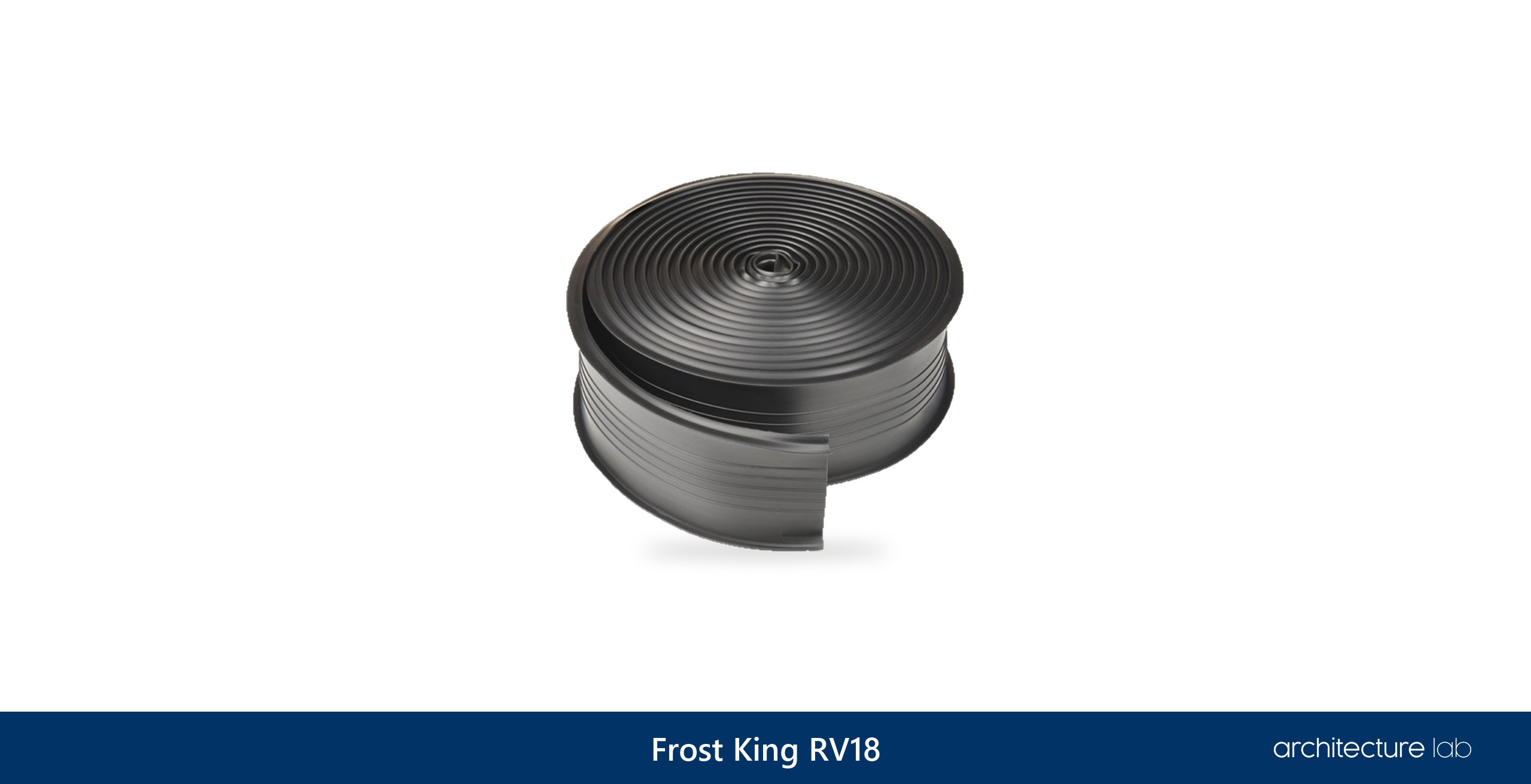
The Frost King RV18 is the insert to buy when the retainer on a metal overhead door is sound and only the vinyl has worn. Frost King designs it for most popular brands of metal overhead door, and it reuses the aluminum retainer already there. The 18-foot strip is formed into a U and slid into both grooves of the retainer, where it hangs below the door as a loop that the closing door presses against the floor along its full width.
The insert seals only if the retainer is sound and matches its profile, and a bent, corroded or incomplete retainer is replaced along with the seal. On one door, a Frost King bottom seal would not slide into the track at all, because the old seal had a half-moon shape and was slightly narrower, and the owner ended up fitting a new aluminum channel with its own seal. Before fitting, Frost King suggests a 10 to 15 minute soak in warm water and a little liquid soap on the edges, and the vinyl trims to length with scissors. The insert is 2-3/4 inches wide and 1/8 inch thick, and a 10-foot RV9 is sold alongside it.
What We Like
- Reuses the retainer already on the door
- Trims with scissors
- 18 ft length, with a 10 ft RV9
What We Don't Like
- Needs a sound retainer with a matching profile
- Metal overhead doors only
2. Frost King G16H – Best Bottom Seal for Wooden Garage Doors
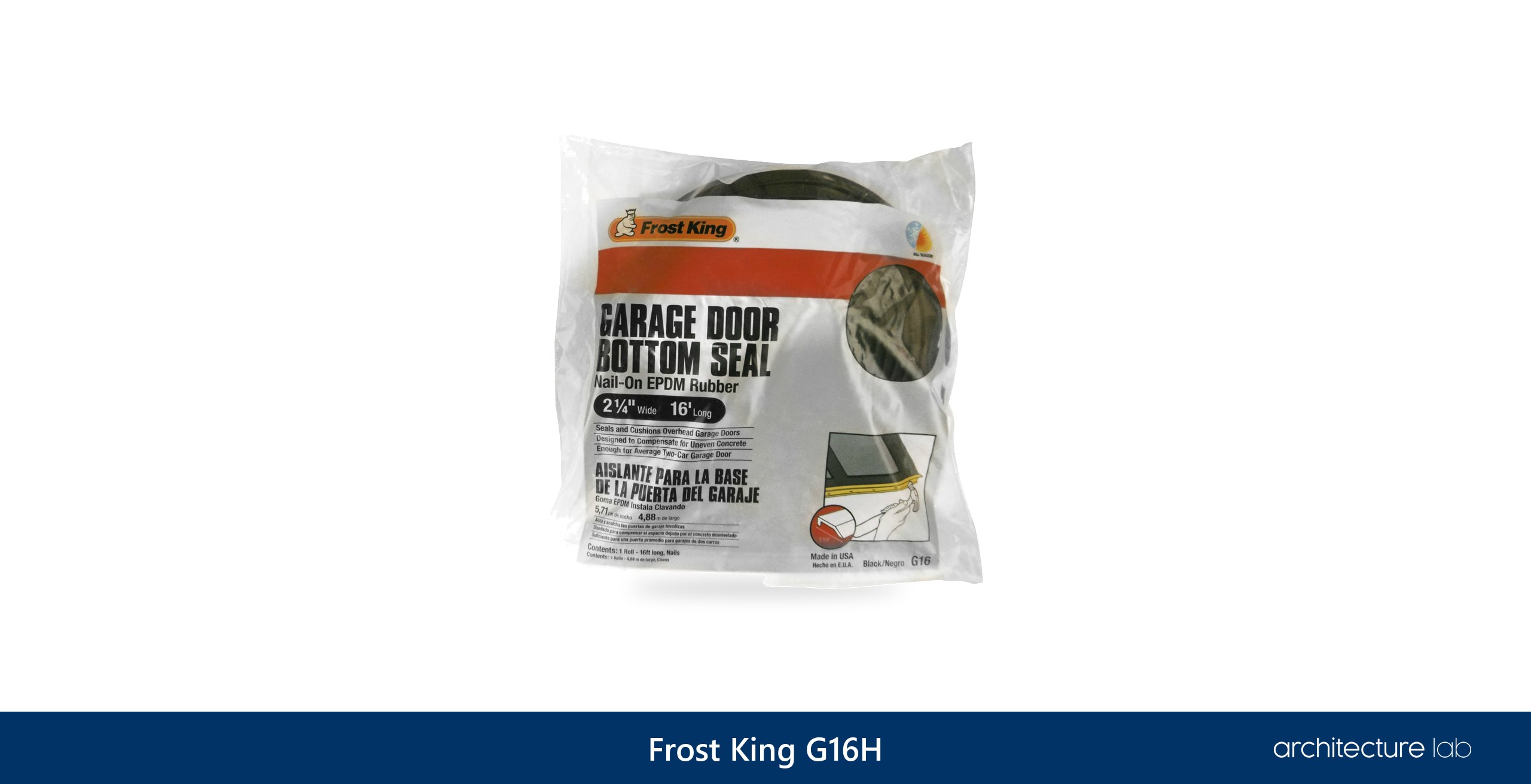
The Frost King G16H is the bottom seal for a wooden garage door with no retainer. The 16-foot strip of EPDM rubber nails straight to the door's lower edge, and its channel shape takes up an uneven concrete floor or an uneven door, cushioning the door as it closes. It stops the cold draft under the door and seals the bottom edge, and it goes on easily, in about half an hour on one wooden door with the roofing nails supplied.
One 16-foot coil covers a two-car door, and the 9-foot G9H covers a one-car door. Frost King has the strip measured to the door's width, shortened if needed and nailed with the nails staggered about 3 inches apart. The wide lip faces the driveway, and it is reversed to face inside when the door sits lower than the driveway. The seal is specified for wooden doors, and on one door with a metal bottom rail, screws in place of nails made the strip pucker until a thin aluminum strip clamped it flat against the rail.
What We Like
- No retainer needed
- Channel shape takes up an uneven floor
- 16 ft coil covers a two-car door
- 1/4 in thick EPDM rubber
What We Don't Like
- Specified for wooden doors only
- Seals the bottom edge only
3. Frost King SG30WH – Best Perimeter Seal for Garage Door Tops and Sides
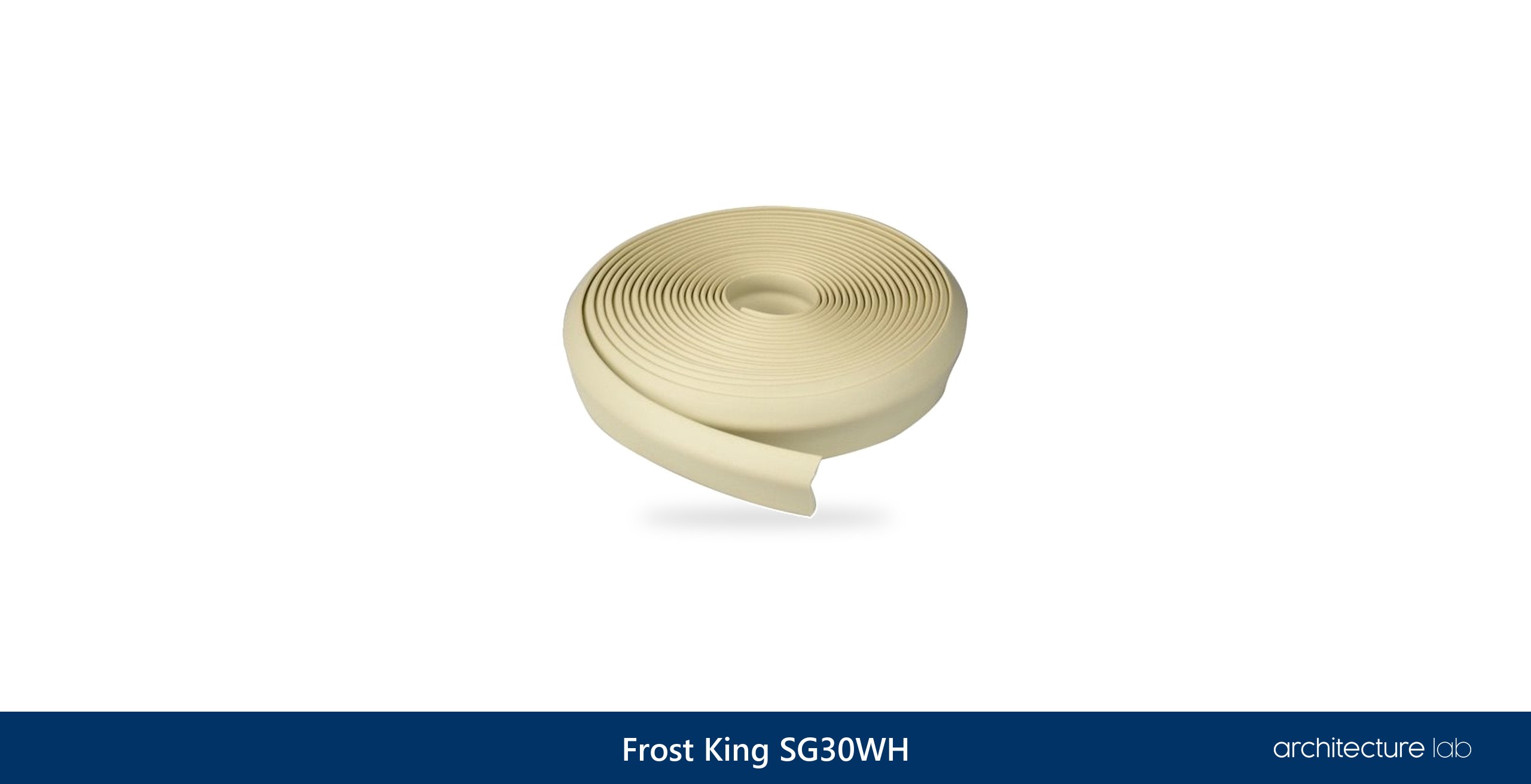
The Frost King SG30WH covers the edges a bottom seal never reaches, the top and both sides of the door, with 30 feet of nail-on vinyl. Each strip nails to the frame by its wide flat side, and the closed door presses against the sealing lip on the other side, shutting out dust, drafts and dirt. It fits overhead doors and swing-open garage doors alike, and it goes up easily, with a second pair of hands holding the strip steady while it is nailed. Tacked along the sides of one single door, it filled the gap and left the garage warmer.
The vinyl is soft, and on one frame the nails pressed into it and left small gaps between them for air and water. Frost King has the nails staggered about 6 inches apart and the sealing lip cut at 45 degrees where the strips meet in the corners, which tightens the seal. The strips are 1-3/4 inches wide, and the bottom of the door still needs its own seal.
What We Like
- Covers the top and both sides
- 30 ft of strip in one kit
- Fits overhead and swing-open doors
- 45-degree corner cuts tighten the seal
What We Don't Like
- The bottom needs its own seal
- Soft vinyl
4. Xcluder X2 Sectional-Door Kit – Best Bottom Seal Kit for Sectional Garage Doors
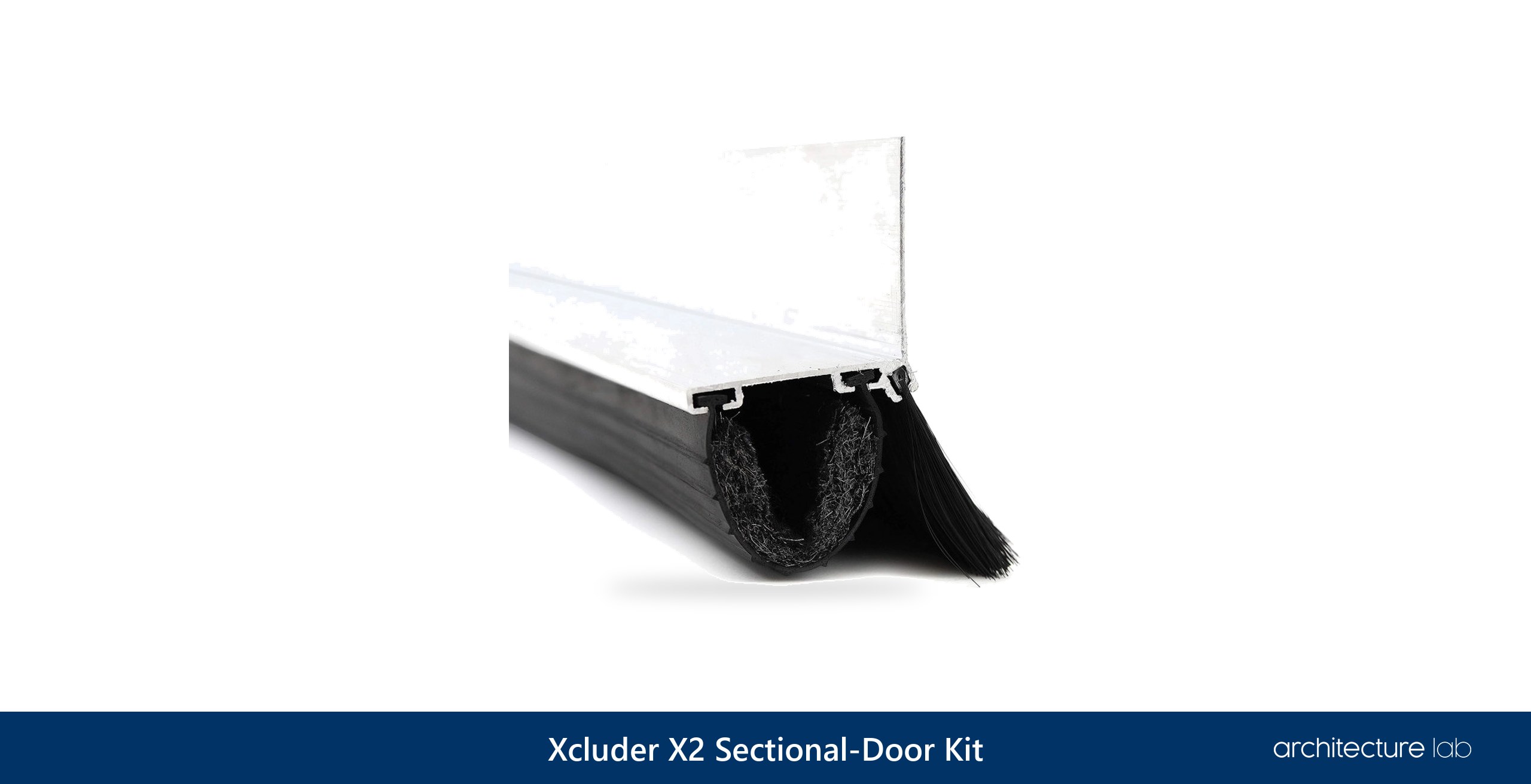
The Xcluder X2 Sectional-Door Kit is the repair for an overhead sectional door whose retainer can no longer hold a seal. A bent, corroded or incomplete retainer is replaced along with the seal, and the X2 supplies both. New aluminum retainers carry a seal of heavy-duty rubber lined with Xcluder's own fill fabric, and a brush seal on the inside face of the door conforms to uneven surfaces, closing tiny gaps and blocking light and insects.
Choosing the kit takes two measurements, the door's width and the thickness of its bottom edge. Retainers come in 1.5, 1.75 and 2 inch sizes to match that thickness, and with the 1.75- and 2-inch retainers the seal is 4 inches wide. An 8-foot kit fits doors up to 8 feet 2 inches wide, 12- and 16-foot kits cover wider doors, and a door between sizes takes the next size up. Corrugated roll-up doors take a separate T-shaped retainer kit.
Fitting the X2 is more work than sliding in an insert. The old seal comes off, the retainers screw on with the supplied mounting screws, the T-rubber and brush go in, and the last retainer is cut to length before the seals are trimmed. The job can mean drilling into the metal and cutting parts with a hacksaw, and it goes better with two people. Once fitted, Xcluder's garage seals have kept mice out.
What We Like
- Supplies new aluminum retainers
- Retainers sized to the door bottom
- Brush seal on the inside face
- Kits in 8, 12 and 16 ft widths
What We Don't Like
- Harder to fit than a slide-in insert
- Overhead sectional doors only
5. GaraDry WS013-250 – Best Floor Threshold for Garage Water Barriers
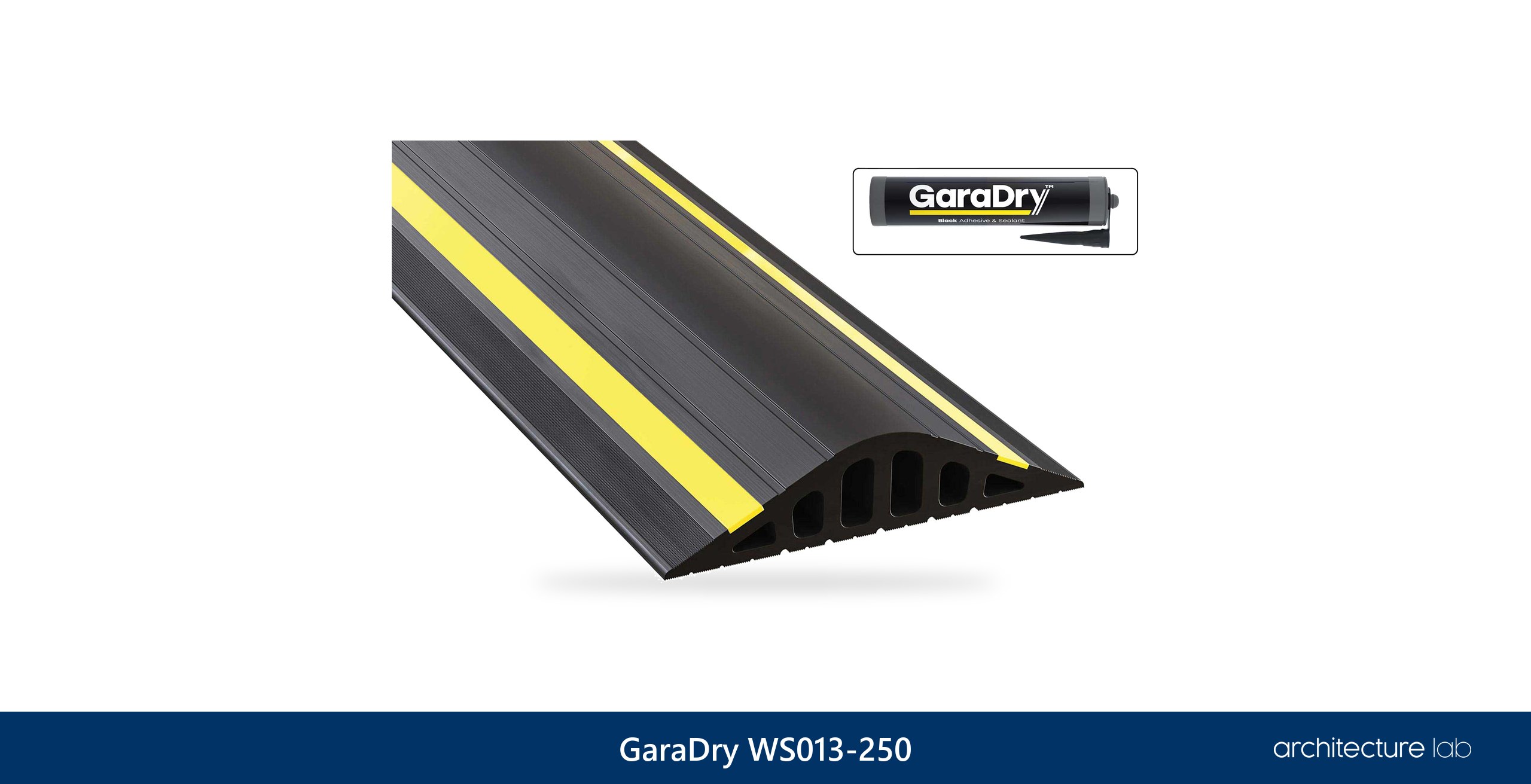
The GaraDry WS013-250 is the threshold for a garage where water stands at the door line. It is a PVC strip bonded to the floor behind the closed door, and the door shuts onto its front face. The threshold then pushes against both door and floor to make a watertight seal up to its own height, and keeps out leaves and dust as well. This one stands 1-1/2 inches tall, and the gap under the door is measured before ordering so the barrier is tall enough to fill it.
The threshold carries up to 6,000 pounds, which suits most cars and small vehicles but rules out trucks, vans and high-traffic areas such as parking garages. Loose concrete and gravel cannot take its bond. Doors with open side tracks also need the kit's foam side blocks, cut to the distance between wall and track, to stop water getting in at the sides.
The kit holds the barrier, adhesive matched to its length, two side blocks and the instructions, and the 8-foot-3-inch WS013-250 comes with two adhesives. Lengths run up to 20 feet 3 inches and cut to fit. GaraDry designs the adhesive to last at least five years, and its five-year warranty covers everything in the kit. Leaks have still meant adding more adhesive, or lifting the threshold, resealing the concrete and laying it again.
What We Like
- Watertight to its own 1-1/2 in height
- Foam side blocks for open side tracks
- Cuts to fit, 8 ft 3 in to 20 ft 3 in
- Five-year warranty on the whole kit
What We Don't Like
- 6,000 lb limit; not for trucks or vans
- Owners have had to top up the adhesive
- Not for loose concrete or gravel
Garage Door Seal Buying Guide
Garage Door Bottom Seal Types: T-Style, Bead, Bulb and J-Type
Garage door bottom seals come in a handful of types, and the end of the retainer shows which one a door takes. Two slots holding T-shaped edges mean a T-style seal, and round beads on the edges mean a bead style. A single slot with a bulb takes a bulb or P-style seal. That bulb flattens from an O shape as the door closes on it. Named for the shape it makes when the door shuts, a J-type seal suits a single-channel retainer. Wooden doors with no retainer take a nail-on seal, and doors from Clopay, Wayne Dalton, Overhead Door and Hormann take the matching brand seal.
Garage Door Seal Sizes: Measuring the T, the Width and the Length
T sizes do not cross over. A 5/16-inch seal will not slide into a 1/4-inch retainer, and a 1/4-inch seal drops out of a 5/16-inch one. Standard residential retainers take 1/4-inch T ends, and mini-warehouse doors from Janus and Amarr use 3/16 inch. Measured across the top of the T, small profiles read more accurately with a caliper than with a tape measure.
Width follows the floor and the door. Most bottom seals are 3 to 4 inches wide, the size for a floor that meets the door evenly, and door thickness sets the insert too, with a 4-inch insert for a 2-inch-thick door and a 3-inch one for a 1-3/8-inch door. Length comes from the door itself, measured across the bottom where the seal will sit, and the seal is bought a few inches longer than the door is wide.
Garage Door Bottom Seal for Uneven Floors
Uneven concrete leaves gaps where the seal no longer touches the floor, and Genie warns that uneven floors may not seal properly. Sizing guides call for a seal 6 inches wide where the floor is uneven or the gap is large. A T-type seal suits an uneven floor that needs protection on both sides of the closed door. On a wooden door, the channel shape of the Frost King G16H is made to take up an uneven floor. On a sectional door, the inside brush of the Xcluder X2 conforms to uneven surfaces.
Garage Door Side and Top Seals
Side seals stop wind-driven rain arriving at an angle and the drafts that enter at the jambs. Above them, top seals stop water running down the face of the garage. That protection counts most on a garage with little roof overhang. Wind also pushes a closed door back and opens a draft at the sides. For that reason the side gap is measured with the door pushed inward. That measurement is taken between door and frame at the top, the bottom and each section joint. Fitted as perimeter stop molding, the top seal goes on first and the side seals meet it. The top flap then sits behind the side flaps.
How a Garage Door Seal Works
Weatherstripping of any material works by plugging and sealing a gap between moving surfaces. On a garage door, the closed door presses against a bulb, a loop or a lip, and the squeezed strip fills the gap. The strip has to be thick enough to compress when the door shuts, yet thin enough that the door stays easy to close. At the bottom, Genie has the door rest on the floor until the strip is compressed along the door's full width.
Compression Seal or Brush Seal
A brush seal fills a gap differently. Its bristles move independently and flex around irregularities that a solid strip has to deform to fill, which makes brushes common on older doors and on frames that have shifted out of true. At the floor line a brush stops wind and debris well but holds back standing water less well than a solid PVC or rubber threshold, so brush seals suit the sides and top of a garage door, and doors that bend and flex.
Vinyl or Rubber Garage Door Seal: Which Is Better?
Synthetic rubber is generally the better garage door seal for sealing and durability, and vinyl is the cheaper one that works in most climates. Both slide into the same 1/4-inch T-style retainer. EPDM rubber stays flexible in hard cold and heat, and very cold, coastal and storm-prone regions call for a high-durability product. As base materials, EPDM carries a service range of -60 to 350°F and PVC a best range of -40 to 140°F.
Garage Door Threshold Seal or Bottom Seal
A bottom seal travels with the door, slid into its retainer or nailed to its edge. A garage door threshold seal stays on the floor, bonded behind the closed door, and pushes against the door's back face. Thresholds handle standing water and wind-driven rain, which pool at the lowest point of most driveways. A threshold needs a floor that will hold its bond. Loose concrete and gravel cannot, dusty or powdery concrete has to be sealed first, and shiny epoxy or very smooth tile is dulled with low-grit sandpaper before the adhesive goes on.
Longevity of Garage Door Seals
A garage door seal typically lasts around two years or more, by the estimate of the door maker Amarr. Rubber and TPE seals stay flexible longer than vinyl. Sun shortens that life, and a south- or west-facing door that bakes all afternoon wears its seal faster.
Garage Seal Soundproofing
Sealing the gaps is part of soundproofing a garage door, because sound travels through any opening with very little loss. National Research Council Canada notes that sound passing through cracks can drastically reduce an assembly's noise reduction. Its figure for an openable window with good weatherstripping is usually 3 to 5 STC points below an equivalent window sealed shut. Those gaps also reappear as buildings settle and doors cycle through temperature and humidity.
How to Find the Gap
Close the door on a bright day and look for daylight along all four edges from inside. Light at the bottom confirms a bottom or threshold gap, and damp patches on the side walls near the frame point to a side seal. A noticeable draft at any edge marks a gap even where no daylight shows.
For gaps too small to see, a lit incense stick passed along the edges shows a leak wherever its smoke is drawn in or out. A flashlight shone over the gaps at night, with a partner watching from the other side, works too, though it can miss small gaps. Paper shut in the door that slides out untorn also marks a gap.
When You Do Not Need a New Seal
A down limit set short on the opener leaves daylight under a closed door while the seal is still sound. The fix is more down travel, added a quarter turn at a time until the seal compresses lightly. Going too far makes the door close and then reverse as it meets the slab. In that case the down travel comes back slightly. In LiftMaster's manual, one turn of the limit screw equals 2 inches of travel, and a door that still will not close completely has its header bracket set too high.
Installation of a Garage Door Seal
A slide-in insert goes in with the door open, once the old insert is pulled out from one end and the channel cleared. Because vinyl and rubber slide harder and relax less in the cold, the seal is stored warm before fitting where practical. Soapy water or silicone sprayed on the channel and the seal's edges eases the feed, and a helper pulling gently at the far end keeps it moving. The seal must never be stretched, and long seals are trimmed only once they are seated. Spare length is folded up at each end, or the retainer ends are crimped to stop the seal sliding out.
A GaraDry threshold needs a tape measure, a hacksaw or sharp utility knife, and a pencil or marker. The opening is measured between the frame or side tracks, with 1-1/2 inches added at each end for notching. Laid flat, the coiled threshold returns to its shape before fitting. Set against the back of the closed door, it has to let the door shut and lock, the opener run normally and no daylight show. Two unbroken parallel lines of adhesive go about 1/3 inch inside the floor marks, with a zigzag between them, at 40 to 95°F. After 24 hours with no vehicles on it, a bucket of water or a hose tests the seal.
Safety Considerations
Any change to the limits or force of the garage door opener calls for the safety reversal test. The same test is also due every month. With the door open, a 1-1/2-inch board or a 2x4 laid flat goes on the floor under it, and the door is closed. It must reverse on contact, and a door that stops on the board is not travelling far enough down. Force is never turned up to push a binding door down, because excessive force interferes with the safety reverse system.
How do I install a garage door seal?
Installing a garage door seal follows the way it fixes. A slide-in insert feeds into the door's retainer, a nail-on strip nails to the door edge or frame, and a threshold bonds to the floor with adhesive. The nail-on Frost King strips go up easily, while Xcluder's retainer kits take more work and are harder to fit than a plain insert.
Are all garage door bottom seals the same?
Garage door bottom seals are not all the same, even when they look alike. The profile has to match the retainer, whether T, bead, bulb or J. The T size has to match as well, since 1/4- and 5/16-inch seals do not cross over. Width varies too, and wider seals serve bigger gaps and uneven floors.
How do I tell which garage door seal I have?
To tell which garage door seal you have, look at the end of the retainer, and for a T-end seal measure across the top of the T. A caliper reads those small profiles more accurately than a tape measure. A short piece of the old gasket taken to a garage door company verifies the fit. Doors from Clopay, Wayne Dalton, Overhead Door and Hormann take the matching brand seal.
What type of garage door seal seals the best?
The type of garage door seal that seals best depends on the gap it has to close. At the floor, a solid threshold holds back standing water better than a brush, and GaraDry rates its threshold watertight up to its own height. Under the door itself, the Maryland Energy Administration ranks vinyl seals with several sealing edges of equal length above felt and brush seals.
What is the difference between a rubber and a foam garage door seal?
The difference between a rubber and a foam garage door seal, among these picks, lies in the part of the door each one closes. Rubber seals the door's own edge by compression, as the door presses against a flexible strip such as the EPDM Frost King G16H or the rubber of the Xcluder X2. Foam in GaraDry's kit fills the space between the wall and an open side track. There it stops water at the sides.
How often should I replace my garage door seal?
How often to replace a garage door seal depends on its condition more than the calendar. It is due once its rubber or vinyl has hardened, cracked, flattened, torn at the ends or begun to disintegrate. A short down limit on the opener leaves the same daylight under the door as a worn seal.
Can a garage door seal keep mice out?
A garage door seal can keep mice out only if it closes the gap and resists gnawing. House mice squeeze under a gap 1/4 inch tall, and light visible under a closed door means the gap admits them. Mice chew through rubber and vinyl, so UC IPM recommends metal on door edges.
Resources
- Frost King — Vinyl Garage Door Bottom Weatherseal Replacement (RV18) and Instruction Sheet; Nail-On Garage Door Bottom (G16H) Instruction Sheet; Garage Door Side and Top Weatherstrip (SG30WH) Instructions
- Xcluder — X2 Garage Door Seal Kits Info Sheet; What Size Opening Can a Mouse Fit Through?
- GaraDry — Garage Door Threshold Seal Kit Installation Instructions; Types of Garage Door Seals Explained; 1-1/2 in Water Barrier Threshold (WS013-250) Specifications
- Amarr — The Importance of Your Garage Door Seals
- Genie — How to Set the Up and Down Travel Limits; How to Test the Reverse Safety Systems
- LiftMaster — Garage Door Opener Owner's Manual (travel and force adjustment)
- Chamberlain — How to Test the Safety Reversal System
- U.S. Department of Energy — Weatherstripping; Home Energy Assessments (leak detection)
- Maryland Energy Administration — Weatherstripping
- University of California IPM — House Mouse Pest Notes
- K-State Research and Extension — Controlling House Mice (MF1123)
- National Research Council Canada — Canadian Building Digest 240, Sound Transmission Through Windows
- Zero International (Allegion) — Sound Control Seals
- Architecture Lab — How to Soundproof a Garage Door; Best Garage Door Openers
Article by Aida Vasquez for Architecture Lab · Published 23 March 2023 · Updated 31 October 2026
More Product Reviews
Topdon TC002C Review for Building Diagnostics: Specs, Field Tests, Alternatives

HIKMICRO B10S Review for Building Diagnostics: Specs, Field Tests, Alternatives

5 Best Fiber Laser Engravers and Cutters for Precision Work