home/products/3 best fire escape ladders – 2-story, 3-story & window fit
3 Best Fire Escape Ladders – 2-Story, 3-Story & Window Fit
A home fire escape ladder turns a second or third story bedroom window into the room’s alternate escape route, so the sill’s height and depth and the window’s opening decide which ladder fits. For a second-story window the Kidde KL-2S extends 13 feet and is the only two-story pick load tested to 1000 lbs. A third-story room takes its counterpart, the Kidde KL-3S, which extends 25 feet for sills no higher than 26 feet from the ground. A household rehearsing the whole descent needs the First Alert EL52-2, a 14-foot ladder that holds 375 lbs, one person at a time, and the only pick tested to a named edition, ASTM Std F2175-07(15). All three belong to the class ASTM F2175 covers, portable and permanent emergency escape ladders for residential use, though Kidde names no test standard for either model. What still divides them is whether a ladder stays sealed for one emergency or comes out for drills, and on the different bases the two makers use to state load.

Review
A home fire escape ladder turns a second or third story bedroom window into the room’s alternate escape route, so the sill’s height and depth and the window’s opening decide which ladder fits. For a second-story window the Kidde KL-2S extends 13 feet and is the only two-story pick load tested to 1000 lbs. A third-story room takes its counterpart, the Kidde KL-3S, which extends 25 feet for sills no higher than 26 feet from the ground. A household rehearsing the whole descent needs the First Alert EL52-2, a 14-foot ladder that holds 375 lbs, one person at a time, and the only pick tested to a named edition, ASTM Std F2175-07(15). All three belong to the class ASTM F2175 covers, portable and permanent emergency escape ladders for residential use, though Kidde names no test standard for either model. What still divides them is whether a ladder stays sealed for one emergency or comes out for drills, and on the different bases the two makers use to state load.
The ladders are listed from the shortest reach to the longest:
- Kidde KL-2S 2-Story Fire Escape Ladder: Kidde's 2-story ladder, approximately 13 feet, load tested to 1000 lbs and built for one-time use
- First Alert EL52-2 Two-Story Fire Escape Ladder: a 14-foot steel and nylon ladder that holds up to 375 lbs, one person at a time, tested to ASTM Std F2175-07(15)
- Kidde KL-3S 3-Story Fire Escape Ladder: Kidde's 3-story ladder, approximately 25 feet, load tested to 1000 lbs, for 5.5 to 11 inch sills
Compare the Best Home Fire Escape Ladders
| Ladder | Best For | Length | Load Rating | Test Standard | Window and Sill | Use |
|---|---|---|---|---|---|---|
| Kidde KL-2S 2-Story Fire Escape Ladder | 2-story windows | About 13 ft, 3.9 m | Load tested to 1000 lbs | None stated | At least 16 in wide, 5.5 to 11 in sills, opening up to 11 in | Single use |
| First Alert EL52-2 Two-Story Fire Escape Ladder | Practice drills, 2-story | 14 ft, 4.3 m | Holds up to 375 lbs, one person at a time | ASTM F2175-07(15) | At least 20 x 32 in, 6 to 10 in sills | Practice drills |
| Kidde KL-3S 3-Story Fire Escape Ladder | 3-story windows | About 25 ft, 7.6 m | Load tested to 1000 lbs | None stated | At least 16 in wide, 5.5 to 11 in sills | Single use |
01. Kidde KL-2S 2-Story Fire Escape Ladder - Best for 2-Story Windows

Hooked over a second-story bedroom sill, the Kidde KL-2S, sold under the name 2-Story Rope Ladder, comes fully assembled and attaches to most common windows without tools, with antislip rungs and a tangle-free, single-use design. Its 13 feet of ladder is rated for sills no higher than 14 feet from the ground, so that height is the measurement to take first. The window then has to open fully, with no grilles or bars, and be at least 16 inches wide, which rules out a barred or part-opening window before any other spec counts.
Kidde’s load figure carries a condition: 750 pounds on one rung, and 1,000 pounds only when the load is distributed over more than one rung, within a cumulative limit of 1000 pounds for the whole ladder. The ladder works once. It is designed for one-time use only and discarded afterward, because repeat use may result in injury or death, so a household rehearses with it by practicing the mount in the window without pulling the release strap, as Kidde strongly recommends, and replaces it every 15 years under a five-year limited warranty.
Children need the most rehearsal. The hooks pivot and swivel, and the feet on the rungs can catch the window frame, so teaching a young child to mount the ladder takes real practice. A deployed ladder may or may not pack back into its box, and the question is moot in any case, since Kidde treats a deployed ladder as spent and limits practice to mounting it with the release strap left closed. A household that wants full practice descents is better served by the First Alert EL52-2.
What We Like
- Load tested to 1000 lbs by Kidde
- Approximately 13 ft, 3.9 m, for 2 stories
- Fits windows at least 16 in wide
- Tangle-free design, antislip rungs
- Flame-resistant, metal rungs
- Five-year limited warranty
What We Don't Like
- Single use, discarded after use
- Practice covers mounting only
- No standard named by Kidde
02. First Alert EL52-2 Two-Story Fire Escape Ladder - Best 2-Story Ladder for Practice Drills

Made to come out for practice drills, the First Alert EL52-2, model 1047153, sold as the First Alert Two-Story Fire Escape Ladder, lets a household rehearse the descent itself, from the sill to the ground. Its 375-pound rating comes with a test to a named edition, ASTM Std F2175-07(15), and its durable steel and nylon construction comes fully assembled with slip-resistant, epoxy coated rungs, folds for storage and is ready to use in less than one minute. First Alert calls it lightweight and gives its weight as 12 pounds in one document and 12.25 lbs in another, a weight that comes into play each time it is carried to the window for a drill.
It asks more of the window than the Kidde ladders do, at least 20 inches wide and 32 inches high against Kidde’s 16 inches of width, with a sill between 6 and 10 inches deep. It is not for rooms higher than a second-floor level, for windowsills higher than 16 feet from the ground, or for a second-story window directly over first-story windows, so a bedroom window stacked over a ground-floor window falls outside its use. One person climbs it at a time, so a family drill runs in turns, and First Alert’s limited warranty runs six years.
In use it does what the design promises. Because it is not a one-use ladder, it can be deployed for family drills, repacked and checked thoroughly after each one, and its window hooks are wide enough for the sills of a house built in the 1930s. The descent is the hard part, since climbing out of a window and down the side of a house is not easy even with practice, and a child of 11 can tangle the rungs and straps on a first attempt, which makes repeated drills worth the time. For a narrower window or a third story, the Kidde ladders need only 16 inches of window width and the KL-3S runs to 25 feet.
What We Like
- Tested to ASTM Std F2175-07(15)
- 14 ft, 4.3 m, 12 rungs
- Made for practice drills
- Fully assembled, folds for storage
- Six-year limited warranty
What We Don't Like
- Holds up to 375 lbs, one person at a time
- Sills between 6 and 10 in only
- Not for a window over first-story windows
03. Kidde KL-3S 3-Story Fire Escape Ladder - Best for 3-Story Windows
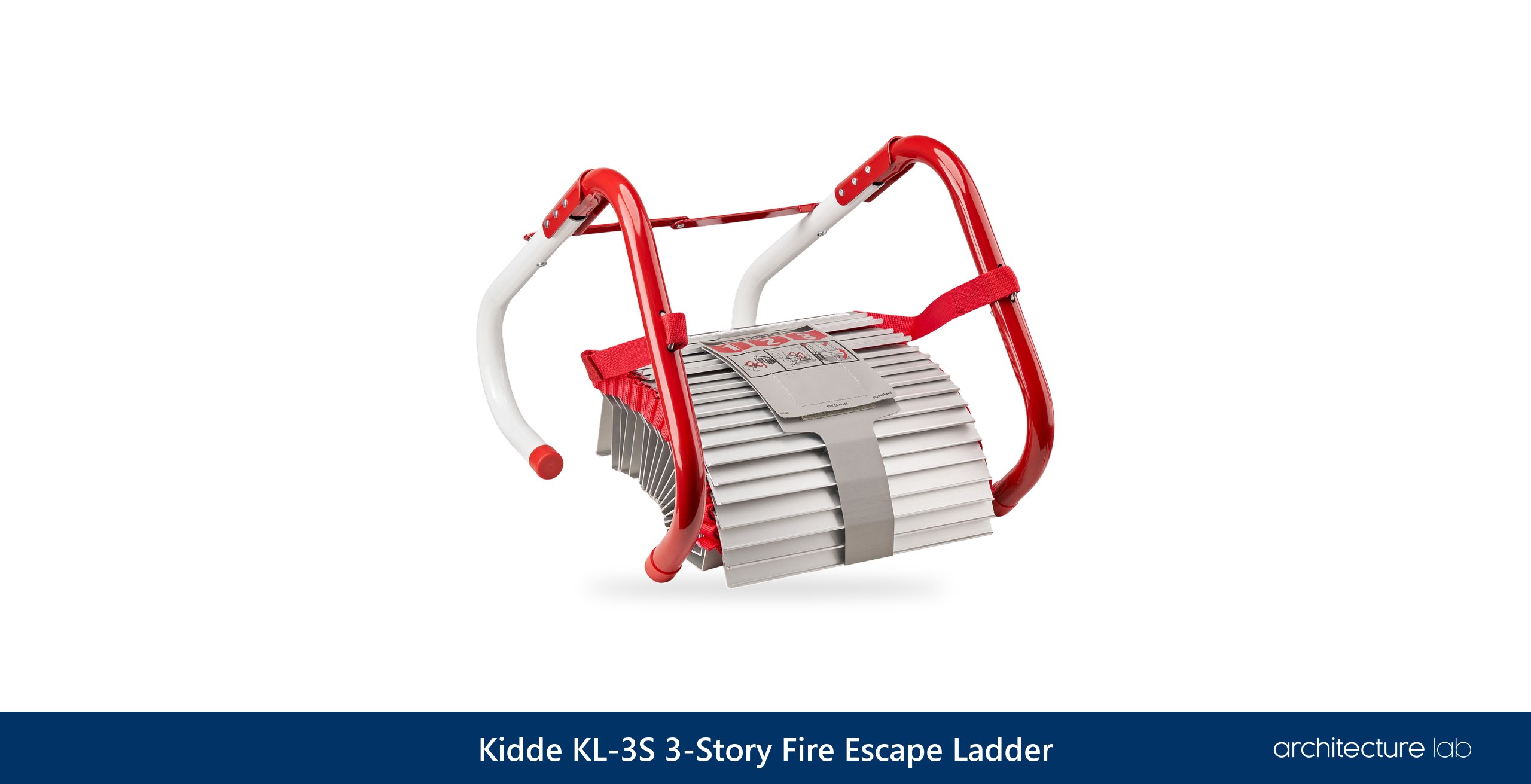
A third-story window needs the Kidde KL-3S, Kidde’s 3-Story Fire Escape Ladder, which retailers also list as a 3-Story Rope Ladder. Its 25 feet of ladder is rated for sills no higher than 26 feet from the ground, so a third-story room’s sill height is the number to check against it. Otherwise it is built like the 2-story model, with the same load test, antislip rungs, tangle-free, single-use design and sill range.
Every KL-2S rule carries over, the 1000-pound cumulative limit, a fully opening escape window at least 16 inches wide, practice mounts with the release strap left closed and replacement every 15 years under the same five-year limited warranty, so a household with both models keeps one set of rules. The house may carry marks afterward, since in normal use the ladder may scratch, dent or blemish the exterior, and Kidde does not recommend it for storm windows or windows that do not open fully.
A test mount in a window or two, with the ladder left undeployed as Kidde asks, is how to check the fit, and the manufacturing month and year are stamped into the bottom of the lowest rung. Even at three-story length it packs small enough for a closet or the space under a bed in an upstairs condo. Its weight draws a mild complaint, heavy but not unacceptably so. For a second-story window the shorter Kidde KL-2S does the same job.
What We Like
- Approximately 25 ft, 7.6 m, for 3 stories
- Load tested to 1000 lbs by Kidde
- Fits 5.5 to 11 in sills
- Flame-resistant, metal rungs
- 15-year replacement interval
- Five-year limited warranty
What We Don't Like
- Single use, practice covers mounting only
- Not for heights over 26 ft
- No standard named by Kidde
Buying Guide for the Best Home Fire Escape Ladders
Height
Height comes before everything else, because each maker caps it. The Kidde KL-2S is approximately 13 feet, 3.9m, long and is not for heights greater than 14 feet, 4.2m, and the KL-3S is approximately 25 feet, 7.6m, and is not for heights greater than 26 feet, 7.9m. First Alert’s two-story ladder is 14 feet, 4.3m, long and is not intended for rooms higher than a second-floor level or for windowsills higher than 16 feet, 4.9 meters, from the ground, while its three-story EL53W-2 runs 24 feet, 7.3m. So the measurement to take before buying is the distance from the escape window’s sill to the ground, held against the ceiling of the ladder under consideration.
Durability
Kidde builds the KL-2S and KL-3S flame-resistant, with metal rungs and heavy duty straps, warns against storing them in direct sunlight or near high temperatures, and recommends replacement every 15 years under a five-year limited warranty. First Alert’s two-story ladder is steel and nylon, with steel anti-slip rungs and strong nylon strapping for strength and stability, a six-year limited warranty and an instruction to inspect it periodically for damage, loosening of any items or significant deterioration of its materials. Weight cannot be compared across the two makers, since Kidde gives none for the KL-2S or KL-3S.
Are Fire Escape Ladders Reusable?
It depends on the maker. Kidde’s KL-2S and KL-3S are designed for one-time use and discarded after a single use, so practice with them stops at mounting the ladder in the window, with the release strap that deploys it left closed.
First Alert takes the opposite approach, telling owners of the EL52-2 to plan and practice drills and to inspect the ladder periodically, and describing both of its ladders as easy to store after practice. Its three-story model is the EL53W-2, a 24-foot ladder, 7.3m, tested to ASTM Std F2175-07(15), for sills between 6 and 13 inches. The choice follows from how a household means to prepare, because a Kidde ladder is rehearsed in the window and kept for the one emergency, while First Alert’s two-story ladder is meant to come out for drills.
Single use is not peculiar to Kidde. The Hausse Retractable 25-foot ladder is also for one-time use only, its seller warns that test fitting will most likely mark siding, windows or walls, and it is to be replaced every 3 years even without use.
How Much Weight Does a Fire Escape Ladder Hold?
Kidde’s answer is 1000 lbs. Both the KL-2S and the KL-3S are load tested to that figure, with a cumulative limit of 1000 pounds, 454 kg, and a rating of up to 750 pounds on one rung or 1,000 pounds when the load is spread over more than one rung.
First Alert’s is 375 lbs, 170kg, for its two-story ladder, and its three-story ladder can safely hold up to 375 pounds at a time. The EL52-2 is designed for one person at a time. A second figure circulates for it, too, since retail descriptions of the EL52-2 cite a test figure of 1,125 pounds for its steel construction, equated with holding up to 375 pounds at a time, while the specification gives only the 375 lbs. Those are different measures, a tested and cumulative load across the whole ladder against a capacity for one climber at a time, so the larger Kidde number is no evidence that its ladder is the stronger one.
What Is the ASTM Standard for Escape Ladders?
ASTM F2175 sets performance requirements for portable and permanent emergency escape ladders for residential use, and it replaced the provisional standard PS 117. The active edition is F2175-23, last updated December 19, 2023, after F2175-07R15, F2175-07 and F2175-02. Its tests cover rated load, the rung release mechanism, heat deflection temperature, standoff, designed length and rung spacing, and F2175-23 also requires a ladder to meet the requirements specified for vertical static load, horizontal static load, deployment weight, deployment time, hook or attachment stability, stress relief and heat aging.
First Alert tests its ladders to ASTM Std F2175-07(15), and the EL52-2 complies with ASTM Standard F2175-07(15), the edition before the active F2175-23, although shorter product descriptions say only that the ladders are tested to ASTM standards. Kidde names no standard at all for the KL-2S or KL-3S.
Which escape ladder is safest cannot be settled from what these makers publish. The comparison the evidence allows is narrower, whether a maker names a standard and its edition at all, and what load it states on its own basis.
Ease of Use
Both makers promise speed. Kidde’s ladders come fully assembled and attach quickly to most common windows without the use of tools, and First Alert’s two-story ladder comes fully assembled and is ready to use in less than one minute. Speed in an emergency comes from rehearsal, though, which is why Kidde strongly recommends practicing the mounting steps without deploying the ladder. Each ladder has its learning curve. A Kidde ladder’s hooks pivot and swivel and its rung feet can catch the window frame, a child’s first try on the First Alert can end with the rungs and straps tangled, and climbing out of a window and down a ladder against the side of a house is hard work for an adult too.
Both makers want an adult in charge when children use the ladder. In a family escape, Kidde advises, the parent exits first to stabilize the ladder during the descent of children or elderly adults, children are carried on the ladder only when absolutely necessary, and pets or other objects stay off it. First Alert strongly recommends that children and elderly adults be assisted by an adult if at all possible, says no pets or other objects should be carried, and asks that children be taught the ladder is for an emergency or an adult supervised exit drill only.
Storage
Storage is about reach. Both makers advise keeping the ladder near the window it will be used from, in a closet or under the bed, and Kidde adds a warning against direct sunlight and high temperatures. First Alert’s two-story ladder folds for storage.
On how many to buy, fire-safety guidance credited to the National Fire Protection Association recommends one ladder in every occupied room on the floors over the main level. Both makers’ ladders allow that, since the First Alert is compact enough to buy one for each room, and even the 25-foot Kidde KL-3S stores under a bed or in a closet.
Attachment Style
Both makers’ ladders hang from hooks over the sill, and the differences lie in what those hooks will take. First Alert’s two-story ladder has large hooks that secure easily to windowsills and steel stabilizers on all rungs, and the extra-wide hooks of its three-story ladder work with almost any windowsill at least 20 inches wide, 32 inches high and 6 to 13 inches deep. Kidde limits its ladders to a wall opening no thicker than 11 inches and gives the KL-2S and KL-3S 5.5 to 11 inch sills, and its hooks pivot and swivel. Balconies fall outside the instructions. Both makers’ published instructions for these ladders speak only of windows and window sills in their attachment steps, with no mention of a balcony, although the 25-foot Kidde ladder can fit well over a balcony wall.
Will a Fire Escape Ladder Fit My Window?
Whether a ladder fits is decided by the opening and the sill, and the two makers draw those limits differently. Kidde needs an escape window at least 16 inches wide that opens fully, with no grilles or bars and a wall opening no thicker than 11 inches, and gives both the KL-2S and the KL-3S 5.5 to 11 inch sills. First Alert needs a window at least 20 inches wide and 32 inches high, with sills between 6 and 10 inches for the two-story ladder and 6 to 13 inches for the three-story EL53W-2, and rules out both ladders from a second-story window directly over first-story windows.
| Ladder | Window minimum | Sill or wall opening | Other limit |
|---|---|---|---|
| Kidde KL-2S | At least 16 in wide, opens fully | 5.5 to 11 in sills, opening up to 11 in | Up to 14 ft, no grilles or bars |
| Kidde KL-3S | At least 16 in wide, opens fully | 5.5 to 11 in sills | Up to 26 ft, no grilles or bars |
| First Alert EL52-2 | At least 20 in wide, 32 in high | 6 to 10 in sills | Sill up to 16 ft, not over first-story windows |
| First Alert EL53W-2 | At least 20 in wide, 32 in high | 6 to 13 in sills | Not over first-story windows |
Window limits for each ladder. Kidde sets a sill range and a maximum wall opening thickness, while First Alert sets a sill depth range and a minimum window width and height. Kidde also needs a window that opens fully with no grilles or bars, and First Alert rules out a second-story window directly over first-story windows, so a window can pass one maker’s limits and fail the other’s.
Deep sills can rule a hook ladder out entirely. A Victorian sash window with a combined sill depth of about 15 to 16 inches is beyond all four of these ladders, whose sill ranges stop at 10, 11 and 13 inches. Storm windows are another obstacle, and Kidde does not recommend its ladders for storm windows or for windows that do not open fully to the minimum space. Sill depth and window opening decide whether a ladder can be used as surely as its length does, so they belong in the same measuring session as the height.
What Do Residential Codes Require of an Egress Window?
Section R310 of the 2020 Minnesota Residential Code requires at least one operable emergency escape and rescue opening in basements, habitable attics and every sleeping room, and an emergency egress and rescue opening in each basement sleeping room. It requires a net clear opening of not less than 5.7 square feet, a net clear height of not less than 24 inches and a net clear width of not less than 20 inches, and a window serving as the opening must have a sill height of no more than 44 inches from the floor. The 2024 IRC renumbers these provisions as Section R319, and local adoption decides which code and edition governs.
When that code speaks of an egress ladder, it means a fixed one, because a window well deeper than 44 inches has to be equipped with a permanently affixed ladder or steps usable with the window in the fully open position. A portable ladder is a different thing, and First Alert notes that its own does not meet local codes as a primary means of exit from multi-family dwellings.
Escape Plan and Practice Drills
A ladder is one part of an escape plan, and the plan comes first. The U.S. Fire Administration tells households to find 2 ways out of every room, make sure doors and windows are not blocked and choose an outside meeting place in front of the home, and it warns that residents could have less than 2 minutes to escape a home fire once the smoke alarm sounds. USFA advises practicing the home fire drill with everyone in the home and, in its escape planning for older adults, practicing twice a year, using both ways out.
Kidde advises closing the doors to the room before opening the escape window, to avoid intensifying a fire, and planning at least two means of escape from each room, a door and a window, with a meeting place outside. First Alert treats its ladder as a last resort, used only when the main exit is blocked, not accessible or unsafe, and as a supplement to fire drills, emergency evacuation plans, smoke alarms and fire extinguishers that does not replace any of them. It is not intended to replace fire escapes in multi-family residences, institutions or rental properties, and First Alert asks occupants to plan and practice drills so they are familiar with its use.
What should I look for in a home fire escape ladder?
Look for reach, load and fit, in that order. A home fire escape ladder has to reach from the escape window within its maker’s height limit, 14 feet for the Kidde KL-2S, 26 feet for the KL-3S and a sill no higher than 16 feet for First Alert’s two-story ladder. It has to hold its rated load, 1000 pounds cumulative for Kidde and 375 lbs for First Alert’s two-story ladder, and it has to fit the maker’s window and sill limits. After that the choice is between Kidde’s one-time-use design and First Alert’s two-story ladder made for practice drills, which among these picks is also the only one tested to a named edition, ASTM Std F2175-07(15).
Are home fire escape ladders easy to use?
Home fire escape ladders are easy to set up and harder to use well. Kidde describes its ladders as easy to use, with no tools needed to hook them to the window, and First Alert’s two-story ladder is ready to use in less than one minute, yet mounting one smoothly takes practice. Kidde’s hooks pivot and swivel and the rung feet can catch the window frame, and a child’s first try on the First Alert can end in tangled rungs. Kidde strongly recommends practicing the mounting steps without pulling the release strap.
Can home fire escape ladders be used on all types of buildings?
Home fire escape ladders are made for homes and are no substitute for a larger building’s fire escapes. ASTM F2175 covers escape ladders for residential use, and First Alert presents its 14-foot ladder as ideal for a two-story home or apartment while stating that it is not intended to replace fire escapes in multi-family residences, institutions or rental properties. Within a house, the window and the height set the limits. First Alert rules out a second-story window directly over first-story windows, Kidde rules out windows with grilles or bars or that do not open fully and does not recommend its ladders for storm windows, and Kidde caps the KL-2S at 14 feet and the KL-3S at 26 feet. High-rise and condominium buildings call for a different plan, and USFA tells residents there to know where all the exit stairs are, leave the apartment and close the door behind them, pull the fire alarm on the way out and use the stairs instead of the elevator unless directed by the fire department.
Has a fire escape ladder been recalled?
No recall of a First Alert or Kidde escape ladder, or of any residential fire escape ladder, appears in CPSC’s recall database as of October 2026. The practical risk with the First Alert EL52-2 is placement, because its rungs can break a window beneath the one being climbed down from, so it belongs at a second-story window without a first-story window beneath it.
Related Articles
- 9 Best Folding Ladders
- 15 of the Best Hard Hats Right Now
- 5 Best Lightweight Hard Hats Comfortable for Construction Workers
- 13 Best Safety Glasses, Reviews & Guide
- 25 Best Gifts for Construction Workers This Year
- 19 Best Torpedo Levels
- 11 Best Work Lights For Any Construction Job
- 13 Best Telescoping Ladders to Climb
Article by Aida Vasquez for Architecture Lab · Published 9 June 2021 · Updated 14 October 2026
More Product Reviews
Topdon TC002C Review for Building Diagnostics: Specs, Field Tests, Alternatives

HIKMICRO B10S Review for Building Diagnostics: Specs, Field Tests, Alternatives

5 Best Fiber Laser Engravers and Cutters for Precision Work