home/products/7 best solar atomic watches – digital, analog & titanium
7 Best Solar Atomic Watches – Digital, Analog & Titanium
A solar atomic watch charges from light and sets itself by radio from North America's WWVB or the UK's MSF, so the stations it hears, its dark run time and indoor charging settle the choice. The Casio G-Shock GW-M5610U fits most wrists in its resin case, hearing WWVB from Colorado and NPL's MSF from Cumbria, and running approximately 10 months in the dark, the longest of the three Casios. Where a compass, altimeter and barometer are wanted, the mud-resistant GW-9500 MUDMAN carries them on the same five stations. For an analog dial on a North American wrist, the Citizen JY8078 Skyhawk's U680 calibre hears WWVB but not MSF, and a UK dress wrist is better served by the Junghans Meister MEGA Solar, which hears Anthorn, Colorado, Mainflingen and Japan. Sun charges the Casio, Citizen and Seiko calibres, three of the four brands, in minutes where indoor light takes hours, and their cells need no routine replacement, though they age over years.
Review
A solar atomic watch charges from light and sets itself by radio from North America's WWVB or the UK's MSF, so the stations it hears, its dark run time and indoor charging settle the choice. The Casio G-Shock GW-M5610U fits most wrists in its resin case, hearing WWVB from Colorado and NPL's MSF from Cumbria, and running approximately 10 months in the dark, the longest of the three Casios. Where a compass, altimeter and barometer are wanted, the mud-resistant GW-9500 MUDMAN carries them on the same five stations. For an analog dial on a North American wrist, the Citizen JY8078 Skyhawk's U680 calibre hears WWVB but not MSF, and a UK dress wrist is better served by the Junghans Meister MEGA Solar, which hears Anthorn, Colorado, Mainflingen and Japan. Sun charges the Casio, Citizen and Seiko calibres, three of the four brands, in minutes where indoor light takes hours, and their cells need no routine replacement, though they age over years.
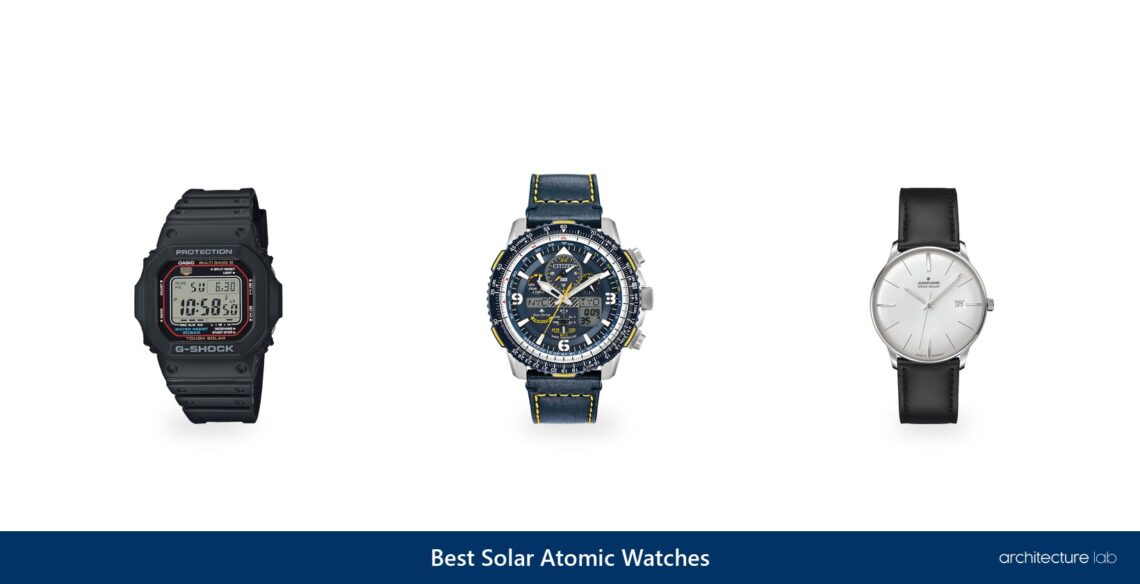
The seven watches line up like this.
- Casio G-Shock GW-M5610U-1: a square G-Shock digital whose Casio module 3495 receives JJY, WWVB, MSF, DCF77 and BPC and runs approximately 10 months from a full charge without light
- Casio G-Shock GMW-BZ5000D-1: a full-metal G-Shock 5000 with a MIP LCD that runs on solar charging alone, the same five call signs and time correction from a smartphone over Bluetooth
- Casio G-Shock GW-9500-1 MUDMAN: a MUDMAN with a digital compass, altimeter and barometer, the same five signals, 20-bar water resistance and about 6 months of running from a full charge
- Citizen Promaster Blue Angels Skyhawk A-T JY8078-01L: an ana-digi Eco-Drive pilot watch on Citizen's U680 that receives WWVB, DCF77, BPC and JJY and runs about 6 months without charging, or about 3.5 years in power saving
- Citizen Tsuki-yomi A-T BY1010-57L: a Super Titanium analog moonphase on Citizen's H874 with a radio-controlled perpetual calendar, world time in 24 time zones and about 6 months of running from a full charge
- Seiko Coutura SSG009 Radio Sync Solar: a Radio Sync Solar chronograph on calibre 8B92 that receives signals from Japan, China, the U.S.A. and Germany and runs approx. 6 months from a full charge
- Junghans Meister MEGA Solar 59/4603.02: a 38.0 mm stainless steel dress watch on the radio-controlled solar movement J101.85 with radio reception in Europe, the UK, the USA and Japan and a dark power reserve of up to 3 years
Compare the Best Solar Atomic Watches
| Watch | Best For | Display | Signals | Run Time from Full Charge | Case | Water Resistance |
|---|---|---|---|---|---|---|
| Casio G-Shock GW-M5610U-1 | Everyday digital | Digital | JJY, WWVB, MSF, DCF77, BPC | Approx. 10 months | Resin | 660 ft |
| Casio G-Shock GMW-BZ5000D-1 | Full-metal digital | Digital MIP LCD | JJY, WWVB, MSF, DCF77, BPC | Approx. 6 months | Full metal, stainless steel | Not specified |
| Casio G-Shock GW-9500-1 MUDMAN | Hiking and field work | Duplex LC digital | JJY, WWVB, MSF, DCF77, BPC | About 6 months | Not specified | 20 bar |
| Citizen Promaster Blue Angels Skyhawk A-T JY8078-01L | Analog-digital pilot | Ana-digi | WWVB, DCF77, BPC, JJY | About 6 months | Two-tone stainless steel | WR200/20Bar/666ft |
| Citizen Tsuki-yomi A-T BY1010-57L | Titanium analog | Analog, moonphase | Japan, USA, Germany, China | About 6 months | Super Titanium | WR100/10Bar/333ft |
| Seiko Coutura SSG009 Radio Sync Solar | Dress chronograph, North America | Analog chronograph | Japan, China, U.S.A., Germany | Approx. 6 months | Stainless steel | 10 bar |
| Junghans Meister MEGA Solar 59/4603.02 | UK and US signals in one dress watch | Analog | Europe, UK, USA, Japan | Up to 3 years dark power reserve | Stainless steel | Up to 5 bar |
01. Casio G-Shock GW-M5610U-1 - Best Everyday Digital, 10 Months in the Dark
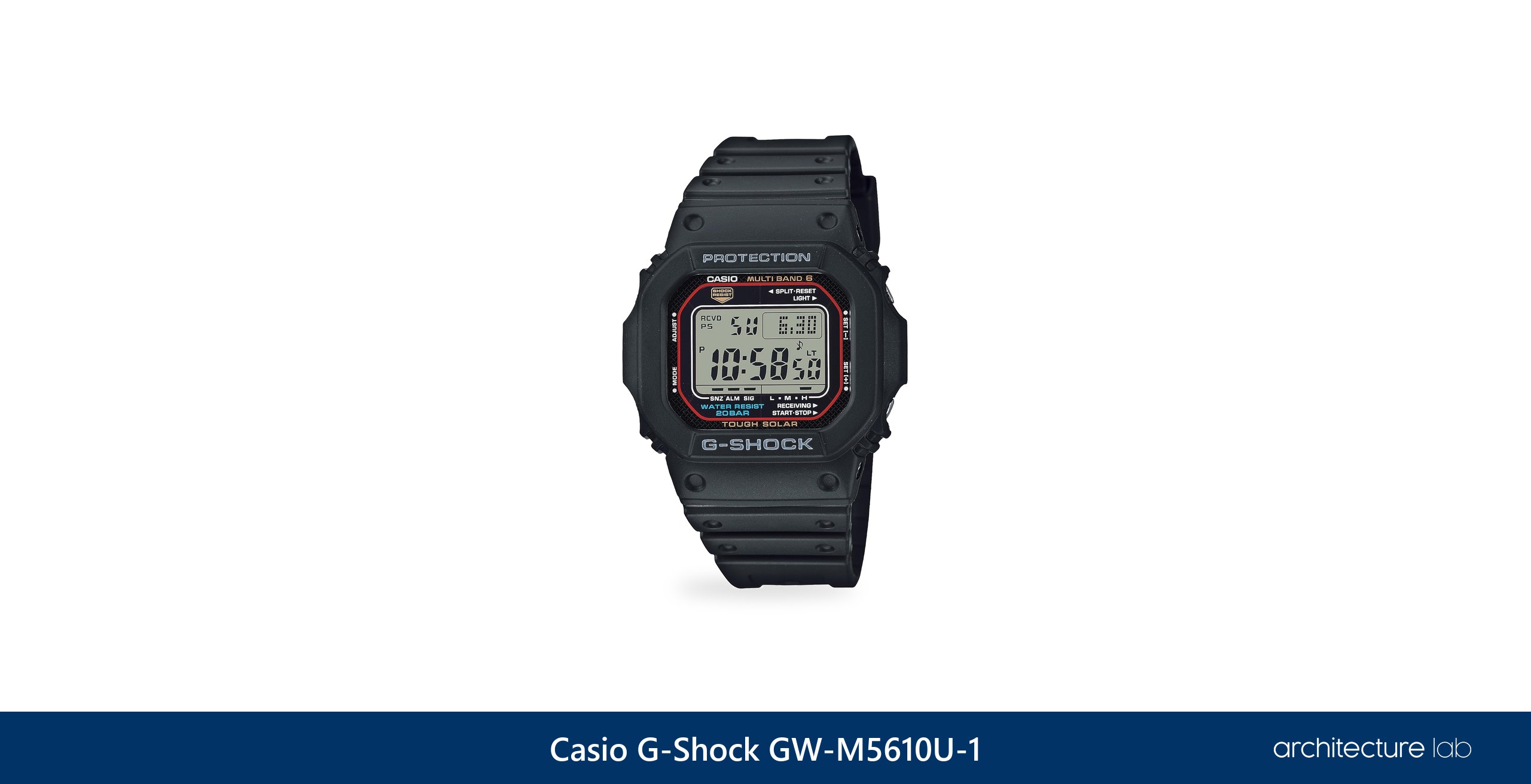
The Casio G-Shock GW-M5610U-1, sold as the Men's Solar Black Resin Sport Watch, receives both stations that matter in North America and the UK, WWVB and MSF, each on 60 kHz, through its module 3495, so it is the safest default of the seven. It also takes Japan's JJY, Germany's DCF77 and China's BPC, so the same watch goes on setting itself within range of those stations. A full charge carries it approximately 10 months without light under daily use that includes one alarm and one signal reception a day, and on nights when no signal gets through it holds within ±15 seconds per month on average, so a missed night costs seconds, not minutes. Casio reported in May 2026 that the GW-M5610U was among the entry-line staples leading its plastic G-SHOCK sales.
Kept indoors, the GW-M5610U charges slowly, because module 3495 banks a day of running in about 8 minutes at 50,000 lux but needs 8 hours at 500 lux, and once the battery runs flat it takes 206 hours under 500 lux indoor fluorescent lighting just to reach a medium charge, against 3 hours outdoors on a sunny day, so a flat watch belongs in the sun. Around the timekeeping sit a full auto LED light, charge level indication, 5 alarms with one snooze alarm, an hourly time signal, a stopwatch in 1/100 seconds for the first hour with split times, a 24-hour countdown timer, world time in 48 cities across 31 time zones plus UTC and switching between 12-hour and 24-hour timekeeping. In daily wear the radio sync simply happens, night after night, and a new watch can arrive at a medium charge and take about two days to reach high, depending on the light it gets. For a metal case in place of resin, the GMW-BZ5000D-1 is the step up.
What We Like
- MSF and WWVB both on its station list
- Approximately 10 months from a full charge without light
- A day of running from minutes of bright light
- Reliable nightly sync
- Among Casio's plastic G-SHOCK sales leaders
- Full auto LED light and 5 alarms
What We Don't Like
- Resin case and band
- Slow to charge under indoor light
02. Casio G-Shock GMW-BZ5000D-1 - Best Full-Metal Digital with Phone Sync
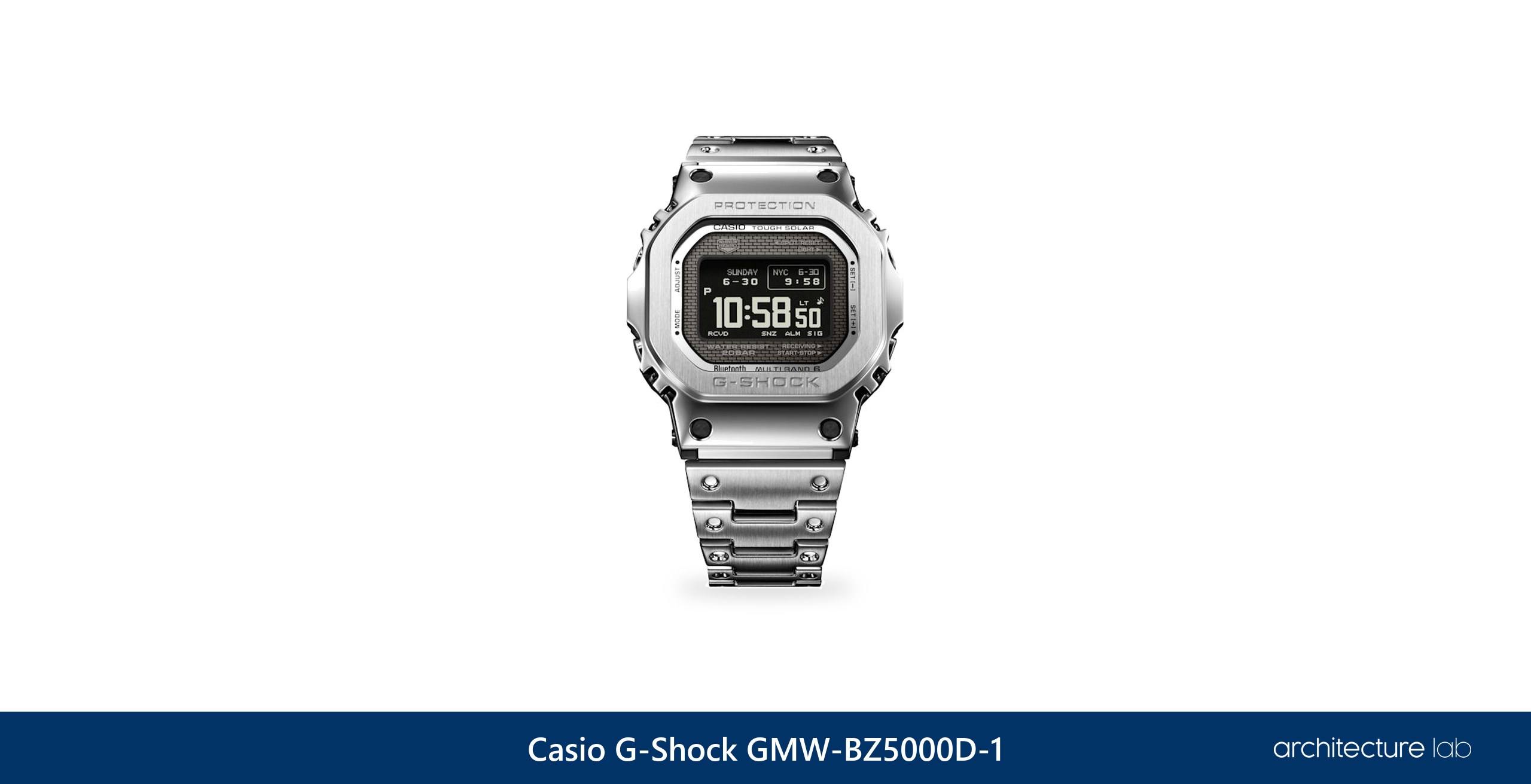
Where the GW-M5610U is resin, the Casio G-Shock GMW-BZ5000D-1, the full-metal 5000 model, puts the same G-Shock radio timekeeping in stainless steel. Casio announced it in Japan on November 4, 2025, and it was offered in the US from December 3, 2025 as the Full Metal 5000 Series Digital Stainless Steel Watch 49.3mm. Its newly developed MIP LCD runs on solar charging alone, and a Bluetooth link to a smartphone gives it a second source of correct time alongside the radio signal.
Inside, module 3575 receives the same five call signs as the resin watch, so it covers North America and the UK equally, and it stores its charge in one rechargeable CTL1616 battery behind the solar panel. That battery gives approximately 6 months with smartphone time correction 4 times a day, against approximately 10 months for the resin GW-M5610U, so the metal watch runs for less time between charges. When neither a signal nor the phone can correct it, it holds ±15 seconds per month, and Casio reported steady 5000-series sales in Japan in May 2026, the GMW-BZ5000D among them.
What We Like
- Full-metal case
- MIP LCD on solar charging alone
- Five call signs plus phone time correction
- Approximately 6 months from a full charge
What We Don't Like
- Shorter operating time than the resin GW-M5610U
- Phone correction needs a paired smartphone
03. Casio G-Shock GW-9500-1 MUDMAN - Best Triple-Sensor Watch for the Outdoors
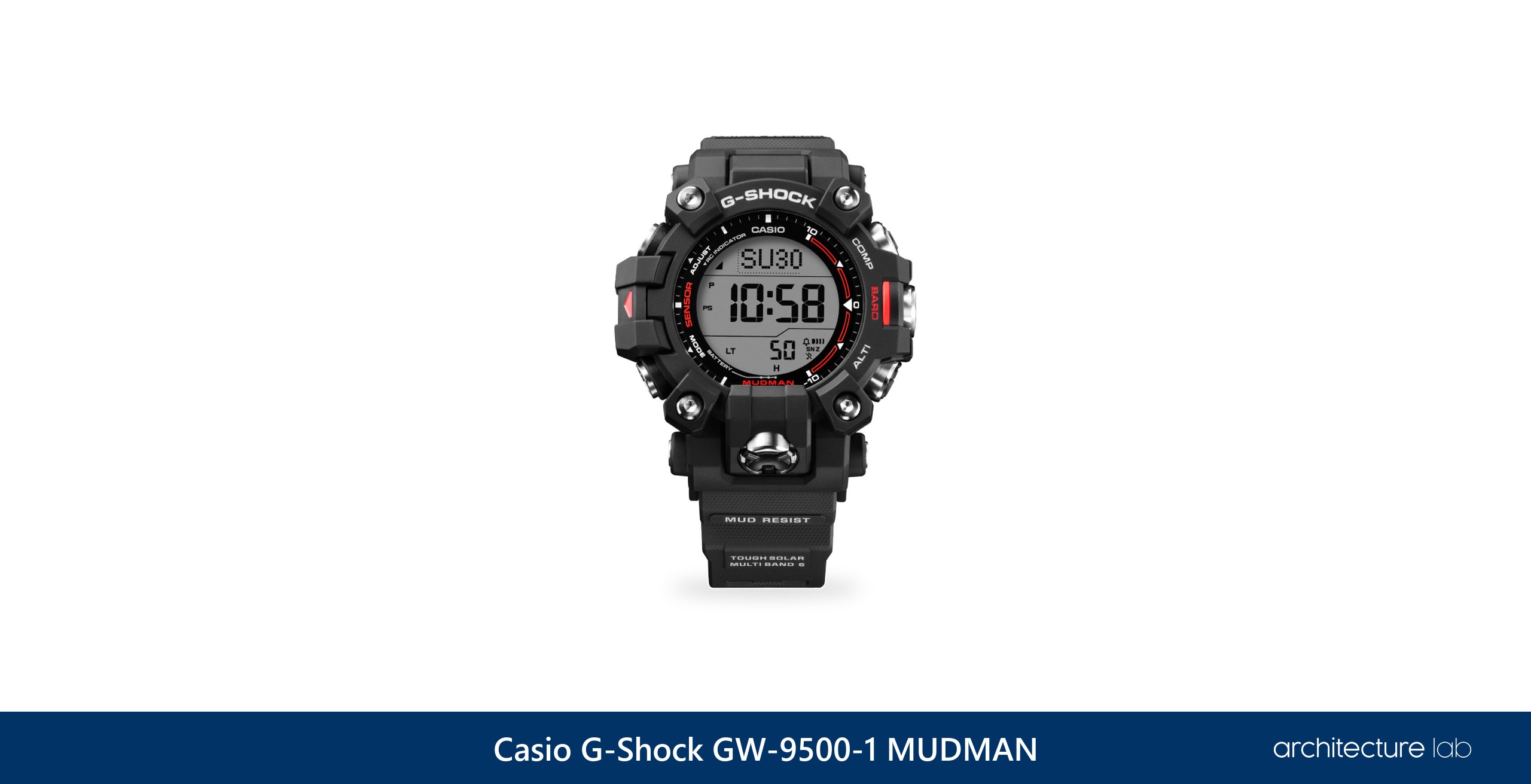
Casio announced the G-Shock GW-9500-1 MUDMAN in Japan on June 29, 2023, as its first new MUDMAN in 12 years, after the GW-9300 of 2011, in a line that began in 1995, and it is built for mud and dust. Shock-resistant, dust- and mud-resistant construction goes with a Duplex LC display, and the watch tries for a signal automatically up to 6 times a day, so one blocked reception is followed by more chances the same day. A full charge lasts about 6 months without solar generation, or about 26 months in the power-saving state.
A triple sensor adds a digital compass, barometric pressure readings and an altimeter with a measuring range of -700 to 10,000 m, and module 3553 needs about 5 minutes at 50,000 lux or 8 hours at 500 lux for one day of running.
Contrast on the positive display could be stronger, and the negative display turns hard to read at a dark work site, a weakness the case does not share, since it wears well and can still look new after nearly two years of use. In the US it arrives as the GW-9500-1JF, a Japan import with no English instructions in the box, so the operation guide for module 3553, which Casio publishes online, is the manual. Without a need for the sensors, the GW-M5610U gives the same five signals in a smaller resin case, 0.5 x 1.7 x 1.84 inches, with approximately 10 months of running from a full charge.
What We Like
- Compass, altimeter and barometer
- 20-bar water resistance
- MSF and WWVB both received
- Dust- and mud-resistant construction
- About 26 months in power saving
What We Don't Like
- Display contrast on the low side
- Japan-import units ship without English instructions
04. Citizen Promaster Blue Angels Skyhawk A-T JY8078-01L - Best Analog-Digital Pilot Watch for North America
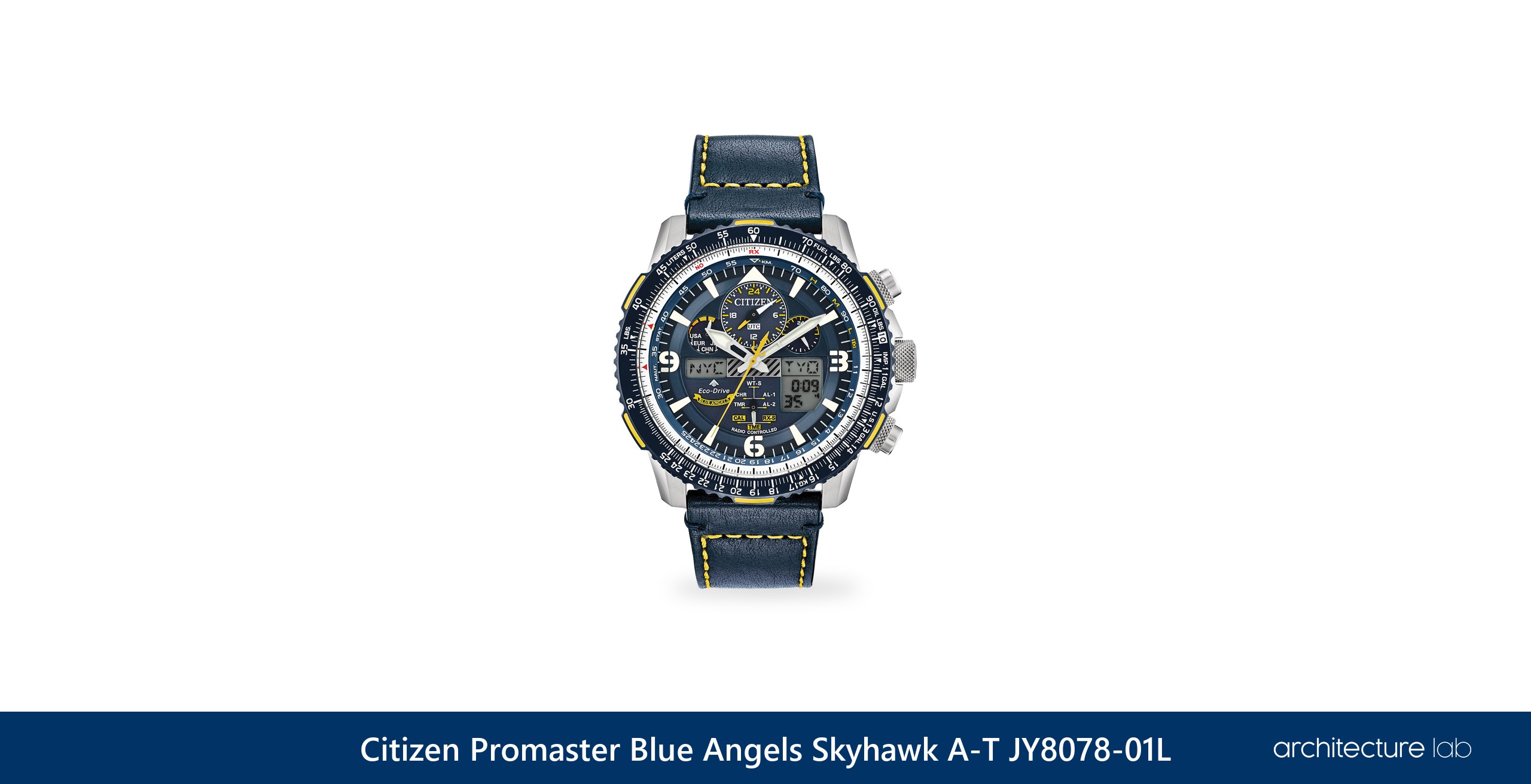
North America is home ground for the Citizen Promaster Blue Angels Skyhawk A-T JY8078-01L, whose U680 Eco-Drive movement receives WWVB from Fort Collins within a radius of approximately 3,000 km and runs about 6 months without charging, or about 3.5 years in the power saving mode. Citizen sells the two-tone ana-digi pilot's watch on its US store alongside the bracelet version JY8078-52L, with atomic timekeeping in 43 world cities.
MSF is missing from the U680's stations, so in Europe it relies on DCF77 from Mainflingen, within a radius of approximately 1,500 km, and a UK owner should look to the Junghans or one of the Casios, which both list MSF. A day of running takes 4 minutes outdoors in sun at 100,000 lx but 4 hours under 500 lx interior lighting, and a full charge from an empty cell takes 30 hours in sun. A manual sync with the Colorado signal is easy to start and keeps the watch right afterwards, though the 4 o'clock button does nothing more than check radio reception.
What We Like
- Receives WWVB, DCF77, BPC and JJY
- About 3.5 years in power saving
- WR200/20Bar/666ft
- Anti-reflective sapphire crystal
- Sold by Citizen in the US
What We Don't Like
- MSF not among its stations
- Indoor light needs 4 hours for one day of running
05. Citizen Tsuki-yomi A-T BY1010-57L - Best Titanium Analog with Moonphase
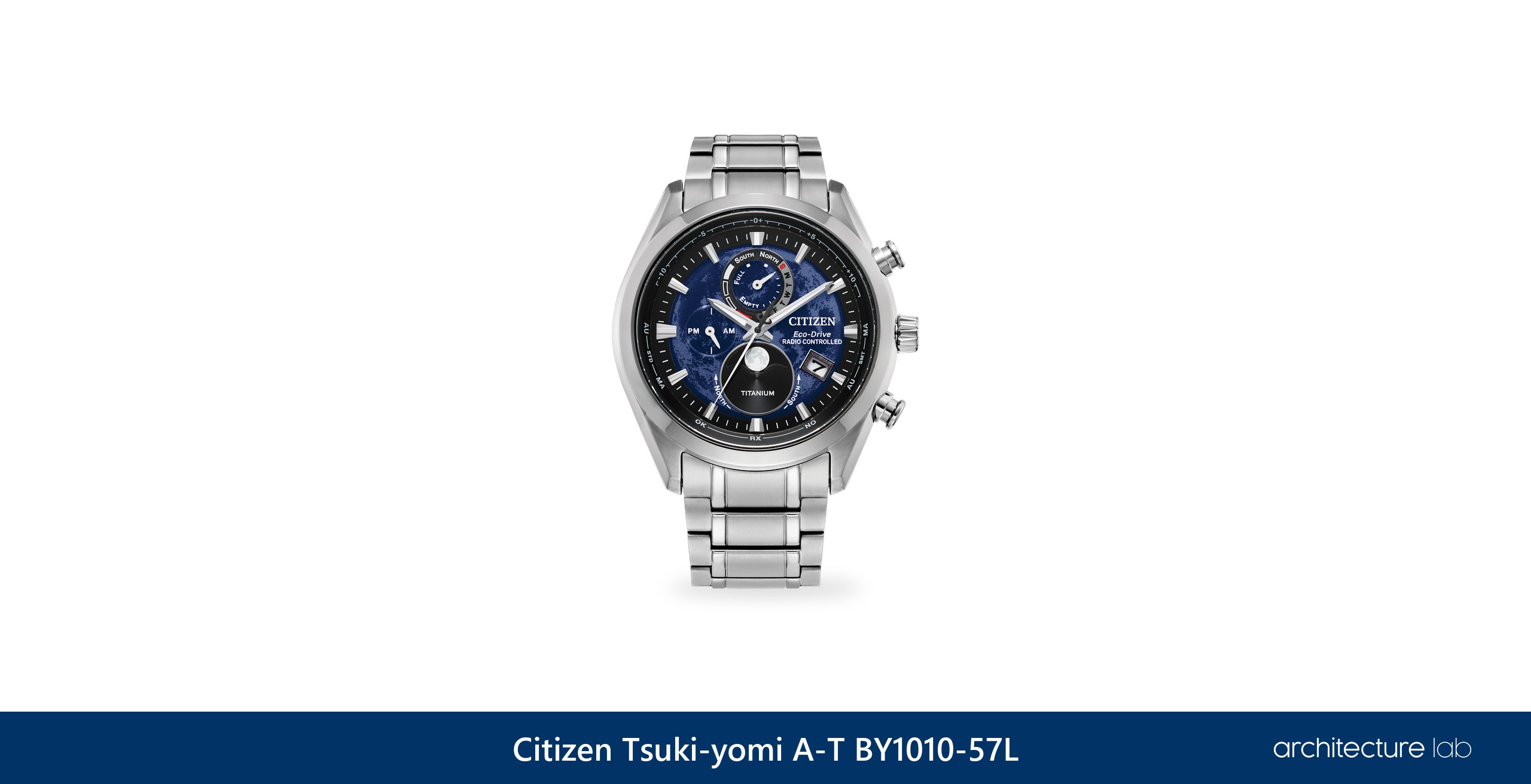
Titanium and a moonphase are the reasons to choose the Citizen Tsuki-yomi A-T BY1010-57L, which pairs a 43mm silver-tone Super Titanium case with a Super Titanium bracelet under sapphire crystal, and Citizen sells it on its US store. Its H874 Eco-Drive movement adds world time in 24 time zones and a radio-controlled perpetual calendar, runs about 6 months after a full charge and receives stations in Japan East and West, the USA, Germany and China.
In sun it needs only 2 minutes at 100,000 lx for a day of running and 40 hours for a full charge from empty, and even on a cloudy day at 10,000 lx a day takes 11 minutes, against 4.0 hours under 500 lx interior lighting, and Citizen publishes no full-charge time for interior light. At WR100/10Bar/333ft its rating trails the JY8078's WR200/20Bar/666ft, so for water the JY8078 is the stronger Citizen, and since MSF is absent from its stations, UK owners get that signal only from the Junghans and the Casio picks.
What We Like
- Super Titanium case and bracelet
- Moonphase
- Radio-controlled perpetual calendar
- World time in 24 time zones
- Sold by Citizen in the US
What We Don't Like
- MSF not among its stations
- Water resistance WR100/10Bar/333ft, lower than the JY8078's WR200
06. Seiko Coutura SSG009 Radio Sync Solar - Best Dress Chronograph for North America

Of the seven, only the Seiko Coutura SSG009 is a dress chronograph, a Radio Sync Solar watch on calibre 8B92 with a stainless steel case and sapphire crystal, and its approximately 6 months on a full charge stretches to approximately 2 years in power save, so it can sit in a drawer for months between wears and still run. It receives official standard radio signals from Japan, China, the U.S.A. and Germany, with no UK station among them, so it serves North America and Germany's signal area but not the UK. In the US it belongs to the Coutura range and is sold through Seiko's retailers, from a company that traces itself to the watch and clock retail and repair store Kintaro Hattori opened in 1881.
Under 700 lux office fluorescent light the 8B92 takes 240 minutes to bank one day of power, against 3 minutes in fair-weather sunlight at 100,000 lux, and it receives WWVB within approximately 3,000 km of Fort Collins. The time zone matters twice over, because the world time function, which shows local time in a selected zone with 25 regions to choose from, also selects the transmitting station.
Its radio sync takes patience, since an afternoon attempt can fail where an overnight one between 2 and 4 am, with the watch laid in a window, succeeds, and in the Saguenay region north-east of Québec City it can miss the signal altogether, leaving the phone app to set the time. The lume is on the weak side, and because the second hand doubles as the charge indicator, running seconds sit in a very small sub-dial.
What We Like
- Approx. 6 months of power reserve, 2 years in power save
- Sapphire crystal
- 10 bar water resistance
- Part of Seiko's US Coutura range
What We Don't Like
- No UK station among its signals
- Weak lume
- Radio sync can take patience
07. Junghans Meister MEGA Solar 59/4603.02 - Best Dress Watch for UK and US Signals
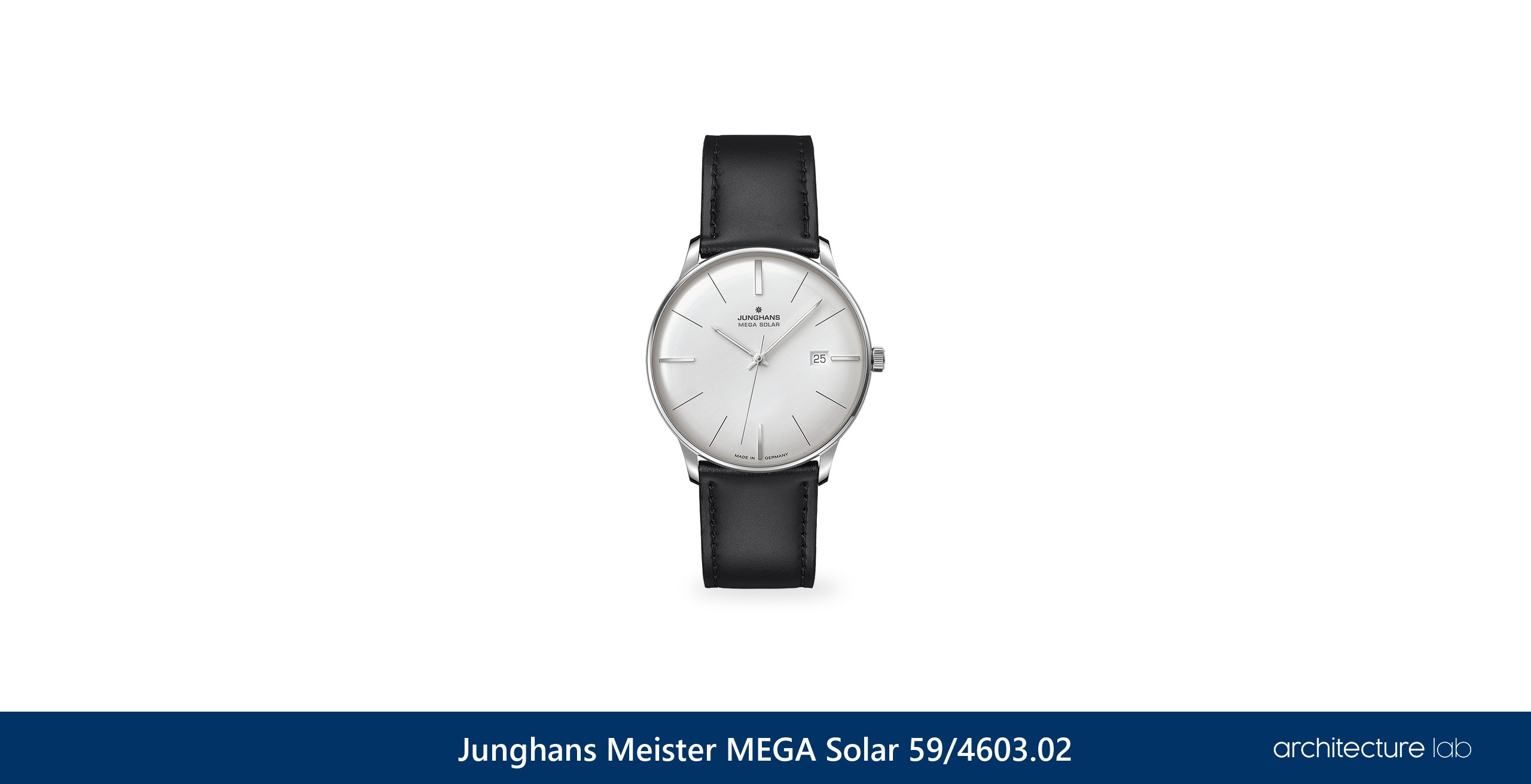
The Junghans Meister MEGA Solar, item 59/4603.02, takes its radio time from Colorado for North America, Mainflingen for Europe, Anthorn in Cumbria for the UK and Mount Ohtakadoya and Mount Hagane for Japan, receiving at 2 or 3 am, so on either side of the Atlantic it is the dress watch to choose. Its connected radio-controlled solar movement J101.85 adds a perpetual calendar, the Junghans app and a dark power reserve of up to 3 years, in a stainless steel case of 38.0 mm only 9.0 mm high under anti-reflective sapphire crystal, slim enough to slide under a shirt cuff.
At up to 5 bar, its water resistance is half the Seiko SSG009's 10 bar, and outside Germany, Austria and Switzerland the route is a retailer, because Junghans's own online shop delivers only to those three countries. Legend of Time in the US and Francis & Gaye in the UK list it with a 2-year manufacturer's warranty and present themselves as an Authorized Junghans Dealer and an Official UK Stockist.
What We Like
- Receives UK, US, European and Japanese signals
- Dark power reserve up to 3 years
- Anti-reflective sapphire crystal
- Perpetual calendar
- 38.0 mm case, 9.0 mm high
What We Don't Like
- Junghans's own shop ships only to Germany, Austria and Switzerland
- Water resistance up to 5 bar
Buying Guide for the Best Solar Atomic Watch
Four questions settle the choice, which stations the watch receives, how long it runs from a full charge, how quickly it charges indoors, and what its case and water resistance are rated for. The first narrows the field fastest for anyone in the UK, and the other three separate whatever is left.
Battery Life
Every maker measures the same thing, running time from a full charge, but each names it differently, and none of the names describes the life of the cell. Casio calls it battery operating time, approximately 10 months for module 3495 in the GW-M5610U and approximately 6 months for module 3553 in the GW-9500 and module 3575 in the GMW-BZ5000. Seiko calls it power reserve, approx. 6 months when fully charged and approx. 2 years in power save for the 8B92. Citizen's U680 runs about 6 months without charging or about 3.5 years in the power saving mode and its H874 about 6 months, while Junghans gives the Meister MEGA Solar a dark power reserve of up to 3 years.
The cell behind that figure ages. Casio's needs no regular replacement, but long use or operating conditions can reduce its capacity or charging efficiency, and a watch that starts running short goes back to the original retailer or a CASIO service center. A Seiko cell can lose capacity or recharging efficiency in the same gradual way, worn parts or degraded oils can shorten its recharging cycles too, and replacing it is a watch retailer's job. Citizen presents Eco-Drive as powered by light without the need for battery replacements, yet its manuals add that power consumption may increase after years of use as internal components wear and oils deteriorate, and recommend an inspection every 2-3 years.
Body
The GW-M5610U, sold as a Black Resin Sport Watch, has a resin case. The GMW-BZ5000D-1 is full metal in stainless steel, Citizen's 45mm JY8078-01L two-tone stainless steel and the 43mm BY1010-57L Super Titanium, while the Seiko SSG009 and the 38.0 mm Junghans are stainless steel. The GW-9500 measures 56.7 x 52.7 x 14.8 mm and weighs about 81 g.
G-SHOCK watches are durable in a literal sense. Casio considers shock-resistant designs such as G-SHOCK fit to wear while operating a chain saw or during strenuous sports such as motocross, though a drop or a strong impact can still lead to malfunction, and the GW-9500 MUDMAN adds dust- and mud-resistant construction and 20-bar water resistance.
Older Casio solar atomic models are still in retail circulation, among them the G-Shock GW-M500A-1 and the analog-digital AWG-M100B-1A, a unisex Tough Solar model, both on sale since 2012, along with the MTG-M900DA-8 in stainless steel and the Rangeman GW9400-3 twin-sensor model, though their operation guides are not among Casio's online HTML manuals.
Water Resistance
Each maker writes water resistance its own way, 20 bar for the GW-9500, WR200/20Bar/666ft for the Citizen JY8078-01L, WR100/10Bar/333ft for the BY1010-57L, 10 bar for the Seiko SSG009 and up to 5 bar for the Junghans. The GW-M5610U is rated to 660 feet, and for the GMW-BZ5000 Casio refers buyers to its product page for the full specifications.
Accuracy
Accuracy comes from the signal. Each successful reception resets the watch to a time code such as WWVB's, which is traceable to the national standard, and the newer WWVB phase modulation leaves existing radio-controlled watches working as before. When no signal arrives, module 3495 holds within ±15 seconds per month on average, module 3575 the same when neither signal nor phone can correct it, and the Seiko SSG009 ±15 seconds per month as well.
Price
Prices move between makers' stores and retailers, so the lasting cost question is service, because none of these cells is the owner's to change. A Casio that starts running short goes back to the original retailer or a CASIO service center, a Seiko cell is replaced by a watch retailer, and a Citizen goes to an Authorized Service center for a chargeable inspection.
What Makes a Watch Solar Atomic?
A solar atomic watch needs two things, a solar cell that charges a rechargeable battery and a receiver that sets the time from a long-wave radio signal. In the GW-M5610U's module 3495 that means a solar panel and one rechargeable battery, and call signs such as WWVB on 60 kHz, which NIST broadcasts from near Fort Collins, Colorado, and MSF on 60 kHz, which NPL has transmitted from Anthorn Radio Station in Cumbria. Junghans calls the same pairing a radio-controlled solar movement. For a solar watch with smart connectivity, two of the seven also link to a phone, the GMW-BZ5000D-1, which corrects its time from a paired smartphone over Bluetooth, and the Junghans, whose connected movement works with the Junghans app and adjusts to all current time zones.
Some watches sold alongside them are neither. The Invicta Pro Diver 8926OB is an automatic whose movement is given as an NH35A in retail specifications and as the IM-A-005 by Invicta itself. Suunto's Core takes a user-replaceable CR2032 battery rated at about 1 year in normal use, and the Timex Ironman Classic 30 T5E901 is a battery quartz watch on a CR2025 cell, and none of the three sets itself by radio.
Which Time Signals Will My Watch Receive in the US, Canada and the UK?
In the US and Canada the station is WWVB, which should work in most places in North America, with coverage largest at night and smallest in the daytime. In the UK it is MSF, which covers the whole of the UK and can be received throughout most of northern and western Europe, and that station splits the seven, since MSF is missing from Seiko's 8B92 and Citizen's U680 and H874, while Casio's modules 3495, 3553 and 3575 and the Junghans MEGA include it.
| Station | Country and site | Frequency | Watch reception range | Listed for these picks |
|---|---|---|---|---|
| WWVB | US, Fort Collins, Colorado | 60 kHz | About 3,000 km, 1,860 mi | All seven |
| MSF | UK, Anthorn, Cumbria | 60 kHz | About 1,500 km, 930 mi | Three Casio picks and the Junghans |
| DCF77 | Germany, Mainflingen | 77.5 kHz | About 1,500 km, 930 mi | All seven |
| JJY | Japan, two stations | 40 kHz and 60 kHz | About 1,000 km, 620 mi, for Casio and Seiko, 1,500 and 2,000 km, 930 and 1,240 mi, for Citizen | All seven |
| BPC | China, Shangqiu | 68.5 kHz | About 1,500 km, 930 mi | Casio, Citizen and Seiko picks |
Ranges as the watch makers rate them, miles converted at 1.609344 km to the mile and rounded.
The makers disagree on the range of only one station, Japan's JJY, at about 1,000 km from each station for Casio and Seiko, against about 1,500 km from Fukushima and 2,000 km from Kyushu for Citizen's U680. At 2000 km from Mainflingen the field strength of DCF77, which PTB runs, is normally enough for sensitive receivers but rarely for radio wristwatches, which fits the watch makers' smaller figure of about 1,500 km. Weather, terrain and tall buildings can still block reception inside any of these ranges, and in favorable conditions a watch can receive beyond them.
How Long Does a Solar Atomic Watch Take to Charge in Sunlight and Indoor Light?
The charging times all point the same way, minutes in sun and hours indoors. For one day of running, Casio's module 3495 needs about 8 minutes at 50,000 lux and 8 hours at 500 lux, Citizen's U680 4 minutes at 100,000 lx and 4 hours at 500 lx, and Seiko's 8B92 3 minutes in fair-weather sunlight and 240 minutes under 700 lux office fluorescent light.
| Watch and calibre | Sun, one day of running | Indoor light, one day of running | Sun, empty to full | Indoor light, empty to full |
|---|---|---|---|---|
| Casio GW-M5610U, 3495 | 8 minutes at 50,000 lux | 8 hours at 500 lux | 3, 34 and 10 hours across three charge steps | 206 hours to medium only at 500 lux |
| Citizen JY8078, U680 | 4 minutes at 100,000 lx | 4 hours at 500 lx | 30 hours | 150 hours at 3,000 lx, no figure at 500 lx |
| Citizen BY1010, H874 | 2 minutes at 100,000 lx | 4.0 hours at 500 lx | 40 hours | No figure at 500 lx |
| Seiko SSG009, 8B92 | 3 minutes at 100,000 lux | 240 minutes at 700 lux | 30 hours | 230 hours at 3,000 lux |
From an empty cell the gap widens. Casio's module 3495 needs 206 hours under 500 lux indoor fluorescent lighting just to reach a medium charge, and for its E660 calibre Citizen recommends direct sunlight because a fluorescent lamp or interior lighting does not have sufficient illumination to charge the cell efficiently. Every one of these times is a maker's guide figure for fluorescent or interior light, and none of the Citizen or Seiko times covers LED lighting.
On a Seiko, the overcharging prevention function stops charging once the cell is full, so long charging does not degrade the watch, though the watch should not exceed 60 °C, 140 °F, while charging, as it can when left on a car dashboard.
Why Won't My Atomic Watch Sync?
Every maker schedules automatic reception for the small hours, when radio wave noise is relatively low and WWVB coverage is at its largest. Casio's module 3495 tries between midnight and 5:00 a.m., Citizen's U680 at 2 a.m., 3 a.m. and 4 a.m., Seiko's 8B92 at 2:00 AM, 3:00 AM and 4:00 AM, and the Junghans MEGA at 2 or 3 am.
Placement comes next. Casio asks for the watch near a window with its 12 o'clock side facing the window, metal objects kept away and the watch left unmoved, Citizen for the U680 off the wrist on a stable surface with its 9:00 position toward a window, and Seiko for the 8B92's antenna at the 9 o'clock position turned toward the outside of the window.
Interference blocks reception too, among buildings, in vehicles, near household appliances, office machines and mobile phones, near high-voltage lines and behind mountains, as well as inside reinforced concrete buildings, near railway overhead wires, beside a computer monitor or under a building's metal roof.
Casio's module 3495 also skips reception while battery power is low, at Level 2 power saving, during a timer countdown or when the home city is one without a receivable signal, and a reception typically takes about three to eight minutes and can take as long as 16. On Seiko's 8B92 the selected time zone also picks the transmitting station, so the watch has to be set to a zone served by the U.S.A., Germany, China or Japan.
In real use the night schedule pays off. The Seiko Coutura tends to fail in the afternoon and sync overnight from a windowsill, and the GW-M5610U syncs night after night, though in the Saguenay region north-east of Québec City the Coutura can miss the signal altogether.
What is the battery life of solar-powered watches?
From about 6 months to several years, depending on the maker and on power saving. Casio gives approximately 10 months for the GW-M5610U's module 3495, Seiko approx. 6 months for the 8B92, Citizen about 3.5 years for the U680 in the power saving mode and up to 7 years for select Eco-Drive models with Power Save Mode, and Junghans a dark power reserve of up to 3 years for the Meister MEGA Solar.
Can solar watches function using softer light sources?
Yes, solar watches function using softer light sources, but they charge slowly. Outdoors on a cloudy day at 10,000 lux, one day of running takes about 30 minutes on Casio's module 3495, 15 minutes on Seiko's 8B92, 12 minutes on Citizen's U680 and 11 minutes on Citizen's H874, while indoor light at 500 lux needs about 8 hours on the Casio and 4 hours on either Citizen, against minutes in sunlight. For its E660 calibre, Citizen adds that a fluorescent lamp or interior lighting does not have sufficient illumination to charge the cell efficiently.
How accurate are solar watches?
A solar atomic watch is as accurate as its last successful reception, and between receptions Casio and Seiko rate these calibres at ±15 seconds per month. Reception depends on place and time of day, which is why WWVB coverage maps are a rough indicator only.
Related Articles
- 29 of the Best Modern Wall Clocks for Design Enthusiasts
- 16 of the Best Bauhaus Watches
- 13 Frank Lloyd Wright Products to Inspire You
- 9 Best Cheap Men’s Watches that Look Expensive & Timeless
- 17 Best Stuhrling Watches Right Now
Article by Aida Vasquez for Architecture Lab · Published 9 May 2023 · Updated 14 October 2026
More Product Reviews
Topdon TC002C Review for Building Diagnostics: Specs, Field Tests, Alternatives
HIKMICRO B10S Review for Building Diagnostics: Specs, Field Tests, Alternatives
5 Best Fiber Laser Engravers and Cutters for Precision Work