

Drawing tablet arms and stands turn a large pen display from a slab on the desk into a screen you can pull toward you, tilt back to draw on, and push upright again when the work is done. For some displays a separate support is required. Huion’s Kamvas Pro 24 and Pro 27 sit on a built-in stand fixed at 20 degrees, and Wacom specifies either its separately sold stand or a VESA 100 arm for the Cintiq Pro 27. The difficulty is that monitor arms are designed to move easily, while a screen you draw on has to hold still. Every arm gives slightly under the pen, and artists manage it in two ways: an arm rated well above the display’s weight, or a stand that gives up some movement for stability. For a 27-inch Cintiq or Kamvas Pro, start with the Ergotron LX. The Ergotron HX is stiffer but rated for screens heavier than any pen display here. The HUANUO HNCM9 lifts high enough to draw standing, and the Colebrook Bosson Saunders Flo turns to portrait under one finger. The Huion Desktop Arm ST500 and the VIVO STAND-V001H stand on bases of their own for desks that cannot take a clamp, and Wacom’s Cintiq Pro 27 Stand is the purpose-built choice for a Cintiq Pro 27 owner who prefers a stand to an arm.
| Product | Best for | Load range | VESA | Mounting | Fits Cintiq Pro 27 |
|---|---|---|---|---|---|
| Ergotron HX Desk Monitor Arm | Heavy pen displays and monitors | 9.1 to 19.1 kg | 75 x 75 up to 400 x 400 mm | Clamp or grommet | Below the 9.1 kg floor |
| Ergotron LX Desk Monitor Arm | Pen displays of 3.2 to 11.3 kg | 3.2 to 11.3 kg | 75 x 75 or 100 x 100 mm | Clamp 10 to 60 mm or grommet | Yes |
| HUANUO HNCM9 | Standing work | Up to 22 lb | 75 x 75 or 100 x 100 mm | Clamp up to 3.93 in or grommet | Yes |
| Colebrook Bosson Saunders Flo | Portrait rotation | 2 to 7 kg | 75 or 100 | Split, top-mount or grommet clamp | Over the 7 kg rating |
| Huion Desktop Arm ST500 | Desks without a clamp edge | 2 to 10 kg | 75 x 75 or 100 x 100 mm | Freestanding base | Yes |
| VIVO STAND-V001H | A fixed pole on a desk base | Up to 22 lb | 75 x 75 or 100 x 100 mm | Freestanding base | Yes |
| Wacom Cintiq Pro 27 Stand | Cintiq Pro 27 owners | Made for the Cintiq Pro 27 | 100 x 100 mm | Desk stand | Made for it |
1. Ergotron HX Desk Monitor Arm – Best Heavy-Duty Drawing Tablet Arm for Large Screens
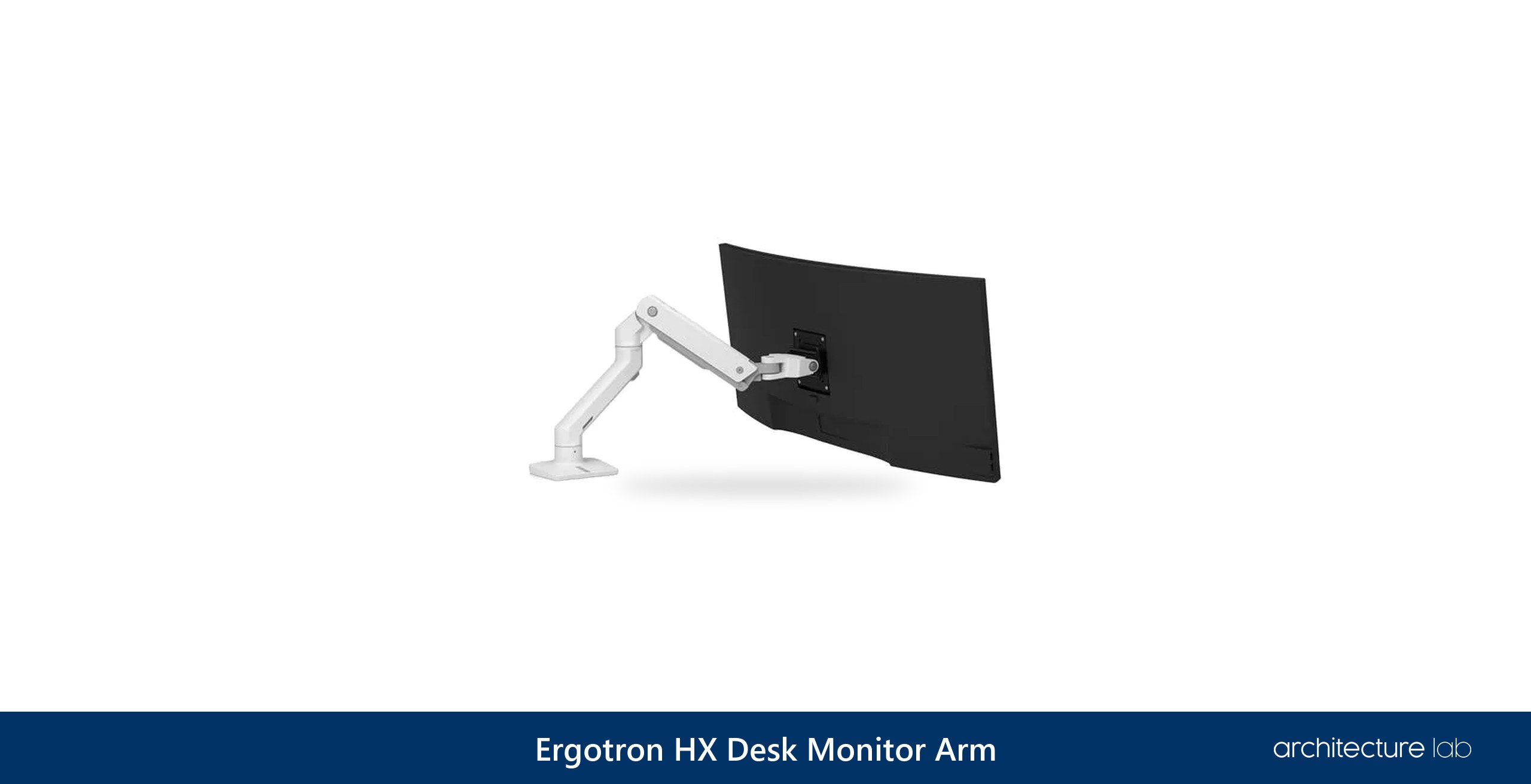
Of the two Ergotrons, the HX is the steadier under the pen. It wobbles less than the LX while you draw, though not entirely. It is built for heavy loads, with a VESA plate that accepts patterns up to 400 x 400 mm, and under 40- to 49-inch monitors it holds any position and assembles without difficulty. For a pen display, the limitation is the bottom of its range. Ergotron rates the HX for 9.1 to 19.1 kg, while a Cintiq Pro 27 weighs 7.2 kg without its stand and a Kamvas Pro 27 weighs 8 kg.
On a drawing desk, then, the HX is the arm for the large monitor beside the tablet. It carries a 42-inch LG C2 without strain once an adapter plate is fitted to the screen’s mounting holes. A 49-inch screen drooped on the standard head, and for curved screens 6 to 12 inches deep Ergotron sells the HX with its stronger HD Pivot.
What We Like
- 9.1 to 19.1 kg capacity with 11.5 in of lift
- Desk clamp and grommet mount both included
- 10-year warranty
- HD Pivot version for deep curved screens
What We Don’t Like
- 9.1 kg floor sits above the 7.2 kg Cintiq Pro 27
- Tilts only 5 degrees down
2. Ergotron LX Desk Monitor Arm – Best Monitor Arm for Drawing Tablets of 7 to 25 lb
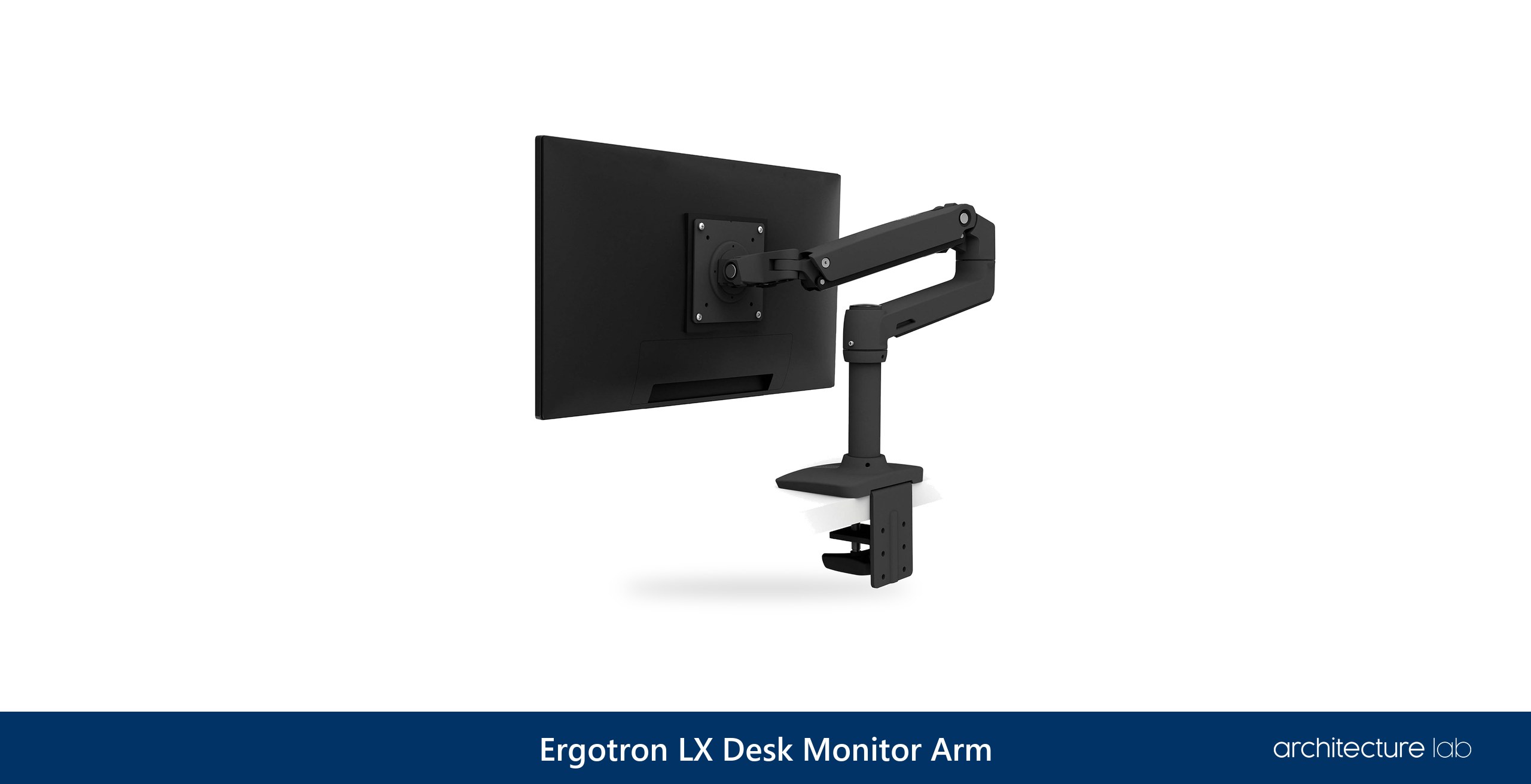
The LX is the arm to buy for a 27-inch pen display. Its 3.2 to 11.3 kg range covers the Cintiq Pro 27, the Kamvas Pro 27 and the Kamvas Pro 24 (Gen 3) with capacity to spare, and that margin counts for more on a drawing arm than on a monitor arm, because a resting hand and the pressure of the pen add load. Under a pen display the LX is reliable, slightly less rugged than the HX, and generous in its range of motion. It also outreaches the HX, at 25 inches against 23.6, and lifts further, at 13 inches against 11.5.
Setting the tension takes patience. The hex screws make it difficult to arrive at exactly the right resistance, and precise positioning can take both hands, although most owners who comment on its sturdiness rate it well. The clamp fits desks from 10 to 60 mm thick, with a grommet option for desks that have a hole. The one display it cannot take is a light one, since the 2 kg Kamvas Pro 19 falls below its minimum.
What We Like
- Range takes in the Cintiq Pro 27 and Kamvas Pro 27
- Up to 25 in of reach with 360° pan and rotation
- Clamp fits desks 10 to 60 mm thick
- 10-year warranty
What We Don’t Like
- Tension takes effort to set
- The 2 kg Kamvas Pro 19 falls below its 3.2 kg floor
3. HUANUO HNCM9 – Best Tall Pole Mount for Sit-Stand Drawing
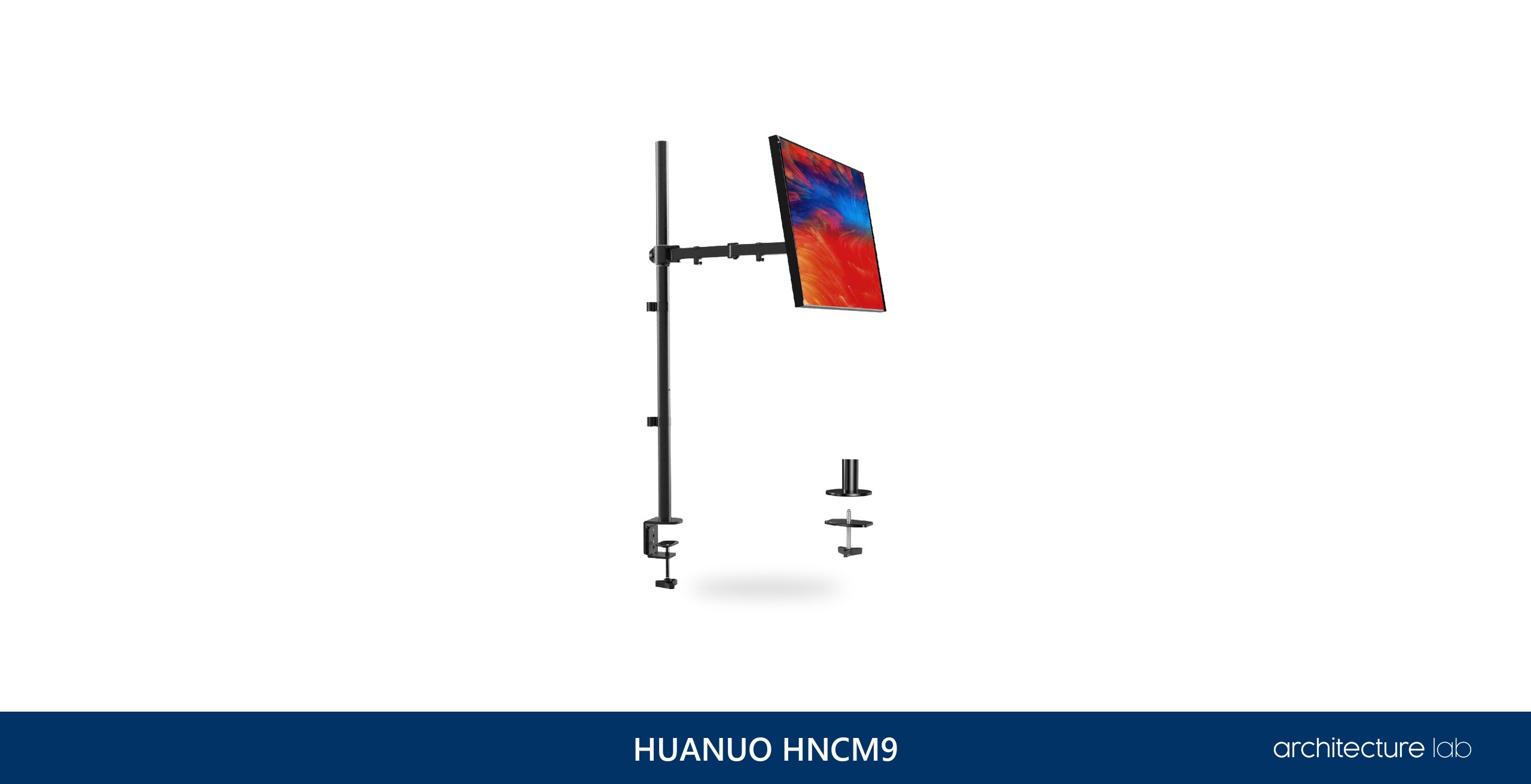
The HNCM9 is the pick for drawing standing up. Its pole raises the screen as high as 39 inches, a height HUANUO designs for people who move between sitting and standing, and the head still tilts and swivels through 180 degrees and rotates fully to portrait. The 22-pound rating sits comfortably above the Cintiq Pro 27’s 15.9 pounds. A screen mounted high stays there without sinking, even the top screen of a three-monitor stack of 34-inch LG displays.
Check the desk before ordering, as HUANUO itself advises. The C-clamp accepts tops up to 3.93 inches thick and the grommet base up to 2.75 inches, and the surface needs to be solid where the mount sits. After that, assembly is straightforward.
What We Like
- Lifts a screen up to 39 in for standing work
- 22 lb rating covers the Cintiq Pro 27
- C-clamp or grommet base
- Warranty of up to 5 years
What We Don’t Like
- Clamp takes desks up to 3.93 in, grommet up to 2.75 in
- Desk thickness has to be confirmed before purchase
4. Colebrook Bosson Saunders Flo – Best Monitor Arm for Portrait Drawing
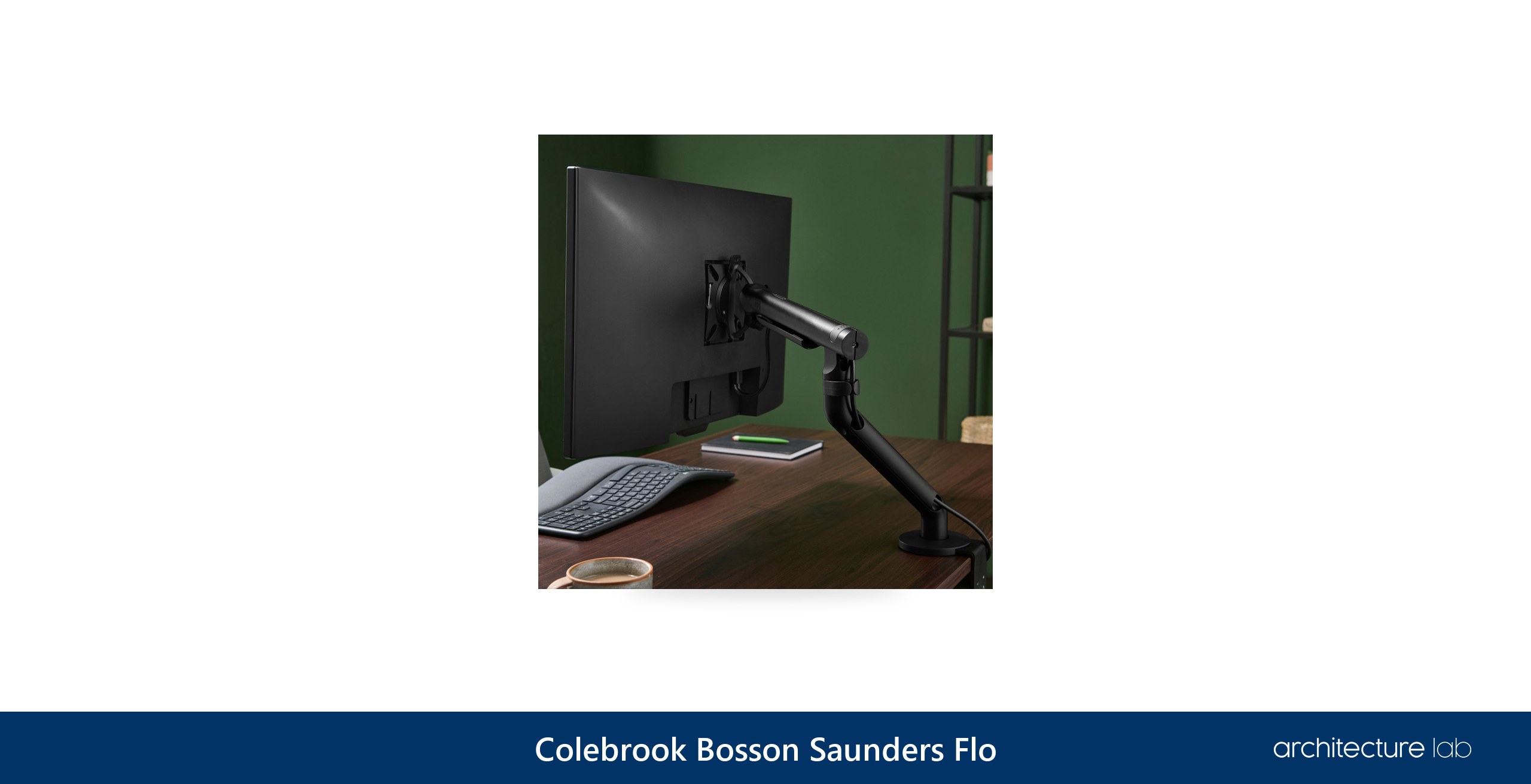
The Flo is designed for artists who rotate their screen often. One finger takes it from landscape to portrait, it stops at 180 degrees, and once the spring is balanced the screen stays wherever it is released, with no knob to tighten. Owners describe the movement as smooth and the arm as sturdy and quick to install. The spring is set once with an Allen key, and a gauge on the arm records the setting, so a second Flo can be matched to the first.
Weight is the constraint. Colebrook Bosson Saunders rates the Flo for 2 to 7 kg, which accommodates the 6.4 kg Kamvas Pro 24 (Gen 3) but leaves the 7.2 kg Cintiq Pro 27 just outside. Herman Miller sells the same arm, which fits a desk by top clamp, grommet clamp or split clamp.
What We Like
- Fingertip turn from landscape to portrait
- 584 mm of horizontal and 483 mm of vertical reach
- Spring holds the screen with no tightening
- Top-mount, grommet and split clamps
What We Don’t Like
- The 7 kg maker rating sits under the 7.2 kg Cintiq Pro 27
- Tension is set with an Allen key
5. Huion Desktop Arm ST500 – Best Freestanding Pen Display Stand for Desks Without a Clamp
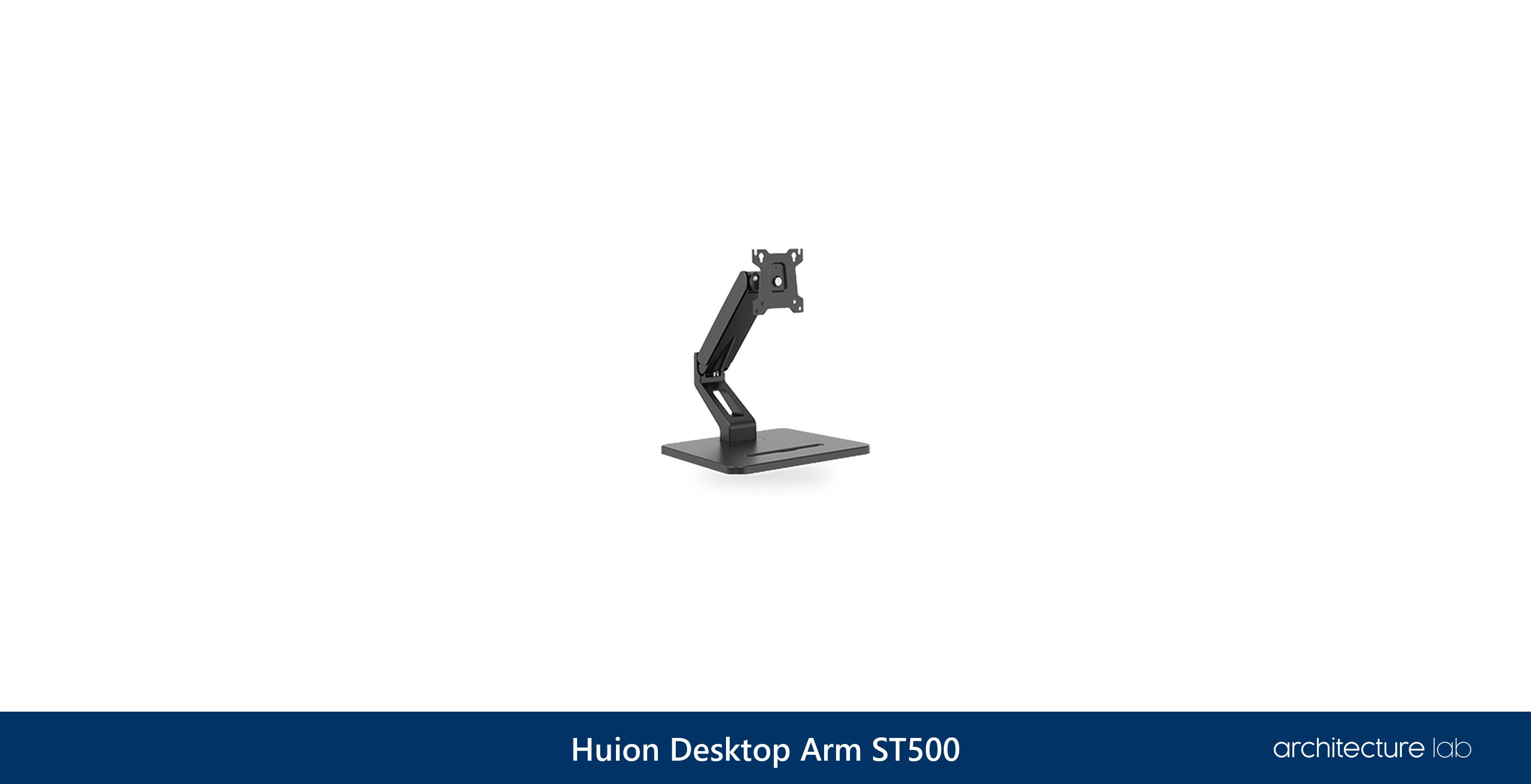
Some desks should not take a clamp at all. Glass, hollow-core and dent-prone tops can be damaged by one, and a desk with no free edge and no grommet hole would need drilling. The ST500 avoids the question entirely. It is Huion’s own gas spring arm on a 325 by 250 mm base that rests on the desk. The spring is easy to adjust and steady enough to rest both palms on the screen without the height dropping, and owners running a Cintiq 24, an XP-Pen 24 Pro or a Kamvas 24 4K on it describe it as sturdy.
It has limits. Firm pressure near the edge of the screen tips it downward, and assembly proved difficult for some owners. At its lowest setting, the bottom edge of a large display can touch the desk. And although Huion lists the Kamvas Pro 27 as compatible, it states that this display cannot be turned to portrait on the ST500.
What We Like
- Freestanding base needs no clamp or grommet
- 2 to 10 kg on a gas spring
- 75 to 325 mm of height
- Pitch from +90 to -45°
What We Don’t Like
- The base takes up desk space
- Moves under hard pen pressure
- The Kamvas Pro 27 cannot turn to 90° on it
6. VIVO STAND-V001H – Best Pole Stand for 13 to 32 Inch Screens
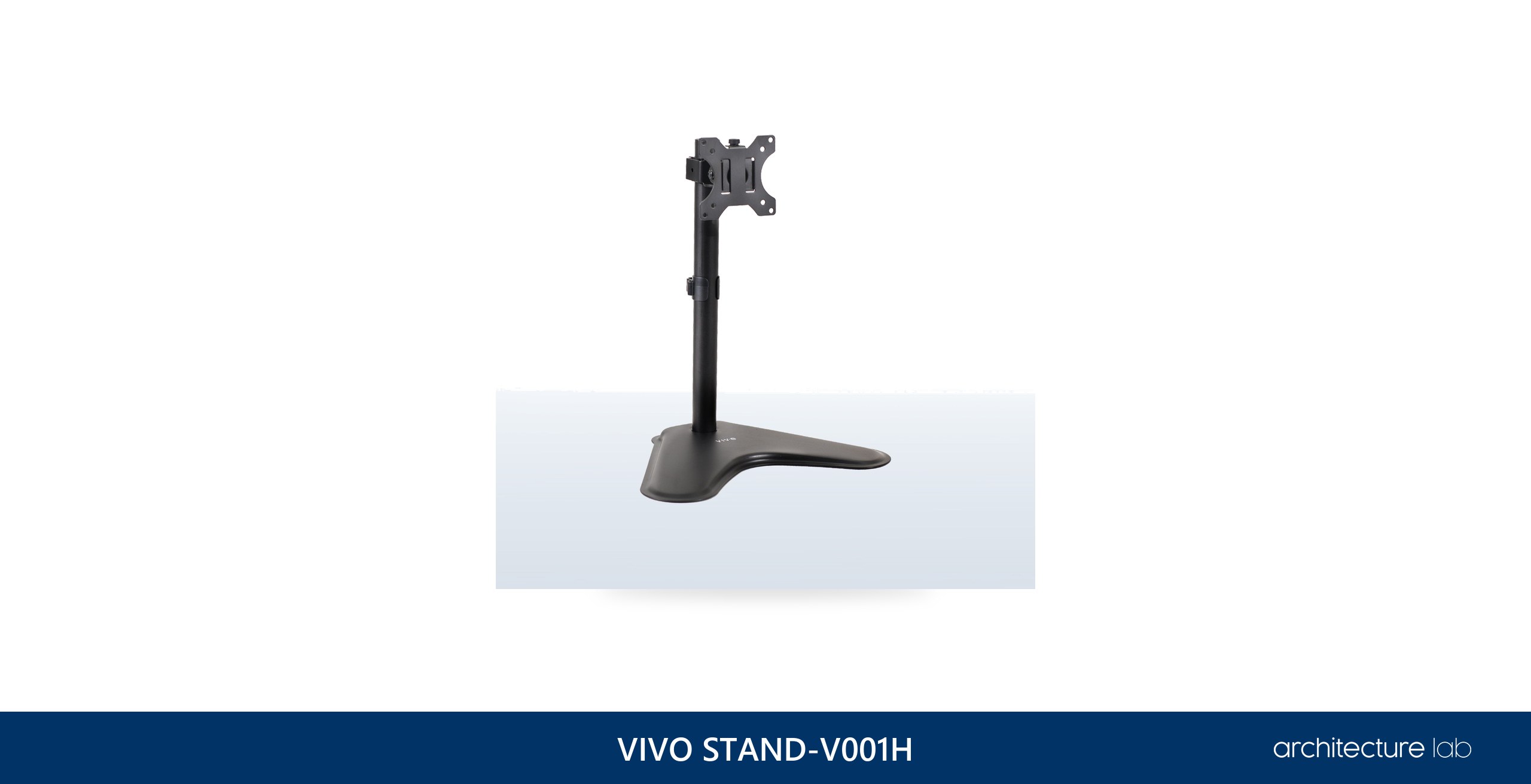
The V001H is the simplest design here, a steel pole 18 inches tall on a 15.5 by 11 inch base. It is rated for 22 pounds and takes 13- to 32-inch screens, so a Cintiq Pro 27 fits. Owners report a solid build, clear instructions and every tool needed in the box. Movement is more limited than on an arm, since the head tilts only 15 degrees each way and swivels 90, and the height is changed with an Allen wrench. For a screen that is set once and left in place, that is no drawback. For a screen that moves through the working day, an arm is the better fit.
What We Like
- Freestanding steel base needs no clamp or hole
- 22 lb rating covers the Cintiq Pro 27
- Portrait or landscape rotation
- 3-year warranty
What We Don’t Like
- Tilt stops at 15° each way
- The base takes up desk space
7. Wacom Cintiq Pro 27 Stand – Best Drawing Tablet Stand for the Wacom Cintiq Pro 27
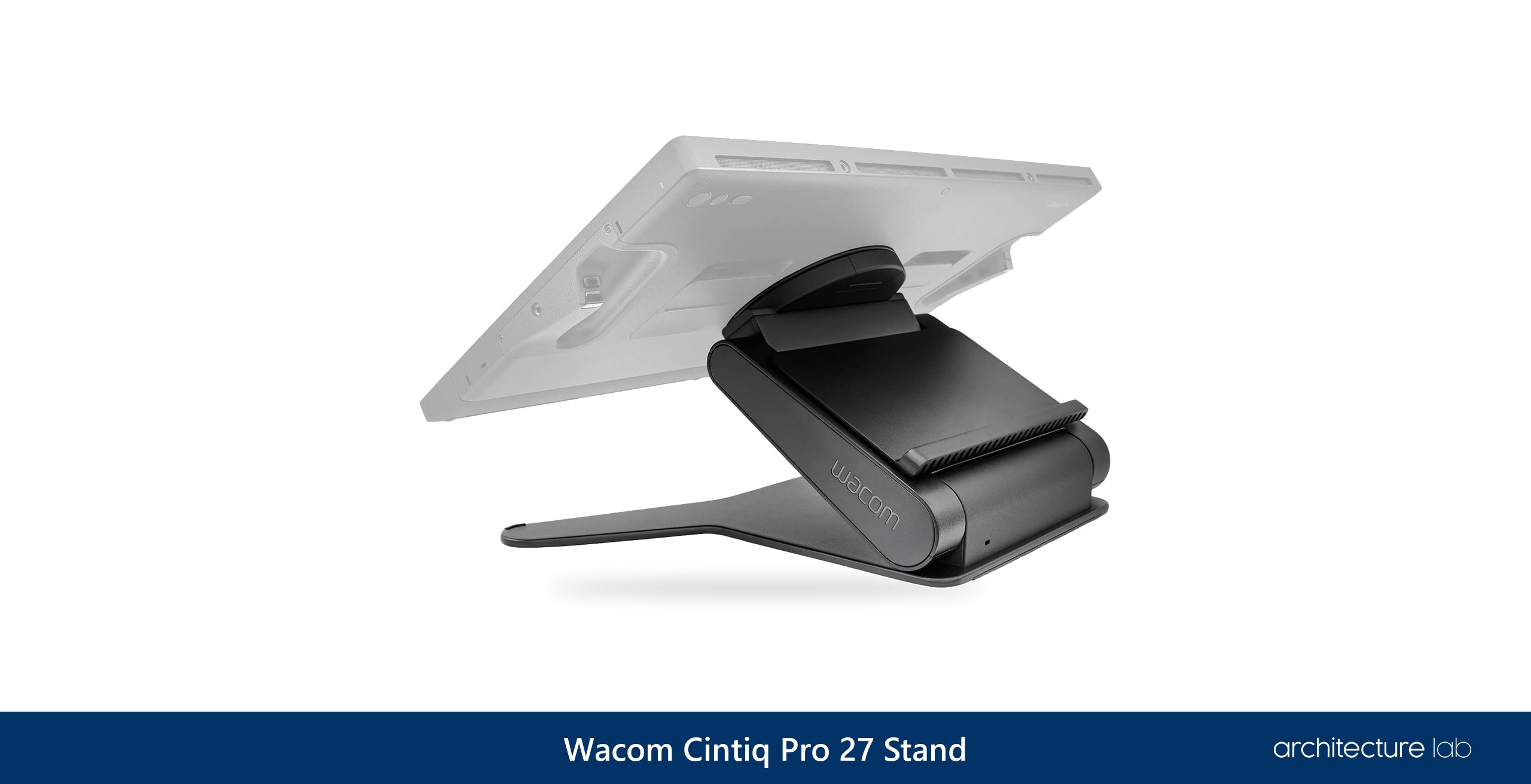
For a Cintiq Pro 27 owner who prefers a stand to an arm, this is the natural choice. Wacom designed it for that one display, and it bolts to the 100 x 100 mm plate on the back. Height and angle adjust quickly, and the screen turns up to 20 degrees either way, which Wacom says supports drawing with natural hand movements. Owners find it sturdy across the angles they work at, though the screw threads can strip during assembly, so the screws are best tightened with care. A full turn to portrait requires an arm, according to Wacom.
What We Like
- Made for the Cintiq Pro 27’s 100 x 100 mm mount
- Height, angle and rotation of up to 20° each way
- Named by Wacom as a support for the display
What We Don’t Like
- Portrait rotation needs a monitor arm
- Rotation stops at up to 20° each way
How to Choose a Drawing Tablet Stand or Arm
Drawing Tablet VESA Mount and Weight: Checking the Fit
Start with the weight, and use the right figure, the display without its stand, usually listed in the manual or on the maker’s site. It has to fall inside the arm’s range at both ends, and the lower end is easy to overlook. The Ergotron LX starts at 3.2 kg and the HX at 9.1, and a display below an arm’s minimum is outside what the maker rates it for. Leave headroom as well, about two or three pounds for the pen and a resting hand.
Next, check the back of the display for VESA holes. The Cintiq Pro 27, Kamvas Pro 27 and Kamvas Pro 24 (Gen 3) use a 100 x 100 mm pattern, and the Kamvas Pro 19 and Kamvas 22 Plus a 75 x 75. Huion’s spec sheet for the Kamvas 16 (Gen 3) shows none. A display without holes needs an adapter or a custom solution. When Wacom’s 2017 Cintiq Pro 16 shipped without them, one animation studio built its own cradle to mount it on an arm.
Gas Spring Arm or Pole Stand
Most arms here use a gas spring, and the spring has to be tuned to the screen. As HUANUO explains, too little tension lets the arm sag, and too much sends the screen drifting back up after it is lowered, so the adjustment goes half a turn at a time until the screen holds its position. A light display can take several turns. The spring is also the reason arms move when you draw. A gas spring cannot ignore the pen and still move easily, and where stability counts for more than mobility, the better choice is a support without one.
A pole stand is the alternative. On the VIVO V001H the height is set along the pole with a wrench, and there is no spring to give under the pen. The HUANUO HNCM9 offers far more height, up to 39 inches, for standing work.
Desk Clamp, Grommet or Freestanding Pen Display Stand
A clamp grips the edge of the desk, and a grommet mount bolts through a hole in a drawing desk. Both have thickness limits, 10 to 60 mm on the Ergotron LX and up to 3.93 inches on the HNCM9’s clamp, and outside them the desk can be damaged or the mount left unstable. The edge matters too. BenQ specifies a flat first 2.5 cm for a clamp to grip properly. The material counts as well, since particle board is relatively soft and HUANUO recommends a reinforcement plate for it.
Glass, hollow-core and soft tops are the surfaces clamps damage. A reinforcement plate between the clamp and the desk spreads the load, and HUANUO sells one, the HNDA1, for particle board and glass. Where there is no hole and drilling is not an option, a freestanding stand does the same job from its own base, at the cost of desk space, 325 by 250 mm for the Huion ST500 and 15.5 by 11 inches for the VIVO V001H.
Huion Monitor Arms and Stands for Kamvas Pen Displays
Huion makes its own supports for Kamvas owners. The Single Monitor Arm ST410 and Dual Monitor Arm ST420 take screens under 32 inches and are Huion’s clamp-mounted alternatives to the ST500. The Adjustable Desk Stand ST100 is for pen displays over 18 inches, and the Pen Display Stand ST300 for smaller models, the Kamvas 12, 13 and 16 (2021) and the Kamvas Pro 12 and 13. For the Kamvas Pro 24 (Gen 3), Huion also offers an Adjustable VESA Stand that holds the screen anywhere from 20 to 80 degrees.
Screen Height for Tall People: Digital Art Equipment Setup
For a screen you look at, Cornell University’s ergonomics guidance puts your eyes level with a point 2 to 3 inches below the top, about an arm’s length away. With a portrait screen, the Canadian Centre for Occupational Health and Safety advises that the top should not rise above eye level, and that a screen too high is worse than one slightly too low. Wearers of bifocals or progressive lenses may prefer it lower still.
Cornell recommends adjusting height at the screen’s support instead of raising the whole desk. A setup shared by two people has to suit both the tallest and the shortest of them. Ergotron says the LX’s 13 inches of travel covers more than nine adults in ten, and for a standing desk the HUANUO HNCM9 reaches 39 inches.
When the Pen Display’s Own Stand Is Enough
An arm is not always necessary. For drawing at a single angle without rotating the screen, the stand supplied with the display can be sufficient. The Kamvas Pro 27, Pro 24 (Gen 3) and Pro 19 sit on a built-in stand at 20 degrees, and the Kamvas 22 Plus comes with one that adjusts from 20 to 80. The Kamvas 16 (Gen 3) takes the ST300 as an option. On the Wacom side, the Cintiq Pro 27 Stand adjusts height and angle and turns 20 degrees each way. Only a turn to portrait calls for an arm.
How to Install and Tension a Drawing Tablet Arm
Measure the desk and confirm the surface under the mount is solid. Fit the arm, then hang the display before adjusting the tension, since the arm needs weight on it before the adjustment bolt can be reached. If the screen sinks, increase the tension, and if it rises, reduce it, half a turn at a time. The spring is under pressure, and the manuals carry a warning to that effect.
Can you use a monitor arm for a drawing tablet?
A monitor arm works for a drawing tablet when the tablet is a pen display with VESA holes and its weight falls inside the arm’s range. Wacom names a VESA 100 monitor arm as one of two supports for the Cintiq Pro 27, and the Kamvas Pro 27 and Pro 24 (Gen 3) use the same 100 x 100 mm pattern. Weigh the display without its stand, and allow headroom for a resting hand.
What is the best monitor arm for artists?
The best monitor arm for most artists with a large pen display is the Ergotron LX. Its 3.2 to 11.3 kg range takes the Cintiq Pro 27 and Kamvas Pro 27 with room left for a resting hand, and artists who use it describe it as reliable. For a display of 7 kg or less that is turned to portrait often, the Colebrook Bosson Saunders Flo rotates under one finger.
Do drawing tablets have a VESA mount?
Most large drawing tablets have a VESA mount. The Cintiq Pro 27, Kamvas Pro 27 and Kamvas Pro 24 (Gen 3) use 100 x 100 mm, and the Kamvas Pro 19 and Kamvas 22 Plus 75 x 75. Smaller models may lack one, and Huion’s spec sheet for the Kamvas 16 (Gen 3) lists no pattern.
What weight rating does a drawing tablet arm need for a Cintiq Pro 27?
An arm for a Cintiq Pro 27 needs a rating that includes 7.2 kg, or 15.9 pounds, the display’s weight without its stand, plus a few pounds for a resting hand. The Ergotron LX, Huion ST500, HUANUO HNCM9 and VIVO V001H all clear it. The Ergotron HX’s range begins at 9.1 kg, and the Flo’s ends at 7.
Can the Huion Kamvas 16 go on an arm mount?
The Kamvas 16 (Gen 3) cannot go on an arm as supplied, because Huion’s spec sheet gives it no VESA pattern, so an adapter would be needed. At 1.2 kg it is also lighter than the 2 kg minimum on the Flo and the ST500. Huion’s own optional stand for it is the ST300.
Can you use the Wacom Cintiq Pro 27 Stand with other Wacom pen displays?
The Cintiq Pro 27 Stand is listed for one display only, the Cintiq Pro 27 (DTH271K0A). Wacom’s FlexArm Adapter ACK64804KZ is similarly limited, to the Cintiq Pro 22 and 27. Other Wacom displays need a monitor arm that matches their VESA pattern and weight.
What is the best digital art equipment for tall people?
For tall people, the most useful digital art equipment is a support with a long height range. Ergotron says the LX’s 13 inches of travel suits more than nine adults in ten, and the HUANUO HNCM9 lifts a screen to 39 inches for drawing standing. The top of a tall or portrait screen should sit no higher than eye level.
Does a drawing tablet arm move under pen pressure?
Drawing tablet arms move slightly under pen pressure, and no arm is entirely free of it. The stiffer HX moves less than the LX. On the Huion ST500 a resting palm does not shift the height, but firm pressure near the edge tips the screen down. Choose an arm with capacity to spare, and keep the heaviest strokes toward the middle of the screen.
Can a drawing tablet arm mount on a glass or particle board desk?
An arm can mount on a glass or particle board desk with a reinforcement plate under the clamp to spread the pressure. HUANUO makes the HNDA1 for both surfaces. The alternative is a freestanding stand such as the Huion ST500, which needs no clamp.
Resources
- Ergotron — HX Desk Monitor Arm Specification Sheet; LX Desk Monitor Arm Specifications
- Wacom — Cintiq Pro 27 Product Specifications; Cintiq Pro 27 Stand ACK64801KZ
- Huion — Desktop Arm ST500 Specifications; Kamvas Pro 27, Kamvas Pro 24 (Gen 3), Kamvas Pro 19, Kamvas 22 Series and Kamvas 16 (Gen 3) Specifications; Stands and Monitor Arms
- HUANUO — HNCM9 Extra Tall Desk Mount; Monitor Arm Setup and Adjustment; FAQs
- VIVO — STAND-V001H Single Monitor Desk Stand
- Colebrook Bosson Saunders — Flo Monitor Arm
- Herman Miller — Flo Monitor Arms; Flo Monitor Support
- BenQ — Single Monitor Arm Setup Checklist (knowledge center)
- VESA — Flat Display Mounting Interface (FDMI) Standard
- Cornell University Ergonomics Web — Workstation Ergonomics Guidelines
- Canadian Centre for Occupational Health and Safety — Monitor Positioning
- Architecture Lab — Best Drawing Tablets; Huion vs Wacom; Best Standalone Drawing Tablets; Best Desks for Artists; Best Monitor Stands; XP-Pen Artist 24 Pro Review
