

Hanging beds suspend a bed frame or sleeping surface from overhead supports or between anchors, indoors or outdoors. The porch-swing models cited here use rope or chain secured to strong beams or joists; a hammock is a swingable canvas or netting lounge or bed slung between trees or other supports. Twenty hanging bed ideas range from an old swinging daybed and a pallet board bed swing to the round Floating Bed and a levitating bed. The Floating Bed’s maker rates it to hold 1,000 lb, 454 kg. Mattress sizes for adults run from twin to king, while suspension depends on the working load limits of chain, rope and eye bolts and the strength of ceiling joists, roof trusses, concrete slabs or trees.
Hanging Bed Ideas
-
Old Swinging Daybed
The old swinging daybed pictured has a pale rectangular frame, chain suspension and neutral bedding beside tall windows. We would carry those muted beige tones into a summer patio scheme, using cushions to soften the contrast between the frame and the surrounding architecture and the light falling across the mattress. Nostalgic’s porch-swing instructions require solid wood framing and a check by an experienced contractor or engineer when its strength is uncertain.

-
Colored Swinging Daybed
The colored swinging daybed pictured hangs on a porch, with rope wrapped around its chain and a blue rug beneath. We would keep that blue as the main accent, pairing it with pale bedding so the rug and suspended frame remain the strongest features.

-
Pallet Board Bed Swing
The pallet board bed swing is a DIY bed swing of old wooden pallet boards hung in a backyard, and for wood left outdoors, federal playground safety guidance calls for a species naturally resistant to rot and insects, such as cedar or redwood, or wood treated against such deterioration.

-
The Floating Bed
The Floating Bed is circular, and its maker gives it a 1,000 lb (454 kg) rating. The maker says every bed undergoes a two-day test with 3,000 lb (1,361 kg), describing this as a three-to-one margin. It also claims the same rating for an installation following its manual; that remains a manufacturer claim about its specified installation.
The Floating Bed’s maker favors a round shape because it avoids protruding corners as its bed rotates. The maker allows lying-down space for four adults in a Queen or five in a King, within its stated weight limit, and prefers a room larger than 10–11 feet (3.0–3.4 m) square. It suggests a tether to reduce movement in smaller spaces.
The Floating Bed’s maker describes its product as weatherproof and offers memory foam, latex or hybrid mattresses. Its adjustable support net changes firmness beneath the sleeping surface. The maker’s design guide offers different mattress and fabric options for indoor and outdoor locations.
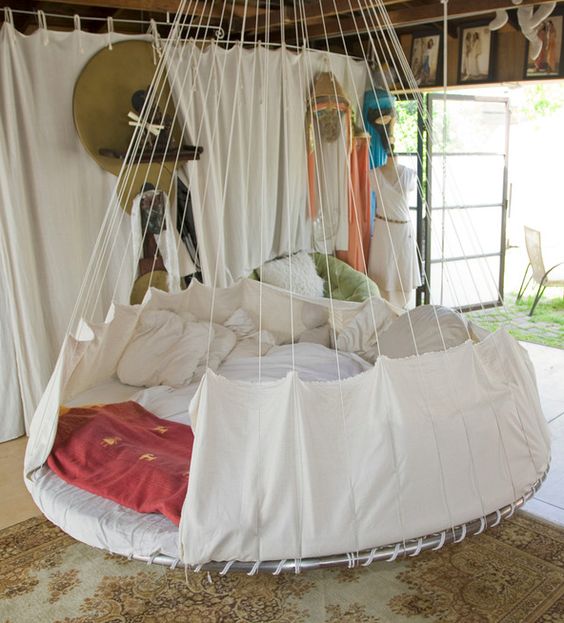
-
Hanging Trampoline Bed
The hanging trampoline bed is presented as an upcycled trampoline idea. We like the pictured canopy beneath a treehouse as outdoor design inspiration, but would have its frame and suspension assessed before using the conversion. Thick-looking rope alone would not persuade us to trust a DIY bed.

-
Outdoor DIY Swinging Bed
The outdoor DIY swinging bed by Run to Radiance hangs in a frame of posts stabilized with cross beams. The blogger used two front curtains, one at each side and two behind, cedar mulch beneath, and wood conditioner before staining. The tutorial also acknowledges using rope labeled against supporting human weight. We would borrow its curtained design, not that suspension choice.

-
Traditional Hanging Bed
The traditional hanging bed pictured combines a green cover, pillows and a tray with glass jars. For upkeep, Nostalgic’s porch-swing instructions call for periodic inspections of ropes, fasteners and the supporting structure, replacement where necessary, and immediate cessation of use if the swing appears unstable.

-
Baby Crib Hanging Bed
The baby crib hanging bed is a porch swing made out of a baby crib, built by Nate as a surprise, so its maker’s tips stand in for step-by-step instructions. Use this conversion as a porch swing, never as an infant sleep space. CPSC advises using a crib, bassinet, play yard or bedside sleeper that meets federal requirements, and moving a baby there if they fall asleep elsewhere.
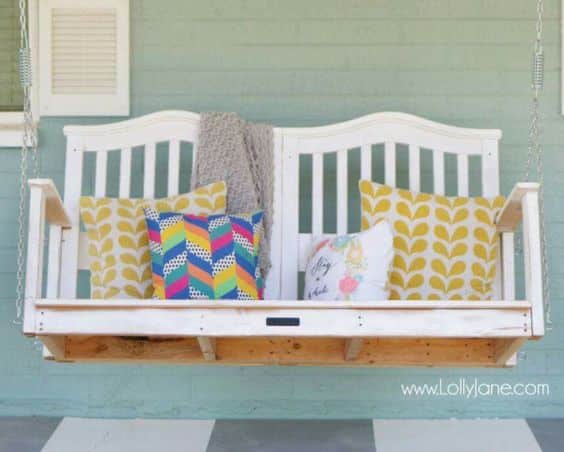
-
Colorful Porch Daybed
The colorful porch daybed is Ana White’s hanging outdoor bed, built around a twin mattress because twins are easy to come by, and hung by chain from all four corners on 8 eye bolts, 4 in the bed and 4 in the ceiling, with about 24 feet, 7.3 m, of chain for a standard 8 foot, 2.4 m, ceiling. The type of bolt varies with the rafters.

-
Suspended Tree Bed
The suspended tree bed pictured sits among tree trunks, with a small ladder at its foot and a lamp beside it. Its quilt and layered pillows create a domestic sleeping arrangement outdoors, while the suspension disappears upward among the surrounding trees.
Leave No Trace hammock guidelines call for straps of webbing 1 inch, 2.5 cm, or wider, wrapped around the trunk once, nothing hammered or screwed into the tree, and living trees at least 6 inches, 15 cm, in diameter. Wisconsin’s state parks require trees greater than 1 foot, 30 cm, in diameter at the attachment point and greater than 5 feet, 1.5 m, tall, rule out rope and paracord, and bar oak trees. Both are hammock rules.

-
Hanging Boat Bed
The hanging boat bed pictured makes the boat shape the centerpiece of the room. We would pair it with pale blue linen for a nautical scheme. For public playground swings, CPSC guidance identifies open S-hooks as a clothing-entanglement hazard and specifies a closed gap no greater than 0.04 inches (about 1 mm), and recommends securing hardware against removal without tools. Have the converted frame, anchors and suspension assessed for their intended occupants.

-
Hanging Bunkbeds
The hanging bunkbeds idea links to Ana White’s easy DIY hanging daybed, a single twin daybed with space around the mattress for drinks, books or a snack. Her plan claims an 800-pound capacity from 200-pound-rated strands; Crosby’s sling guidance requires loads to be calculated with the suspension angle. The plan’s arithmetic therefore supplies no independent verification of a complete bed installation.

CPSC’s current bunk-bed guidance points to 16 CFR Part 1213 for adult beds and Part 1513 for children’s beds. A bed falls within the definition when the underside of its mattress foundation is more than 30 inches (760 mm) off the floor. Upper bunks require at least two guardrails, one on each side, with their tops at least 5 inches (130 mm) higher than the mattress. CPSC’s safety guidance also warns against kids under six using an upper bunk.
-
Space Saving Hanging Bed
The space-saving hanging bed pictured places a sleeping platform over a compact study, with upright metal-looking supports and a ladder beside the desk. We would consider that arrangement for a small apartment only after checking both the support design and the applicable raised-bed requirements.
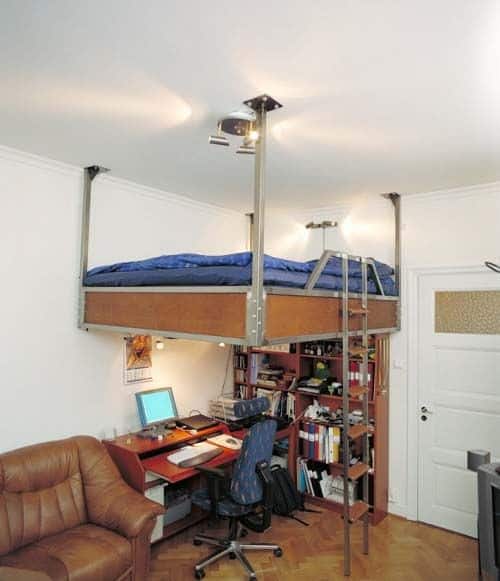
-
Rustic Hanging Bed
The rustic hanging bed is a wooden bed frame hung on metal chain in a modern, industrial-styled room, and chain is rated by grade and size, with Campbell’s Grade 30 proof coil chain marked Do not use for overhead lifting.

-
Swinging Hammock Bed
The swinging hammock bed uses a flexible suspended sleeping surface. Merriam-Webster defines a hammock as a swinging couch or bed, usually made of netting or canvas and slung by cords from supports at each end. The pictured example uses fabric sides and a broad sling-like sleeping area.

-
Twin Hanging Beds
Twin hanging beds use frames sized for twin mattresses. Ana White’s hanging outdoor bed plan uses eight eye bolts: four in the bed and four in the ceiling, with about 24 feet (7.3 m) of chain for an 8-foot (2.4 m) ceiling.
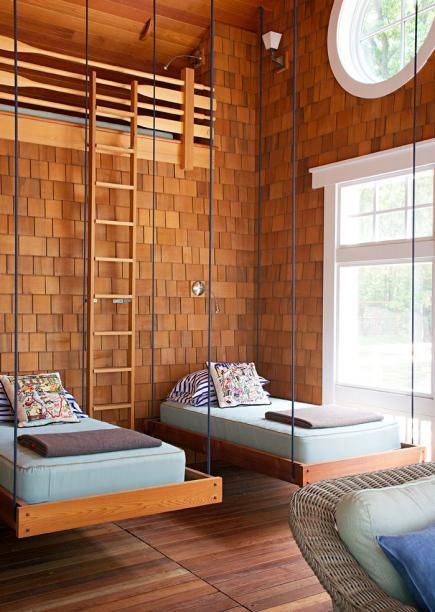
-
Minimalist Beach Bed
The minimalist beach bed pictured has a narrow, raft-like frame suspended in a white bedroom. We like the contrast between its irregular timber-like members and the pale bedding; the beach association is a styling interpretation; its construction history is unverified.

-
Levitating Bed
For a king-size version of this look, compare the frame’s specified mattress opening with the intended mattress. The Better Sleep Council’s US chart gives a king as approximately 76 by 80 inches (193 by 203 cm), the widest of its listed adult sizes.

-
Hanging Wooden Bed
The hanging wooden bed pictured pairs a dark rectangular frame with thick rope-like suspension. We like the way the visible supports become part of the room’s composition, but would choose the suspension by its specified performance using the maker’s specifications.

-
Swinging Nest Bed
The swinging nest bed pictured has a woven-looking enclosure, an arched opening and red bedding. We like its enclosed, nest-like shape as an alternative to an open platform. Its appearance alone does not establish rattan or jute construction, ventilation performance or how far it can rotate.

What Is a Hanging Bed Called?
A hanging bed is called a swing bed when a mattress platform hangs from ceiling hooks, and its other names include the hammock, a bed of canvas or netting slung between two trees or other supports, and brand names such as the Floating Bed, while the Hindi झूला, jhula, means a swing or a cradle. The type of bed suspended between two supports is the hammock, a word borrowed from the Spanish hamaca, itself from Taíno. Ceiling-hung beds use overhead suspension, while a floating appearance can also come from supports recessed beneath the bed frame.
What Size Mattress Does a Hanging Bed Take?
A hanging bed takes the mattress size specified for its frame. Ana White’s two hanging daybed plans take a twin, and the Porch Swing Company offers twin and full sizes. For a larger hanging bed for adults, the Floating Bed maker describes lying-down space for four adults in its Queen, within its stated weight limit.
| Size | Width x length, in | Width x length, cm | Sized by |
|---|---|---|---|
| Twin, US | 38 x 75 | 97 x 191 | Better Sleep Council |
| Twin XL, US | 38 x 80 | 97 x 203 | Better Sleep Council |
| Full, US | 53 x 75 | 135 x 191 | Better Sleep Council |
| Queen, US | 60 x 80 | 152 x 203 | Better Sleep Council |
| King, US | 76 x 80 | 193 x 203 | Better Sleep Council |
| California King, US | 72 x 84 | 183 x 213 | Better Sleep Council |
| Single, UK | 35 x 75 | 90 x 190 | UK bed-size guide |
| Small Double, UK | 47 x 75 | 120 x 190 | UK bed-size guide |
| Double, UK | 53 x 75 | 135 x 190 | UK bed-size guide |
| King Size, UK | 59 x 79 | 150 x 200 | UK bed-size guide |
| Superking, UK | 71 x 79 | 180 x 200 | UK bed-size guide |
Better Sleep Council’s US dimensions are approximate. Serta gives lengths half an inch shorter: 74.5 inches for a twin and 79.5 for a queen (both US sources read October 22, 2026). Converted figures use 2.54 cm to the inch. UK names and metric dimensions follow the Sleep Council’s Bed Buyers Guide; their imperial figures are rounded conversions. A UK king differs from a US king.
How Do You Hang a Bed From the Ceiling?
A swing bed’s support must suit the bed and occupants. Nostalgic recommends an experienced contractor or engineer when the ceiling’s strength is uncertain. Nostalgic’s two-point porch-swing kit uses 3/8-inch (9.5 mm) through-bolts in 3/8-inch holes. Its four-point kit specifies eyehole lags in 5/16-inch (7.9 mm) pilot holes at least 4 inches (10 cm) deep. These hole sizes belong to those kits.
Joists, Beams, Trusses or Concrete?
Joists, beams, trusses and concrete each carry a hanging bed differently. Table R301.5 of the 2021 IRC, as Washington adopted it effective March 2024, sets a minimum uniformly distributed live load of 10 psf, 0.48 kN/m², for uninhabitable attics without storage, against 30 psf, 1.44 kN/m², for sleeping areas. Local adoption decides which edition governs.
In that 2021 IRC table as adopted by Washington, the no-storage category includes attics with no more than 42 inches (107 cm) clear between joists and rafters, or where two adjacent trusses have web configurations unable to accommodate a rectangle 42 inches high by 24 inches wide within their plane. These are attic classification criteria. They do not establish an allowable hanging-bed load.
A hanging bed also imposes concentrated suspension loads, for which the bed maker requires checking the support and intended occupants. Minneapolis’s January 2009 building bulletin requires verification before adding loads beyond a truss’s design capacity. This historical document addresses alteration and loading of wood framing. The applicable local code edition and the truss’s actual design determine the requirements for a proposed installation.
The swing2sleep ceiling-hook kit is advertised as loadable to 200 kg (441 lb), with its supplied screws and dowels suitable only for concrete. That component rating is not a whole-bed rating. Fischer’s advice for swinging furniture calls for an anchoring base able to carry the furniture, user and extra swinging loads; it names the FH II internal threaded anchor for concrete and warns against attachment to suspended plasterboard ceilings.
Two-Point or Four-Point Hang?
The Porch Swing Company describes a four-point hang as four hooks with ropes or chains running vertically, and a two-point hang as two hooks with converging suspension lines. Its terminology differs between documents: inverted V in its sizing guide and inverted Y in its hanging-style comparison (both read October 22, 2026).
An angled suspension changes the load on an eye bolt. Crosby prohibits regular nut eye bolts for angular lifts; its shoulder-nut instructions retain 80% of the rated working load at 15 degrees from in-line, 65% at 30 degrees and 30% at 45 degrees. Those figures apply to the specified Crosby products and assembly conditions.
How High and How Far From the Wall?
The Porch Swing Company suggests a distance of 18–24 inches (46–61 cm) from the porch floor to the top of the seat slats or cushion for a standard bench-style porch swing. Nostalgic specifies a minimum rear clearance of 16 inches (41 cm) for its porch swing. The Floating Bed maker suggests tethering to reduce movement in smaller rooms, to limit its travel.
What Rope or Chain Can Hold a Hanging Bed?
Choose rope, chain and fixings as part of the complete suspension design. Campbell defines working load limit as the maximum combined static and dynamic load in service, while Crosby requires angled sling loads to be calculated. Backyard City advertised its SBO Nautical cypress swing bed with a capacity of 800–1,000 lb depending on the hanging method. Those figures describe that product; adding hardware ratings does not establish that capacity.
| Hardware | Size | Working load limit, lb | Working load limit, kg | Rated by |
|---|---|---|---|---|
| Grade 30 proof coil chain | 3/16 in (about 4.8 mm by conversion) | 800 | 365 | Campbell |
| Grade 30 proof coil chain | 1/4 in (about 6.4 mm by conversion) | 1,300 | 580 | Campbell |
| Grade 30 proof coil chain | 5/16 in (about 7.9 mm by conversion) | 1,900 | 860 | Campbell |
| Manila rope | 3/8 in, 9.5 mm | 122 | 55 | Peerless |
| Manila rope | 1/2 in, 12.7 mm | 240 | 109 | Peerless |
| Manila rope | 5/8 in, 15.9 mm | 400 | 181 | Peerless |
| Forged eye bolt | 5/16 in, 7.9 mm | 1,200 | 544 | Crosby |
| Forged eye bolt | 3/8 in, 9.5 mm | 1,550 | 703 | Crosby |
| Forged eye bolt | 1/2 in, 12.7 mm | 2,600 | 1,179 | Crosby |
| Forged metric eye bolt | M8 | 882 | 400 | Crosby |
| Forged metric eye bolt | M10 | 1,411 | 640 | Crosby |
| Forged metric eye bolt | M12 | 2,205 | 1,000 | Crosby |
| REMA DIN 580-pattern eye bolt, C15E steel | M8 | 309 | 140 | REMA/CERTEX in-line rating |
| REMA DIN 580-pattern eye bolt, C15E steel | M10 | 507 | 230 | REMA/CERTEX in-line rating |
| REMA DIN 580-pattern eye bolt, C15E steel | M12 | 750 | 340 | REMA/CERTEX in-line rating |
| Concrete ceiling hook | 4 screws and dowels | 441 | 200 | swing2sleep, loadable up to, concrete only |
Published component ratings for the stated products, not a hanging-bed system specification. Crosby eye-bolt figures are for in-line pull; angular loading changes them. Chain and rope suppliers publish both units; other secondary units are converted at 0.45359237 kg per pound. Campbell Grade 30 chain is marked Do not use for overhead lifting. The concrete hook entry is the seller’s loadable-up-to rating.
A metric eye bolt is bought by its marked working load limit, since the same M8 thread carries nearly three times the rating as a Crosby forged eye bolt that it does as a REMA DIN 580-pattern eye bolt of C15E steel, and the Crosby angle reductions apply to Crosby products only, while CERTEX Denmark’s DIN 580 eye-bolt product guidance prohibits an angle between the slings larger than 90 degrees.
