home/products/rotring 500 vs 600 comparison review
Rotring 500 vs 600 Comparison Review
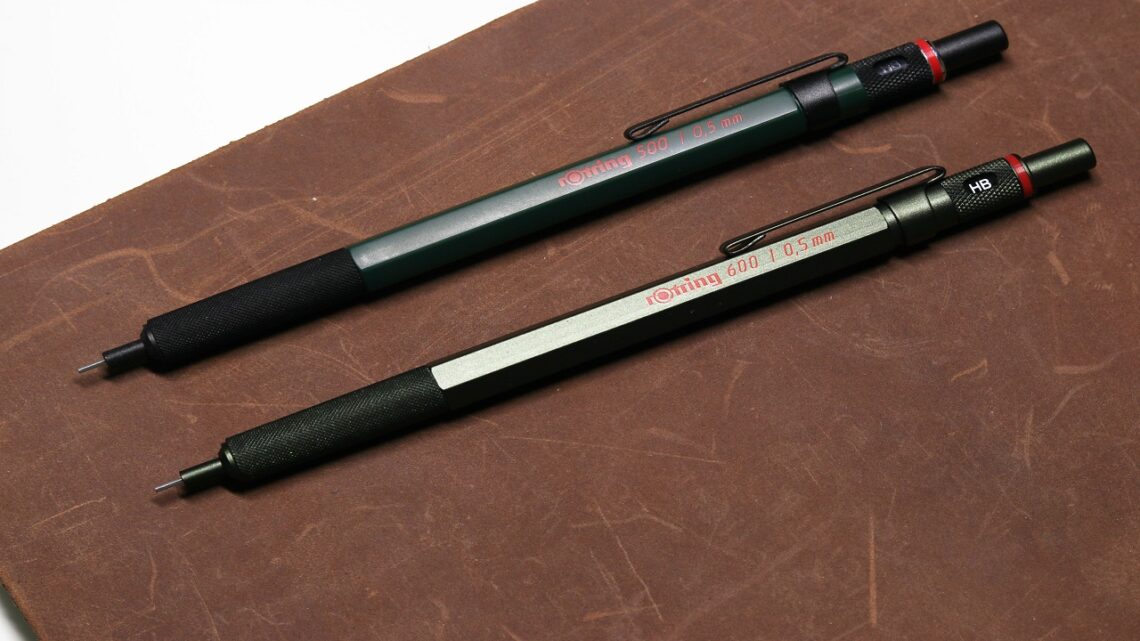
The Rotring 500 vs 600 decision turns on the barrel. The Rotring 500 is rOtring's lightweight drafting pencil with a hexagonal plastic barrel, while the Rotring 600, introduced in 1989, has a full metal body, brass where the 500 has plastic. Measured with lead, the 500 weighs 13 g, 0.46 oz, against 22 g, 0.78 oz, for the 600, in a body of the same 14.1 cm length, and rOtring gives no official weight for either pencil in its product specifications. Both carry a rOtring brass mechanism for precision lead advancement, a fixed lead guidance sleeve, a non-slip knurled metal grip and a lead hardness grade indicator. The light 500 carries its balance toward the tip and stays comfortable through a long session, while the heavier 600 balances along its length and holds a steadier line at the drawing board.
Review
The Rotring 500 vs 600 decision turns on the barrel. The Rotring 500 is rOtring's lightweight drafting pencil with a hexagonal plastic barrel, while the Rotring 600, introduced in 1989, has a full metal body, brass where the 500 has plastic. Measured with lead, the 500 weighs 13 g, 0.46 oz, against 22 g, 0.78 oz, for the 600, in a body of the same 14.1 cm length, and rOtring gives no official weight for either pencil in its product specifications. Both carry a rOtring brass mechanism for precision lead advancement, a fixed lead guidance sleeve, a non-slip knurled metal grip and a lead hardness grade indicator. The light 500 carries its balance toward the tip and stays comfortable through a long session, while the heavier 600 balances along its length and holds a steadier line at the drawing board.
About rOtring
rOtring dates its first nibless fountain pen, known to rOtring loyalists as the Tintenkuli, to 1928, and the brand signs itself Germany 1928. By 1940 the company had its first commercial van painted with the Tintenkuli and the red ring logo, and in 1998 rOtring became part of Sanford, a division of Newell Brands.
The red ring gave the brand its name. In 1961 the German roter Ring, the red ring, the symbol for active precision, became the official name for all products bearing the red ring, and the 500's top cap carries the Rotring red circle.
What Is the Difference Between Rotring 500 and 600?
Side by side, the difference between Rotring 500 and 600 pencils is the barrel material, plastic against full metal, with the grip, clip, lead indicator, eraser and cap otherwise alike. Both grips are knurled metal, a plain cylinder on the 500 and on the 600 a non-slip knurled section that keeps the pencil safely in hand, yet they differ in detail: the 500's knurling can feel harsher, and the grip threads are cut to different lengths, so the grips are not really interchangeable between the two.
| Feature | Rotring 500 | Rotring 600 |
|---|---|---|
| Barrel | Ergonomic hexagonal plastic | Hexagonal, full metal |
| Grip | Non-slip knurled metal grip | Non-slip metal knurled grip |
| Lead advance | Brass mechanism, push-button cap | Brass mechanism, push-button cap |
| Lead sleeve | Fixed, 4.2 mm or 0.17 in | Fixed, 4.2 mm or 0.17 in |
| Lead hardness grade indicator | Yes, marked 4H to 2B | Yes, marked 4H to 2B |
| Eraser | Under the push-button cap | Under the push-button cap |
| Lead sizes, US range | 0.5 mm and 0.7 mm | 0.5 mm and 0.7 mm |
| Body length, measured | 14.1 cm or 5.6 in | 14.1 cm or 5.6 in |
| Weight with lead, measured | 13 g or 0.46 oz, 13.4 g or 0.47 oz in 0.3 mm | 22 g or 0.78 oz, 21.7 g to 22.7 g in 0.7 mm |
Barrel, grip, lead advance and eraser are maker features. rOtring gives no weight, length or diameter in either pencil's specifications, so those figures are measured, with ounces and inches converted at the NIST Handbook 44 factors. The second weight in each cell comes from weighing actual pencils, one 0.3 mm 500 and two 0.7 mm 600s.
Both pencils come in 0.5 mm and 0.7 mm in rOtring's US range, but the thicker size is harder to get on the 500. In 2025 the black Rotring 500 was offered in both sizes while the blue 500 had the 0.7 mm size disabled, and one UK retailer stocks the 0.7 mm 500 in black only. The colored Rotring 600 is less restricted, with the red and the blue offered in both 0.5 and 0.7 in 2024 and 2025.
How Much Does the Rotring 600 Weigh?
With lead, the Rotring 600 weighs 22 grams, 0.78 oz, and the figure holds up on a scale, where two 0.7 mm Rotring 600 pencils read 21.7 g and 22.7 g. The Rotring 500 weighs 13 grams, 0.46 oz, and a 0.3 mm Rotring 500 comes in close, at 13.4 g. Published weights for the 500 run from 13 g to 16 g, but on the scale the pencil settles at 13 g. Newell, rOtring's parent, gives the 500 only unit net and gross weights, in hundredths of a pound and of a kilogram.
rOtring 500 Review
The Rotring 500 is the light one of the pair, a hexagonal plastic barrel on a non-slip knurled metal grip, with a brass mechanism for precision lead advancement behind a fixed lead guidance sleeve that keeps the lead from breaking.
Made in Japan, the Rotring 500 came in black, blue, green, red and white in rOtring's US range in 2025 and 2026. In rOtring's line it sits between the all-plastic Rotring 300 and the all-metal 600, a colored plastic body on a metal grip, and that plastic makes it the more economical counterpart to the Rotring 600.
rOtring 500 Features
The 500's features are few and well chosen: a plastic body for a light-weight tool, a hexagonal barrel shaped so the pencil does not slide when laid down on tables, a knurled metal grip, and a lead hardness grade indicator, with an eraser under the push-button.
1. rOtring Classic Design
The hexagon is the shared rOtring shape, and on the 500 it keeps the pencil from rolling even on an inclined drafting table. Because the barrel is plastic, its corners come out a bit less sharp and more rounded than on the brass 600 and 800.
Under the cap, the lead grade indicator sits in a knurled metal casing, and the eraser under the push-button is attached and refillable. Only the barrel is plastic, ABS in fact: the 500's grip, lead hardness indicator and cap are brass and its clip stainless steel.
Red, blue and green barrels had joined black by January 2023, and white has been added since. On the black 500 the color is painted on instead of anodized, which means heavy use wears through to the white metal underneath, most visibly at the grip.
2. Comfortable Drafting Pencil
rOtring shapes the hexagonal barrel for fatigue-free writing and drawing, and the plastic body keeps the whole pencil light. Over a long session that lightness gives the 500 its edge over the 600: the plastic barrel is more comfortable in the hand, and the lighter pencil is more practical for extensive use.

3. Knurled Grip
A metal grip on a plastic barrel moves the weight forward, so the 500's center of balance sits closer to the tip. The shift is slight: on a 0.3 mm Rotring 500 the balance point measured 68 mm from the tip of the 141 mm pencil, almost exactly the middle, and the pencil still feels a tiny bit top heavy.
The 500's grip is given as 8.1 mm, 0.32 in, across and its body as 9.0 mm, 0.35 in, yet that same 0.3 mm pencil measured slimmer, a 7.5 mm grip and a body of 8 mm across the points. Under the fingers the grade-indicator ring can feel scratchy, and the metal pocket clip is easily removable for anyone who prefers the pencil without one.
4. Top-Knock Lead Advancement System
The Rotring 500 advances lead from a top button through rOtring's brass mechanism, and its fixed sleeve does not retract. The knurled grip and the built-in eraser under the push-button cap run through the whole family, 500, 600, 800 and 800+. On servicing the 500 gives ground: unlike the 600's, its tip is not replaceable, and taken apart it shows its clutch and ratcheting mechanism as an integral part of the body, so the inside of the mechanism cannot be repaired.
Pros
- Plastic body for a light-weight tool
- Non-slip knurled metal grip
- Lead hardness grade indicator
- Barrels in colors beyond black
Cons
- Tip not replaceable
- Mechanism built into the body
rOtring 600 Review
The Rotring 600 arrived in 1989 as rOtring's entry into the upscale writing instrument market, a full-metal model built around the brass mechanism for precision lead advancement and a fixed lead guidance sleeve. The Rotring 800, also full metal, joins both pencils in the rOtring 500, 600 and 800 comparison.
It was not always easy to buy outside Japan: in 2009 the 600 series still seemed to be marketed only there, whereas rOtring now sells the 600 in the US in 0.5 and 0.7 sizes, in black, silver and a range of colors. It is an iconic technical writing instrument designed for a lifetime of use, aimed at writing, drafting, engineering and architecture professionals.
rOtring 600 Features
Much of the 600's feature list reads like the 500's, a lead hardness grade indicator, a non-slip metal knurled grip and a built-in eraser under the push-button cap, with metal where the 500 has plastic and a replaceable tip where the 500's cannot be replaced.
1. Metallic Design
The weight is deliberate. rOtring machined the 1989 600 on a lathe from one piece of brass to give it ample weight, so that the architect need not apply extra pressure, and shaped its barrel as a hexagon to keep it from rolling on the drawing table.
At the cap end sit the red ring and the lead hardness grade indicator, which runs from 4H through 2H, H, F, HB and B to 2B so the loaded grade can be identified rapidly while working. The eraser waits under the push-button cap.
At the other end, the fixed 4.2 mm, 0.17 in, lead guidance sleeve protects the lead from breaking and leaves an unimpeded view of the page for precise ruler-based drawing. The metal pocket clip, by contrast, grips hard, so sliding it onto a pocket takes some effort.

2. Professional-Grade Writing Feel
Its brass mechanism guides each advance of the lead to prevent breakage, but the metal changes the feel most through balance. With a full metal barrel the 600 carries its weight evenly along its length, its center of gravity about the middle of the pencil, while the 500's metal grip pulls its balance toward the tip.
3. Metallic Knurled Grip
On paper the Rotring 600's non-slip metal knurled grip matches the 500's at 8.1 mm, 0.32 in, though a 600 can measure as slim as 7 mm at the grip. Barrel figures cluster tightly, from 9.0 mm, 0.35 in, at its maximum and 9 mm across the points up to 9.1 mm, 0.36 in.
The 600's tip is replaceable, and it needs to be: with the weight of a full metal pencil behind it, a drop often bends the thin lead sleeve, so the tip from the knurling down has been sold on its own and a bent sleeve need not mean a new pencil.
4. Focused Design
The Rotring 600 is a pencil for ruler-based drawing first and everyday writing second, with its fixed sleeve, its grade indicator and its metal weight all serving drafting. The weight helps away from the ruler as well: next to the 600, the far lighter 500 can feel slightly less stable when connecting lines precisely without any straight edge.
Pros
- Full metal body
- Fixed sleeve for precise ruler-based drawing
- Lead hardness grade indicator
- Non-slip metal knurled grip
- Replaceable tip
Cons
- The pocket clip may not latch on easily
- A drop often bends the lead sleeve

Rotring 500 vs 600 Conclusion
Choose the Rotring 500 for long writing and sketching sessions: it is the lighter pencil, which makes it easier to hold through extensive use, and it costs less than the Rotring 600. Choose the rOtring 600 mechanical pencil for the drawing board, where its brass weight spares the architect extra pressure and its fixed sleeve stays in view along the ruler. Both are everyday pencils, and the hand settles it, weight for the 600 and lightness for the 500. Each goes further in comparisons against its siblings and against other drafting pencils.
- Rotring 500 vs 600 vs 800
- Rotring 600 vs 800
- Rotring 600 mechanical pencil
- Staedtler 925 vs Rotring 600
- Best Rotring pencil
- Best mechanical pencils
Article by Anton Giuroiu for Architecture Lab · Published 19 January 2023 · Updated 14 October 2026
More Product Reviews
Topdon TC002C Review for Building Diagnostics: Specs, Field Tests, Alternatives
HIKMICRO B10S Review for Building Diagnostics: Specs, Field Tests, Alternatives
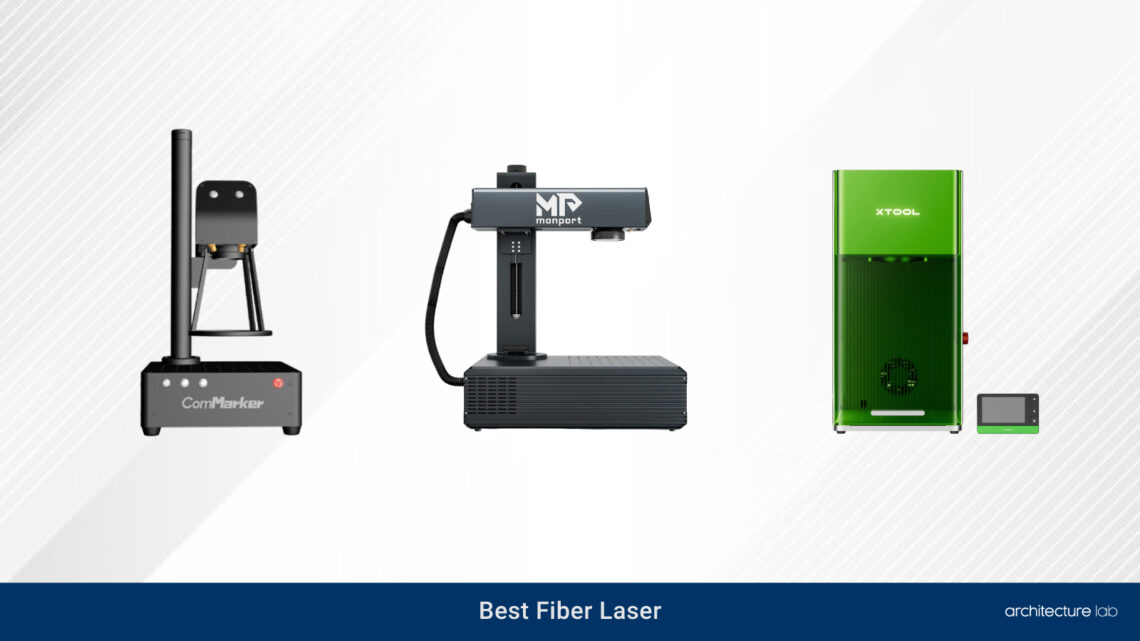
5 Best Fiber Laser Engravers and Cutters for Precision Work