

The most loved mid-century modern chairs are collected here as twenty-three documented designs — designer, date, and current licensed maker for each — ordered roughly by how deeply the world has taken them in. Love, in furniture, leaves evidence: continuous production, museum acquisitions, auction records, and above all copies, since the most loved chair of any era is reliably also the most copied, a law we traced through a century and a half in the most imitated chair in design history. This list applies that law’s discipline: every entry names who actually drew the chair and when, who builds the authentic one today, and — where the record is colorful — what the design survived on its way to icon status.
One honest note before the list, because four of these chairs require it. The mid-century canon is older than the label: the Wassily, the Cesca, the Barcelona, and the Butterfly were drawn between 1925 and 1938, before the era whose name they now carry. They belong on this list anyway, and the reason is the era’s doing — mid-century production made them icons. Knoll put the Barcelona into serial manufacture in 1953; Gavina’s 1962 reissues gave Breuer’s chairs the very names we know them by; the Butterfly conquered American patios in the late 1940s. The chairs were interwar. The love was mid-century.
1. Eames Lounge Chair and Ottoman – Herman Miller, 1956
The Eames Lounge Chair is the era’s reigning throne: three curved plywood shells in rosewood veneer (walnut and other species today), leather cushions, and a five-star aluminum base, introduced by Herman Miller in 1956. Charles and Ray Eames set out to give the club chair the warm, receptive look of a well-used first baseman’s mitt, and the brief survives in every sitting. It is also the most economically consequential design here — the licensed piece runs to five figures while a global replica industry sells the silhouette for a twentieth of that, an economy we dissect factory by factory in our essay on the most imitated chair in design history.
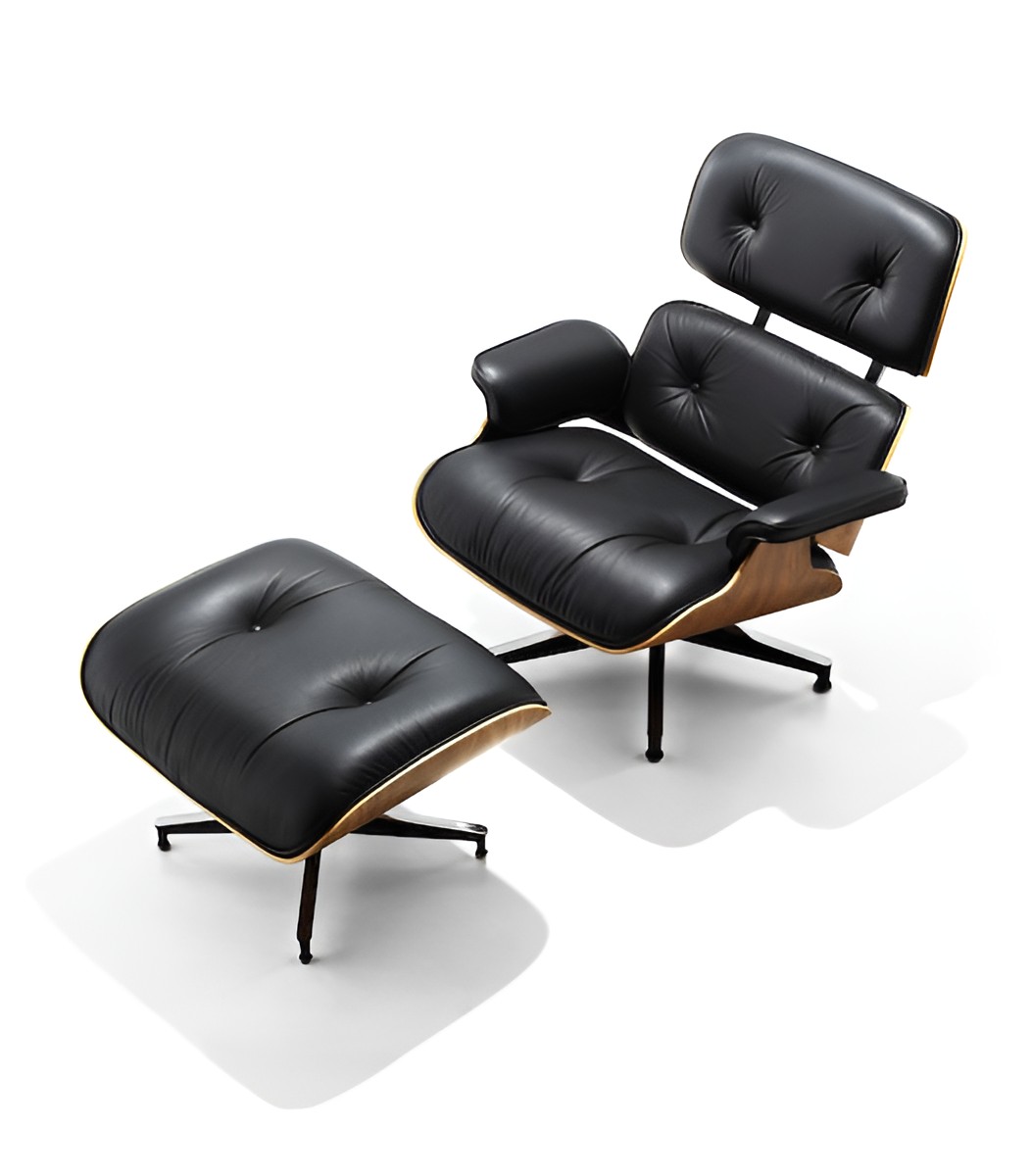
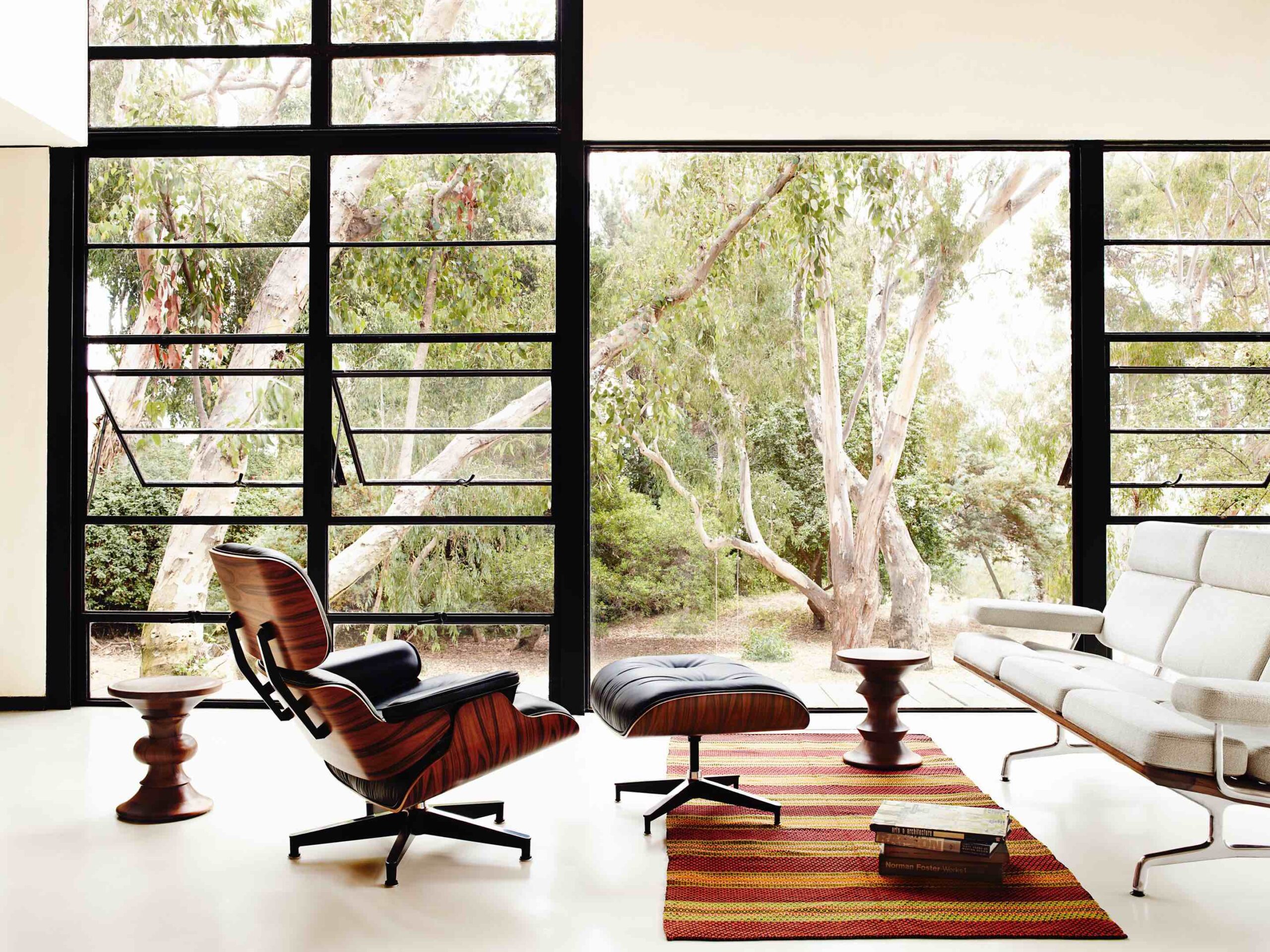
Eames Lounge Chair & Ottoman
Reigning IconDesigner — Charles and Ray Eames for Herman Miller.
Materials — Three molded plywood shells (originally rosewood veneer), leather cushions, five-star aluminum base.
Signature Details
- The club chair rebuilt as three floating shells
- Ottoman designed as an equal, not an accessory
- The largest replica economy of any modern chair
Spotting an Original
- Herman Miller or Vitra medallions and labels
- Shell veneer and cushion construction match era
- Replicas save money in the base castings
Production
1956 onward
Licensed Today
Herman Miller / Vitra
2. Wishbone Chair (CH24) – Hans Wegner, 1949
The Wishbone is the best-selling proof that Danish modern never went out of production: designed by Hans Wegner in 1949, manufactured continuously by Carl Hansen & Søn since 1950. The Y-shaped backrest that names it braces a steam-bent top rail; the seat is roughly 120 meters of paper cord woven by hand. Wegner drew it after studying portraits of Danish merchants seated in Ming chairs, and the East-Asian bone structure is still visible under the Scandinavian skin.
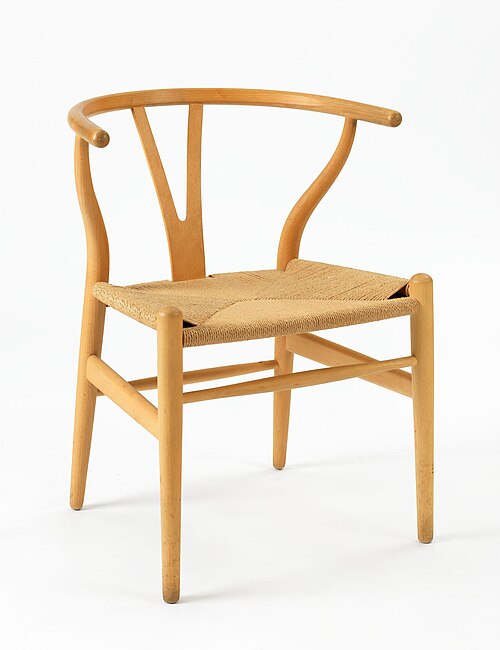
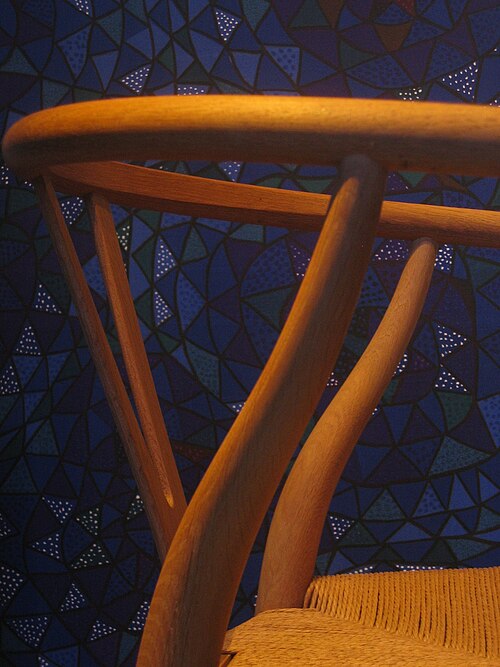
Wishbone Chair (CH24)
Danish Best-SellerDesigner — Hans Wegner for Carl Hansen & Søn, 1949.
Materials — Steam-bent solid wood top rail, Y-back, hand-woven paper-cord seat of roughly 120 meters.
Signature Details
- Ming-chair bone structure under Danish skin
- In continuous production since 1950
- Hand-woven seat on every authentic example
Spotting an Original
- Carl Hansen & Søn markings
- Paper cord, never plastic cord
- Joinery quality at the Y-to-rail junction
Production
1950 onward
Licensed Today
Carl Hansen & Søn
3. Womb Chair – Eero Saarinen, Knoll, 1948
The Womb Chair answered a commission phrased as furniture criticism: Florence Knoll asked Eero Saarinen for a chair she could curl up in, tired of designs that dictated a single upright posture. Saarinen’s reply — a fiberglass shell padded and upholstered into a total enclosure, on slim steel legs — reached production at Knoll in 1948 and named itself. It remains the era’s most explicit argument that comfort is a design material rather than an upholstery afterthought.
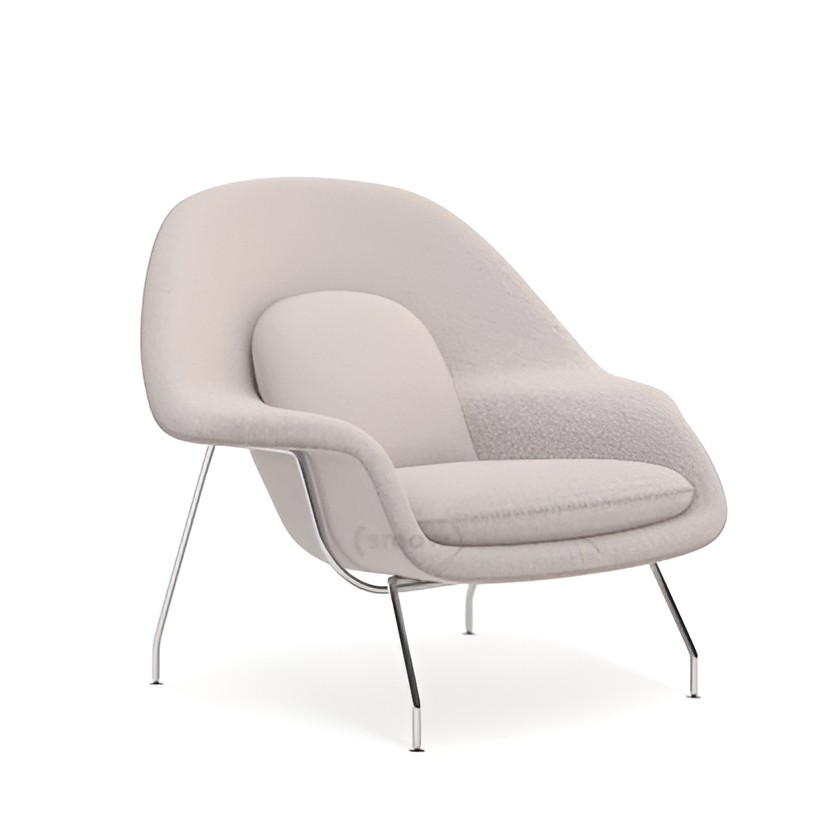
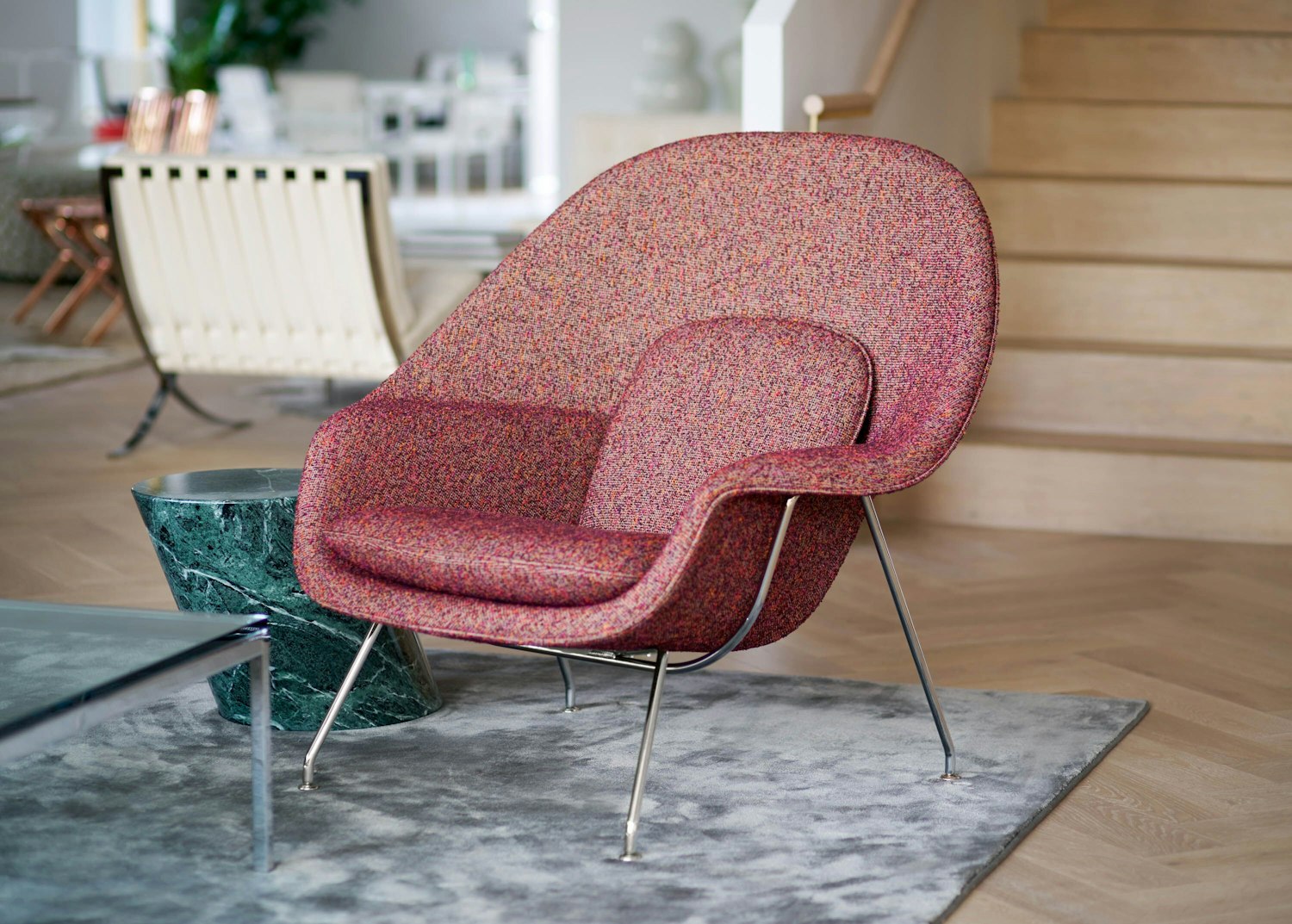
Womb Chair
Comfort as DesignDesigner — Eero Saarinen for Knoll, answering Florence Knoll’s brief.
Materials — Upholstered fiberglass shell, loose seat and back cushions, slim tubular steel legs.
Signature Details
- Total-enclosure sitting posture
- Commissioned as a chair to curl up in
- Named itself on arrival
Spotting an Original
- Knoll labels and provenance
- Shell proportions — replicas run shallow
- Original bases in polished or painted steel
Production
1948 onward
Licensed Today
Knoll
4. Eames Molded Chair – Herman Miller, 1950
The Eames molded chair put a one-piece seat shell under more people than any design on this list: introduced in fiberglass by Herman Miller in 1950 as the first mass-produced plastic chair, offered from the start as a system — one shell, interchangeable bases, wire “Eiffel,” wood dowel, rocker, or stacking legs. The fiberglass originals developed a collector market of their own, identifiable by the visible strand texture in the shell; current production runs in recyclable polypropylene and re-engineered fiberglass.
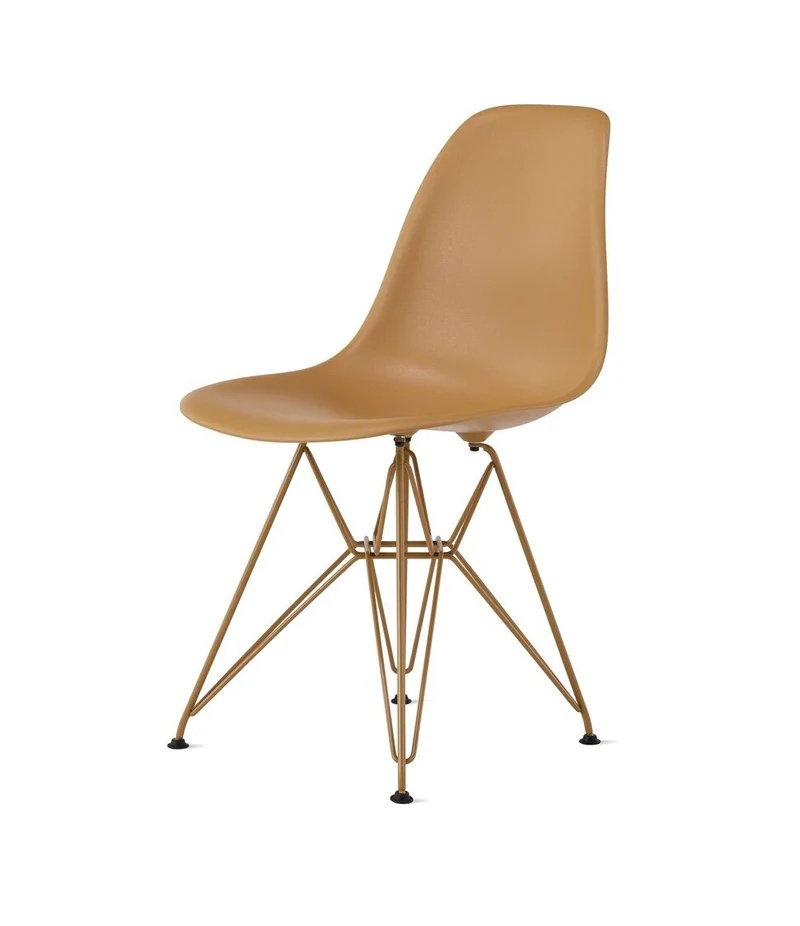
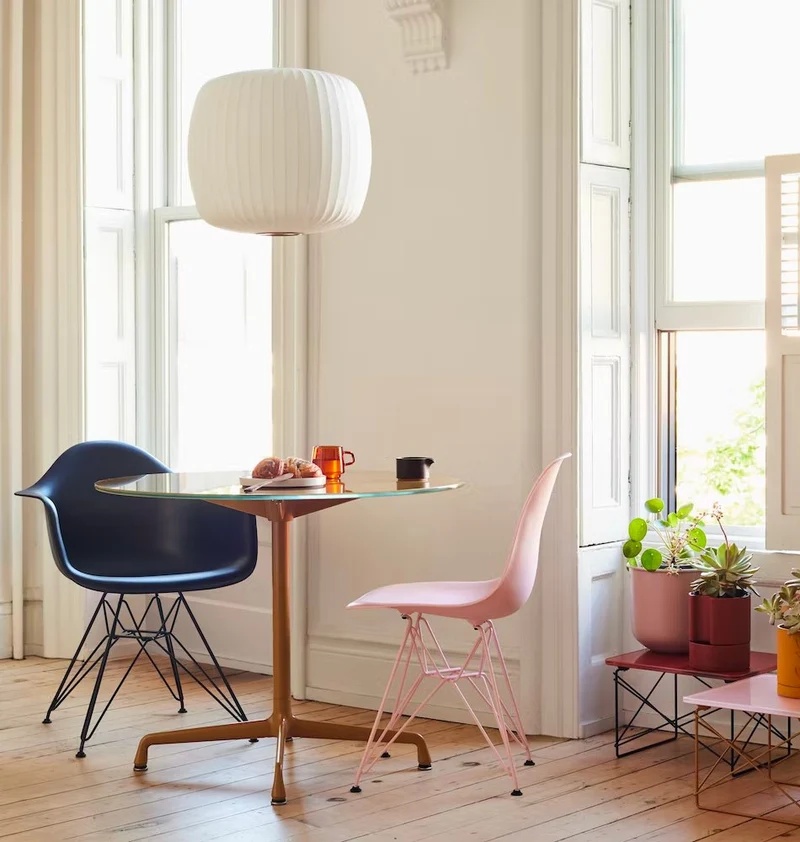
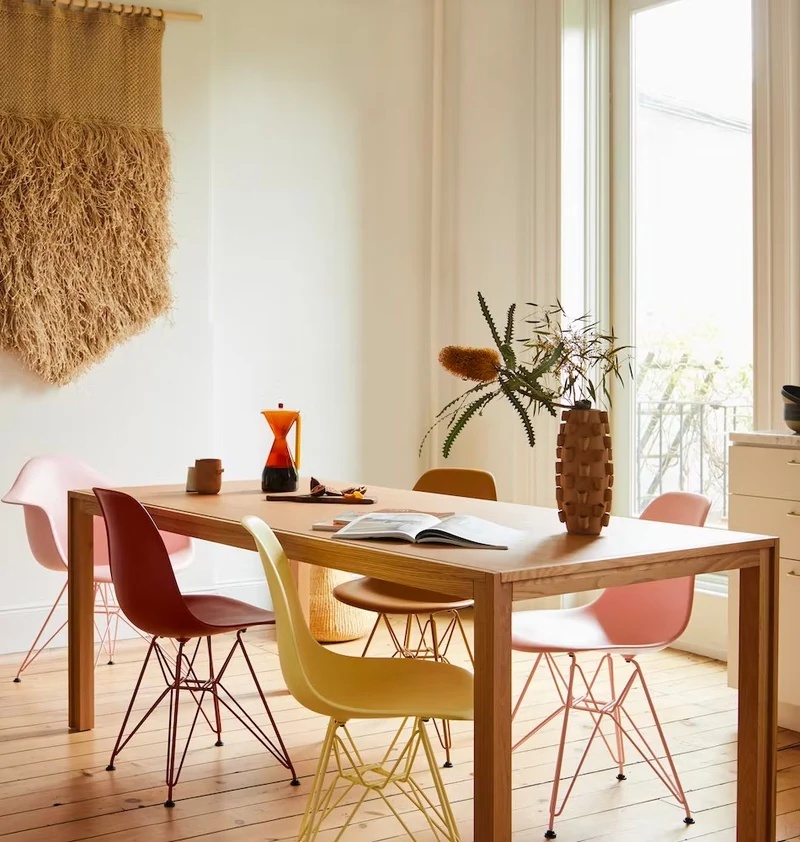
Eames Molded Chair
First Mass-Produced PlasticDesigner — Charles and Ray Eames for Herman Miller.
Materials — One-piece fiberglass shell (now polypropylene and re-engineered fiberglass); interchangeable bases.
Signature Details
- One shell, many bases — Eiffel, dowel, rocker, stacking
- Vintage fiberglass shows visible strand texture
- A system, not a single chair
Spotting an Original
- Herman Miller stamps under the shell
- Strand texture and shell edge finish on vintage
- Base geometry exact on originals
Production
1950 onward
Licensed Today
Herman Miller / Vitra; Modernica fiberglass
5. Barcelona Chair – Mies van der Rohe and Lilly Reich, 1929
The Barcelona Chair predates the era and outranks most of it: designed by Ludwig Mies van der Rohe with Lilly Reich — whose co-authorship the record now properly credits — for the German Pavilion at the 1929 Barcelona International Exposition, where it seated Spanish royalty on chromed steel and pigskin. Knoll placed it in serial production in 1953, which is the year it became mid-century furniture rather than avant-garde scenography. The X-frame is a single welded and hand-polished sculpture; on replicas, the curve is where the money was saved.
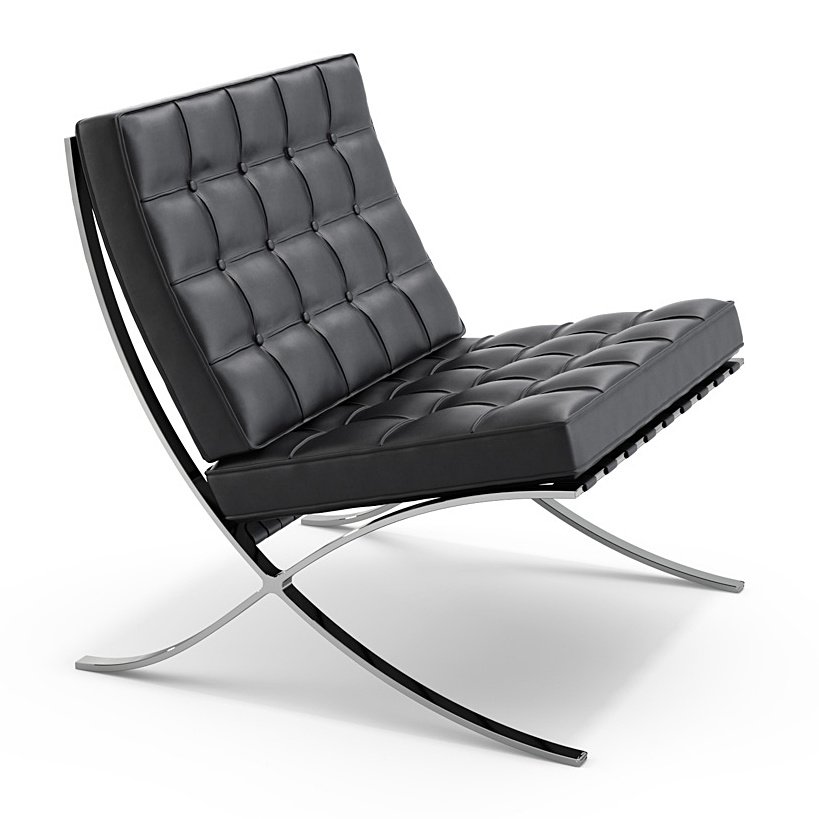
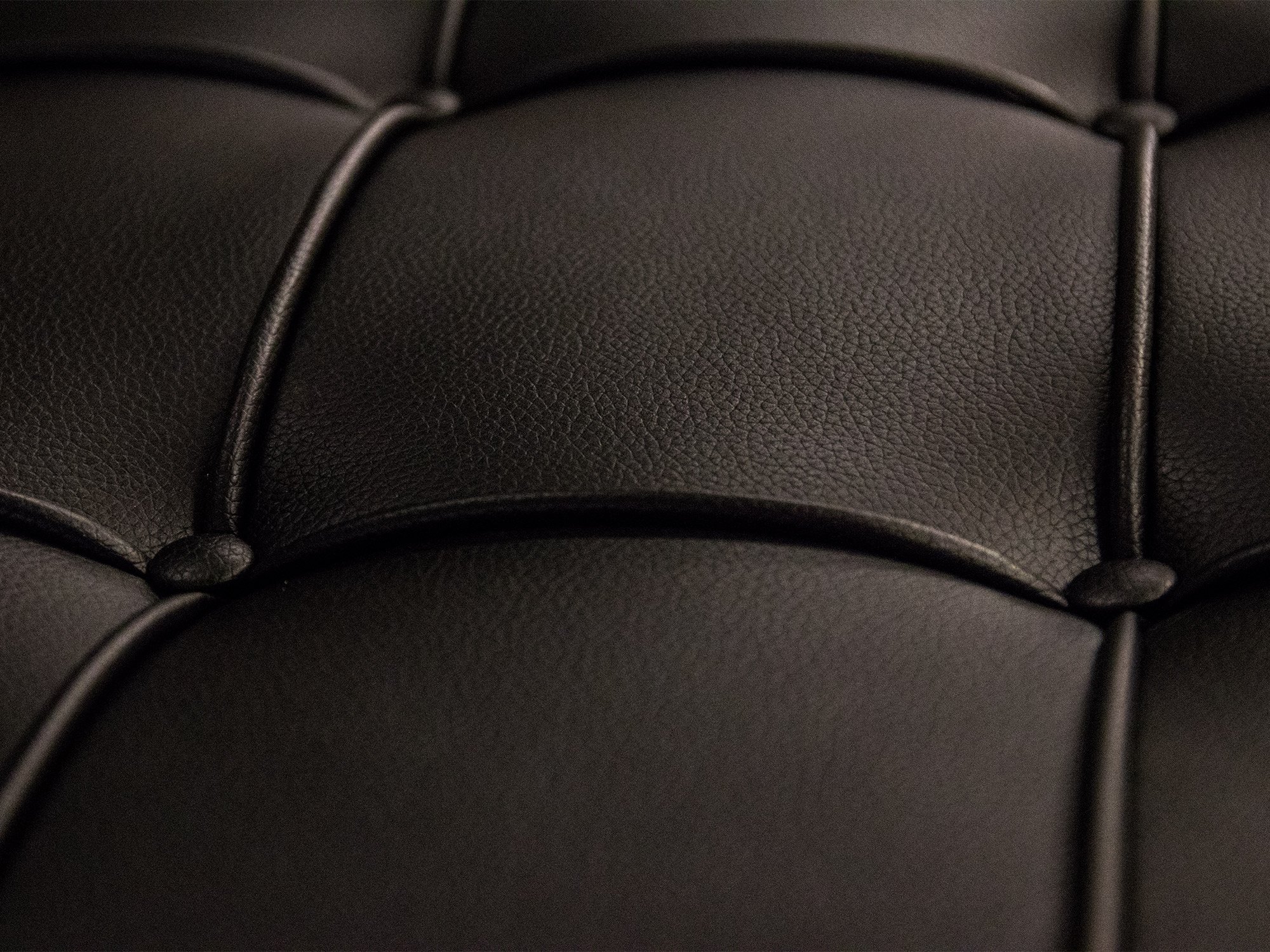
Barcelona Chair
Interwar Design, Mid-Century IconDesigner — Ludwig Mies van der Rohe with Lilly Reich, for the 1929 Barcelona Pavilion.
Materials — Chromed steel X-frame, hand-welded and polished; leather straps and tufted cushions.
Signature Details
- Designed to seat Spanish royalty
- Reich’s co-authorship now properly credited
- Serial production began at Knoll in 1953
Spotting an Original
- Knoll production markings
- The X-curve is one polished sculpture — replicas seam it
- Leather strap and welt construction
Production
1929 design; Knoll from 1953
Licensed Today
Knoll
6. Egg Chair – Arne Jacobsen, Fritz Hansen, 1958
The Egg is architecture at chair scale: Arne Jacobsen sculpted it in 1958 for the SAS Royal Hotel in Copenhagen, the building he designed down to the doorknobs, and the foam-over-shell technique he used — clay models refined in his garage, then a molded shell upholstered without seam interruptions — created the free-form silhouette the lobby needed against its glass grid. A tilting mechanism and swivel base made a private room out of a public seat.
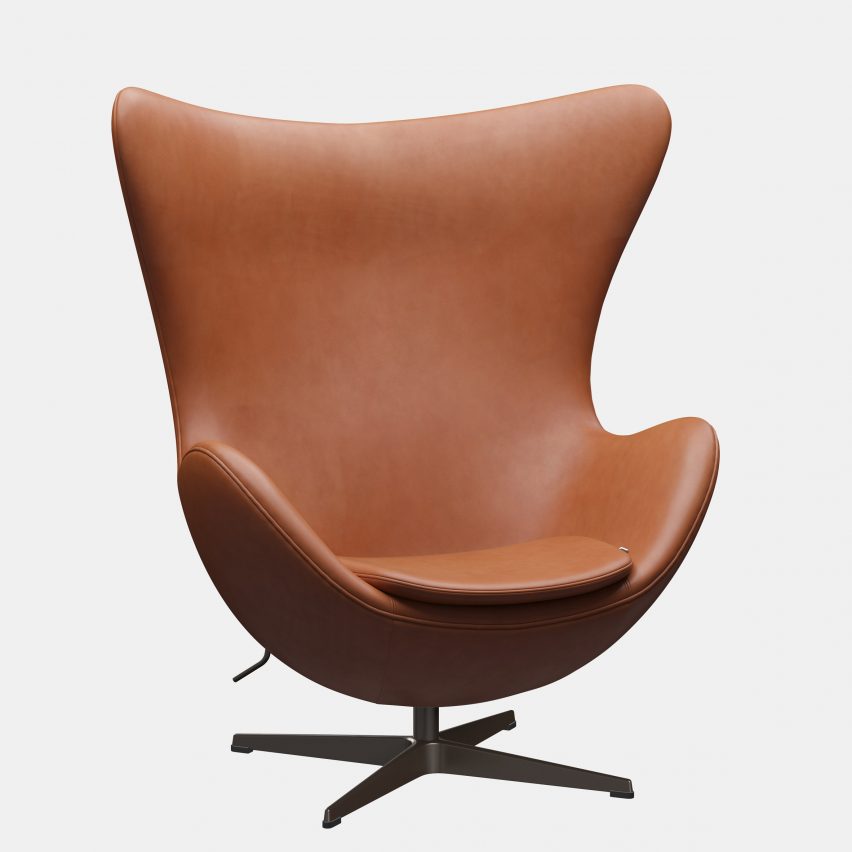
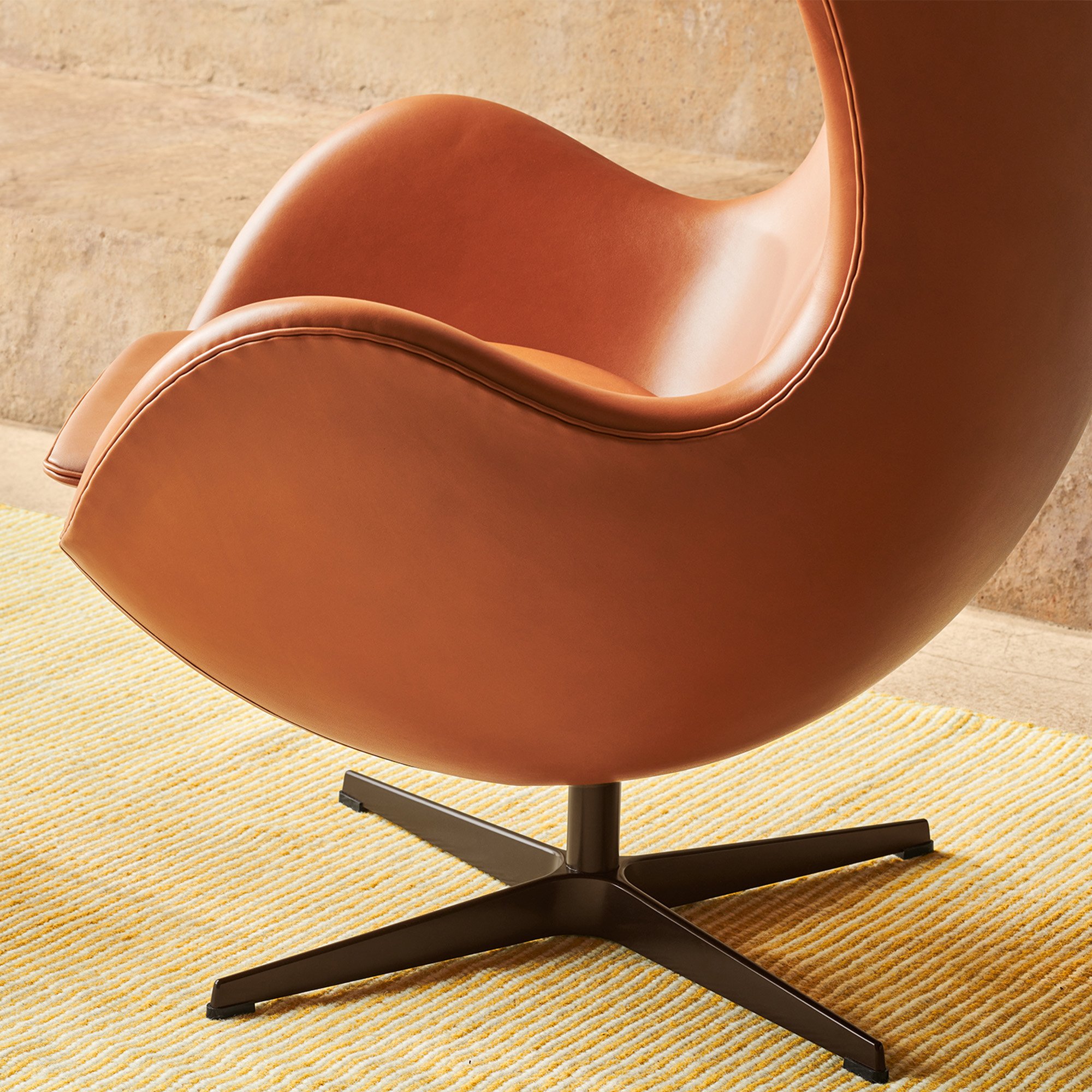
Egg Chair
Architecture at Chair ScaleDesigner — Arne Jacobsen, for the SAS Royal Hotel, Copenhagen.
Materials — Molded shell under seam-minimal upholstery, foam-sculpted form, tilting swivel base.
Signature Details
- Sculpted in clay in Jacobsen’s garage
- A private room inside a public lobby
- Part of a building designed to the doorknobs
Spotting an Original
- Fritz Hansen markings and serial history
- Upholstery seams — originals minimize them
- Tilt mechanism construction
Production
1958 onward
Licensed Today
Fritz Hansen
7. Tulip Chair – Eero Saarinen, Knoll, 1956
The Tulip Chair is a demolition presented as furniture: Saarinen wanted to clear what he called the “slum of legs” beneath tables and chairs, and answered with a single cast-aluminum pedestal under a molded fiberglass shell, introduced by Knoll in 1956 within the Pedestal Collection. The stem is aluminum finished to match the shell because the one-material chair Saarinen actually wanted was beyond 1950s plastics — an honest compromise the design wears invisibly.
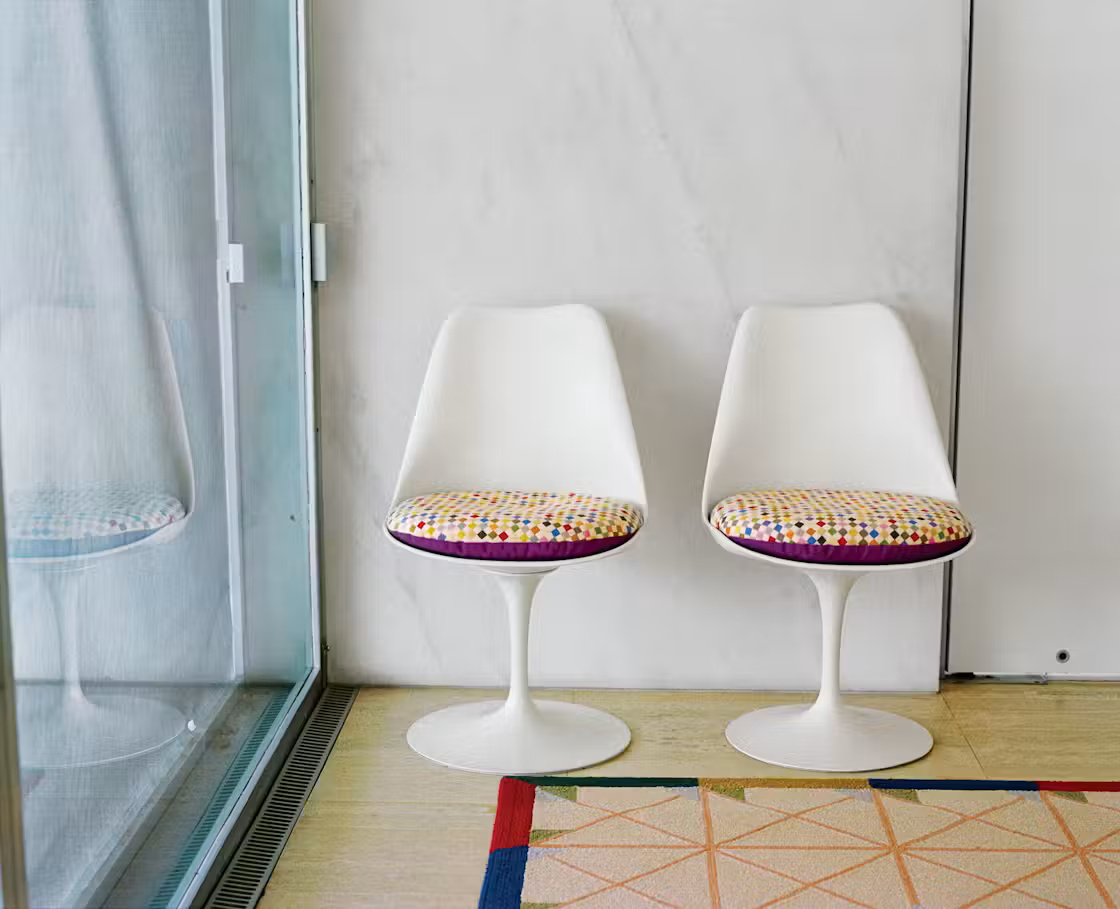
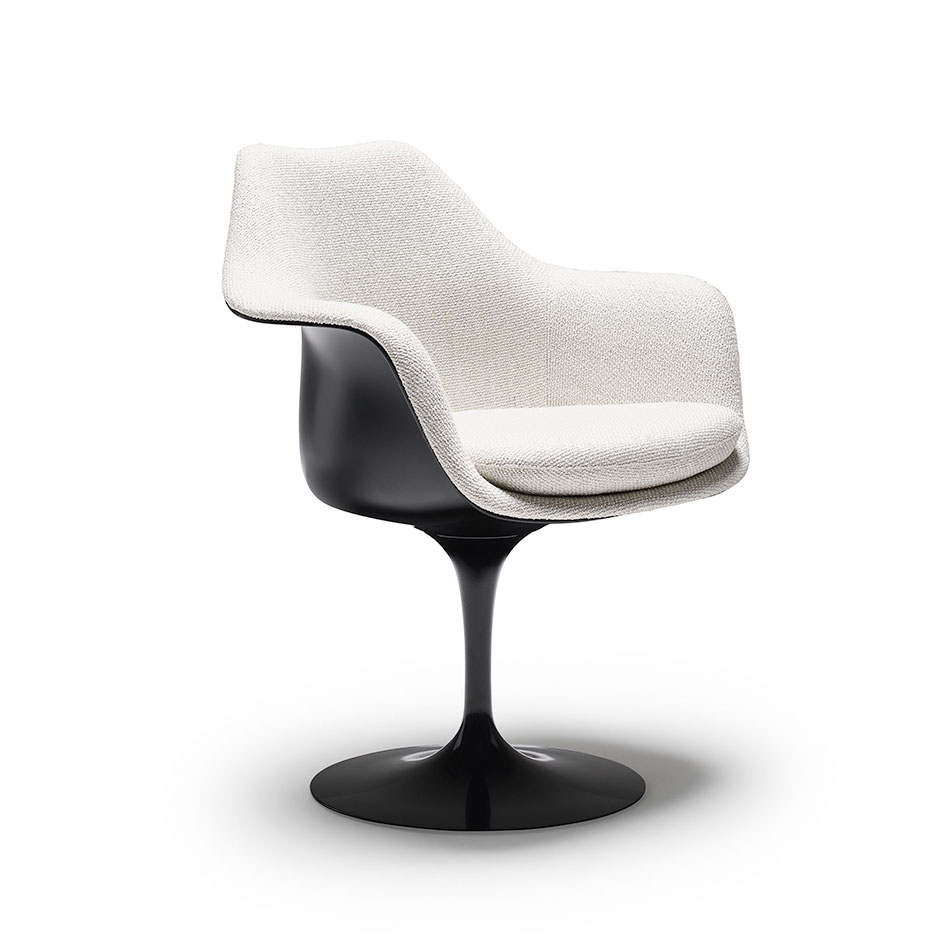
Tulip Chair
The Slum of Legs, ClearedDesigner — Eero Saarinen for Knoll, Pedestal Collection.
Materials — Molded fiberglass shell on a single cast-aluminum pedestal finished to match.
Signature Details
- One stem where four legs stood
- Aluminum base painted to read as one material
- The Pedestal Collection’s signature seat
Spotting an Original
- Knoll labels
- Cast-aluminum base — replicas often use lighter alloys
- Shell-to-stem junction finish
Production
1956 onward
Licensed Today
Knoll
8. Swan Chair – Arne Jacobsen, Fritz Hansen, 1958
The Swan is the Egg’s traveling companion, designed the same year for the same hotel: a smaller shell with wing-spread arms on a swivel base, no straight lines anywhere in the body. Where the Egg builds a room, the Swan furnishes one — it scaled from the SAS lobby into decades of reception rooms precisely because it holds its sculptural line at conversational size.
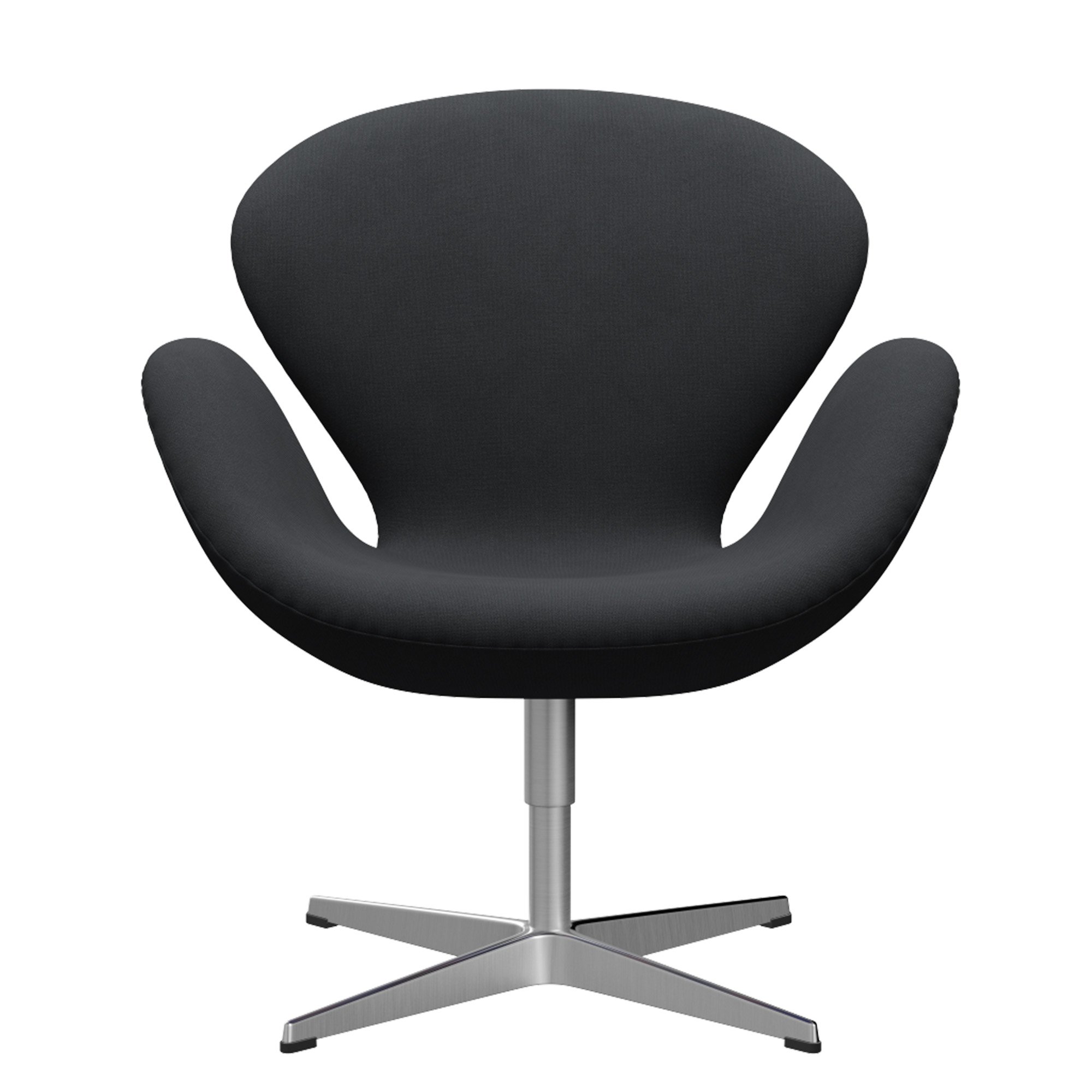
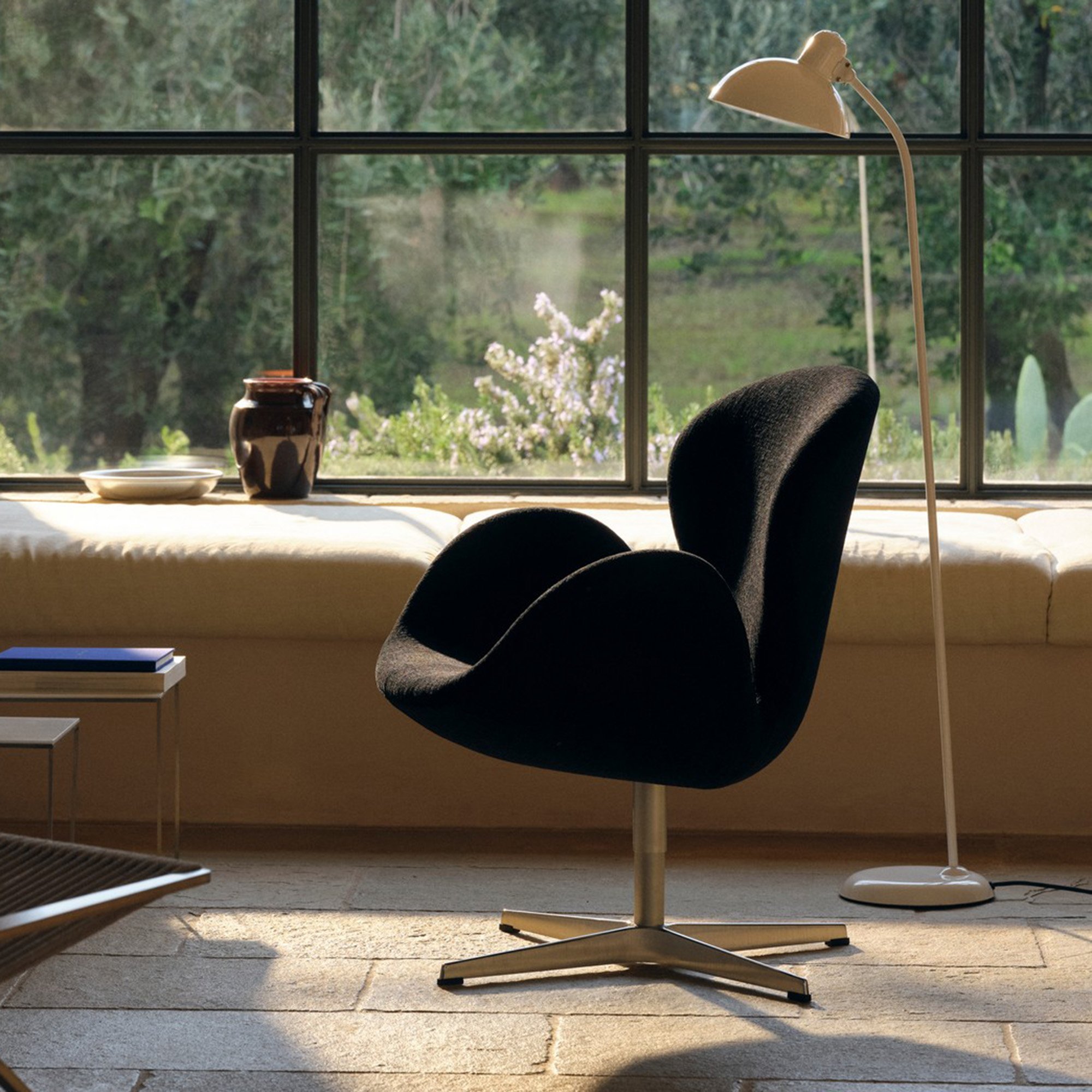
Swan Chair
The Egg’s CompanionDesigner — Arne Jacobsen, for the SAS Royal Hotel.
Materials — Molded shell with wing-spread arms, full upholstery, swivel base; no straight lines in the body.
Signature Details
- Same hotel, same year, conversational scale
- Curvature continuous through arms and back
- Scaled for rooms, not lobbies
Spotting an Original
- Fritz Hansen markings
- Shell curvature — copies flatten the wings
- Base and swivel quality
Production
1958 onward
Licensed Today
Fritz Hansen
9. Panton Chair – Verner Panton, Vitra, 1967
The Panton Chair is the single-form ideal made real: conceived by Verner Panton in 1959 and developed with Vitra until serial production began in 1967, it was the first all-plastic chair molded in one piece with a cantilever. Its afterlife is a pop-culture archive — a Nova magazine shoot in 1970, Kate Moss on the cover of British Vogue in 1995 — and its material history is a lesson in patience: only in 1999 did plastics catch up with the chair Panton had drawn forty years earlier. The one-piece plastic lineage it opened runs straight to the anonymous seat we followed in the story of the monobloc chair.
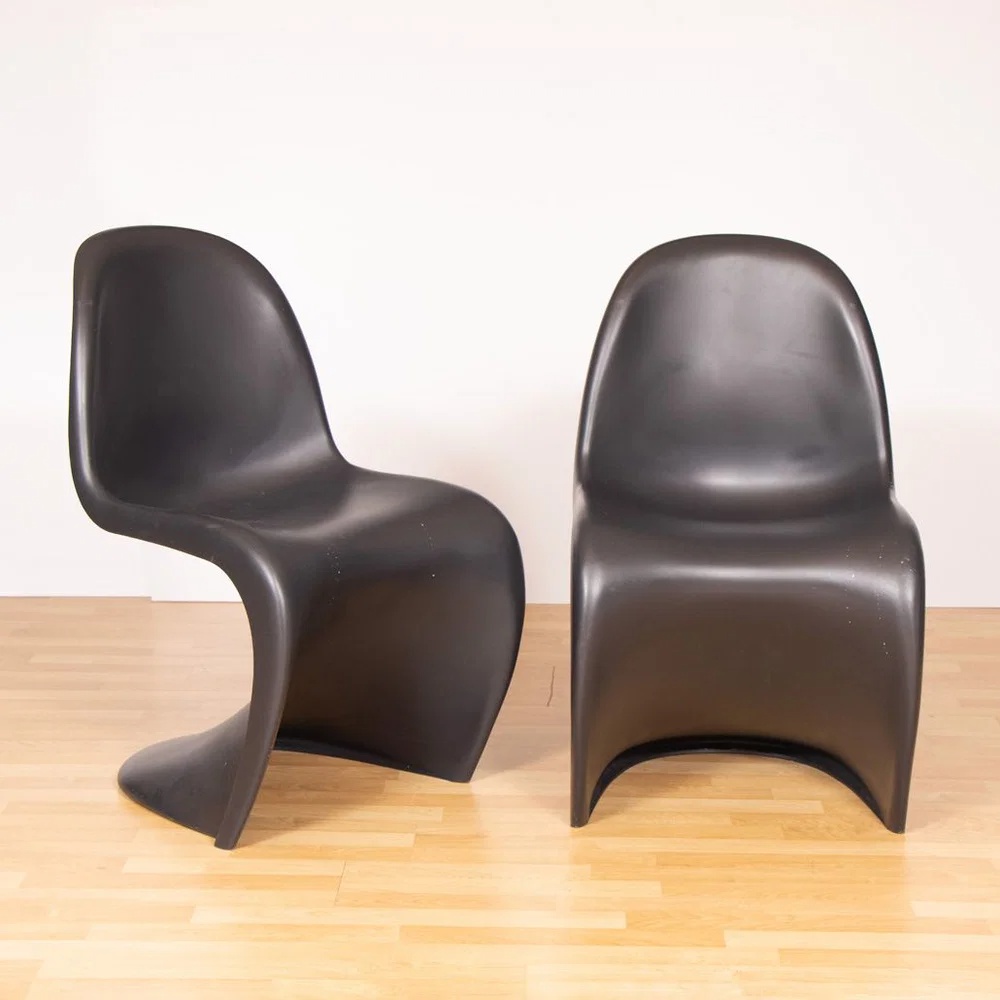
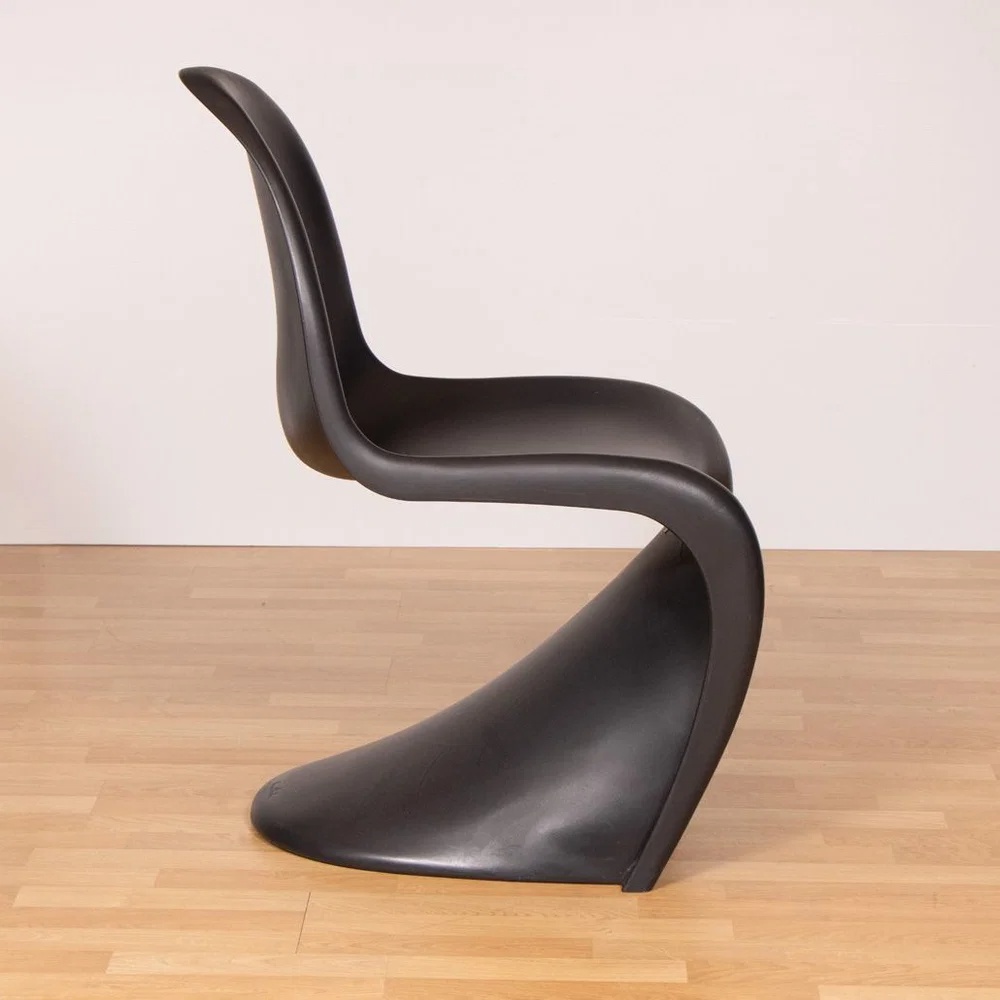
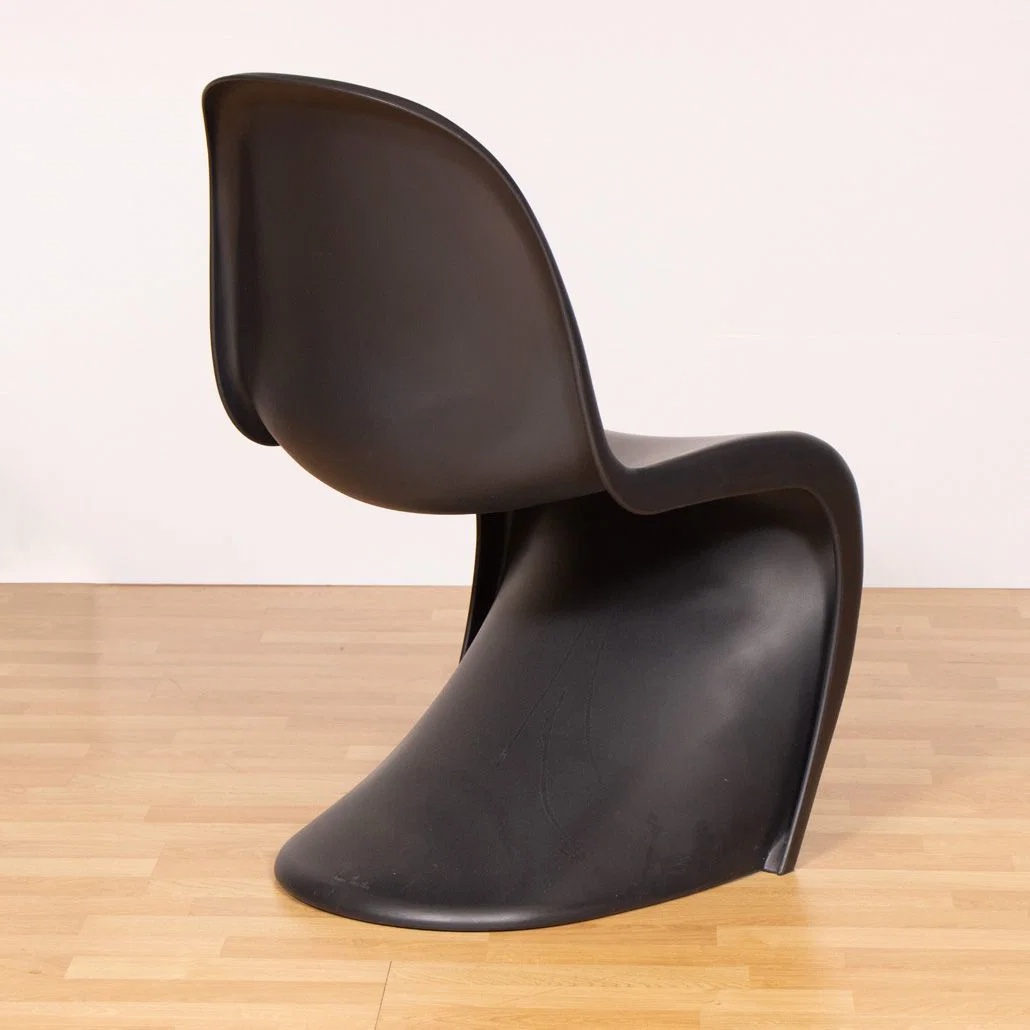
Panton Chair
First One-Piece Plastic CantileverDesigner — Verner Panton, developed with Vitra.
Materials — Single-piece molded plastic; dyed-through polypropylene since 1999.
Signature Details
- Conceived 1959, achievable only by 1967
- Cantilever comfort from material flex
- Kate Moss, Vogue cover, 1995
Spotting an Original
- Vitra markings and production-phase details
- Material generation identifies the era
- Knockoffs crack at the cantilever knee
Production
1967 onward
Licensed Today
Vitra
10. Series 7 Chair – Arne Jacobsen, Fritz Hansen, 1955
The Series 7 is the best-selling chair in Danish history: Jacobsen’s 1955 refinement of molded plywood into a waisted one-piece shell on steel legs, stackable, light, and produced by Fritz Hansen in the millions. It also owns the era’s most famous photographic cameo with an asterisk — the 1963 Lewis Morley portrait of Christine Keeler was staged on a copy, not an original, which makes the most reproduced image of the chair a reproduction twice over.
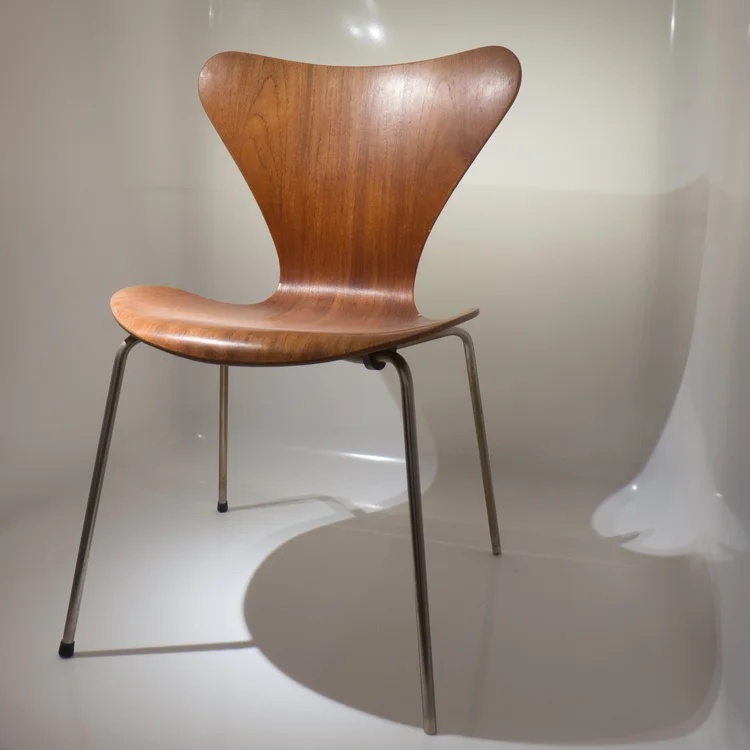
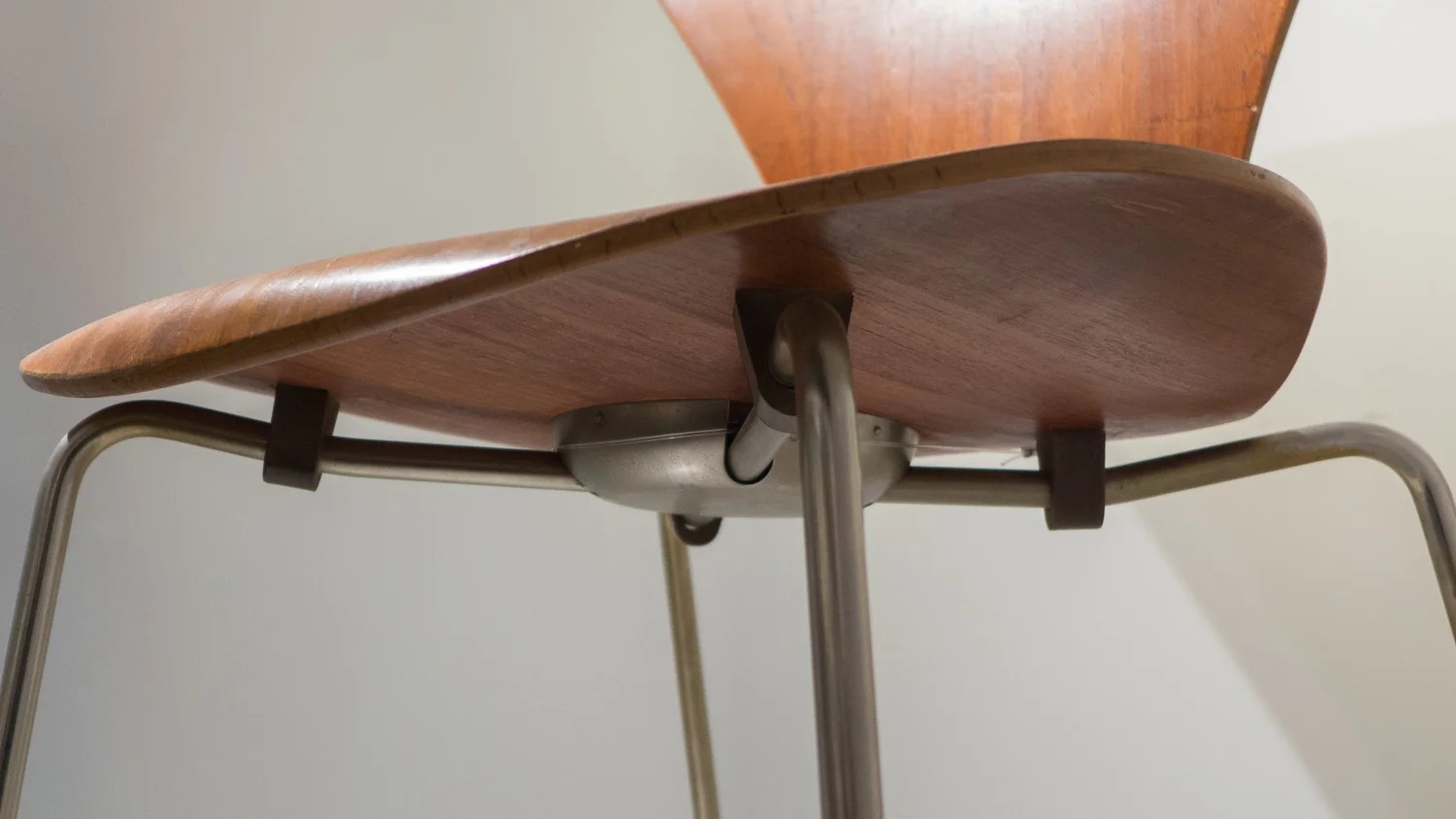
Series 7 Chair
Best-Selling Danish ChairDesigner — Arne Jacobsen for Fritz Hansen.
Materials — One-piece waisted molded plywood shell on tubular steel legs; stackable.
Signature Details
- Produced in the millions
- The 1963 Keeler portrait used a copy
- Jacobsen’s plywood refinement at its peak
Spotting an Original
- Fritz Hansen markings under the seat
- Shell waist proportions
- Lamination quality at the shell edge
Production
1955 onward
Licensed Today
Fritz Hansen
11. Wassily Chair – Marcel Breuer, 1925
The Wassily Chair brought the bicycle into the living room: Marcel Breuer, then a twenty-three-year-old master at the Bauhaus, bent nickeled tubular steel into a floating frame strung with fabric strips in 1925, reportedly inspired by the handlebars of his Adler bicycle. The name arrived decades later — Gavina’s 1962 reissue christened it after Wassily Kandinsky, Breuer’s Bauhaus colleague who had admired the prototype — and Knoll’s 1968 acquisition of Gavina carried the chair, name and all, into its permanent catalog.
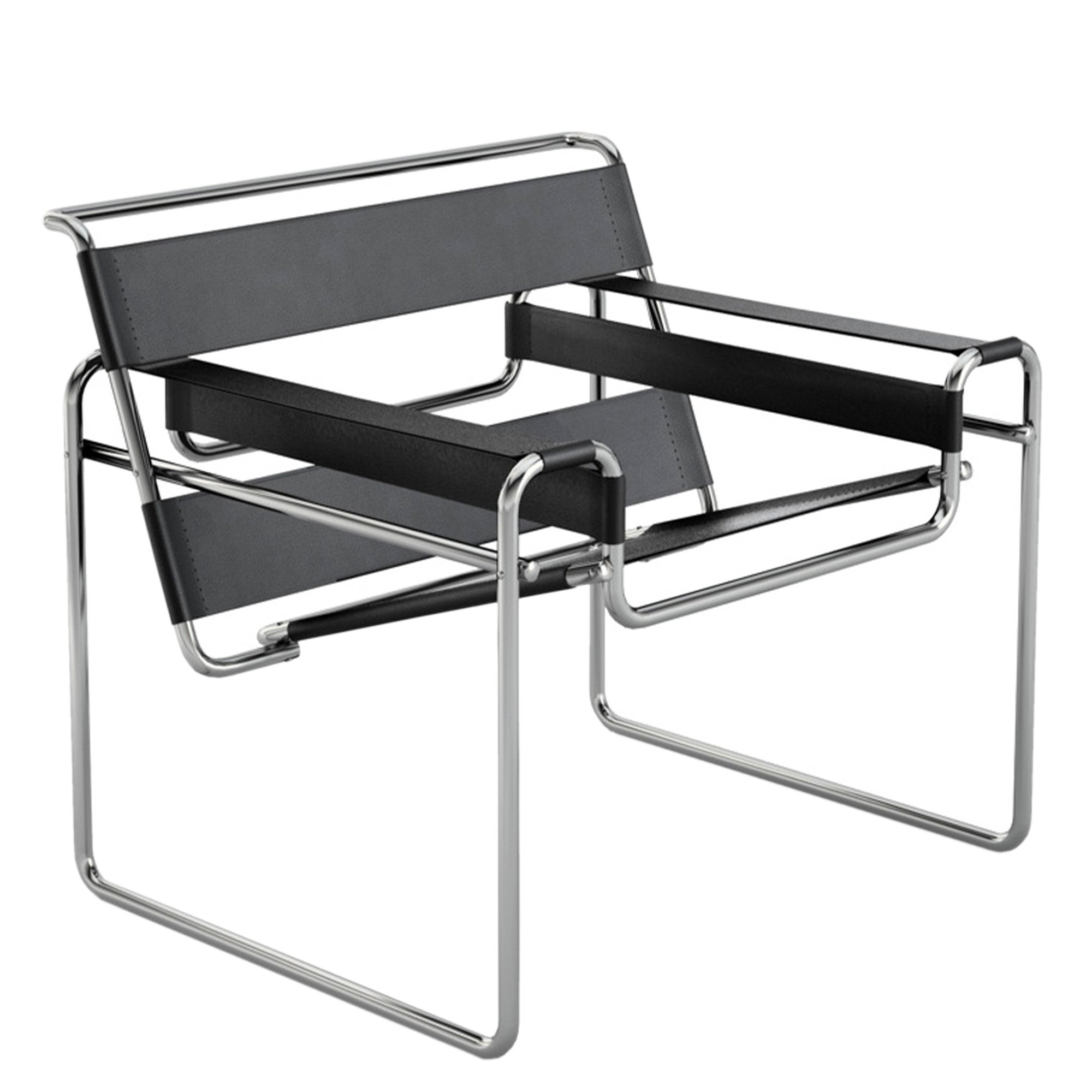
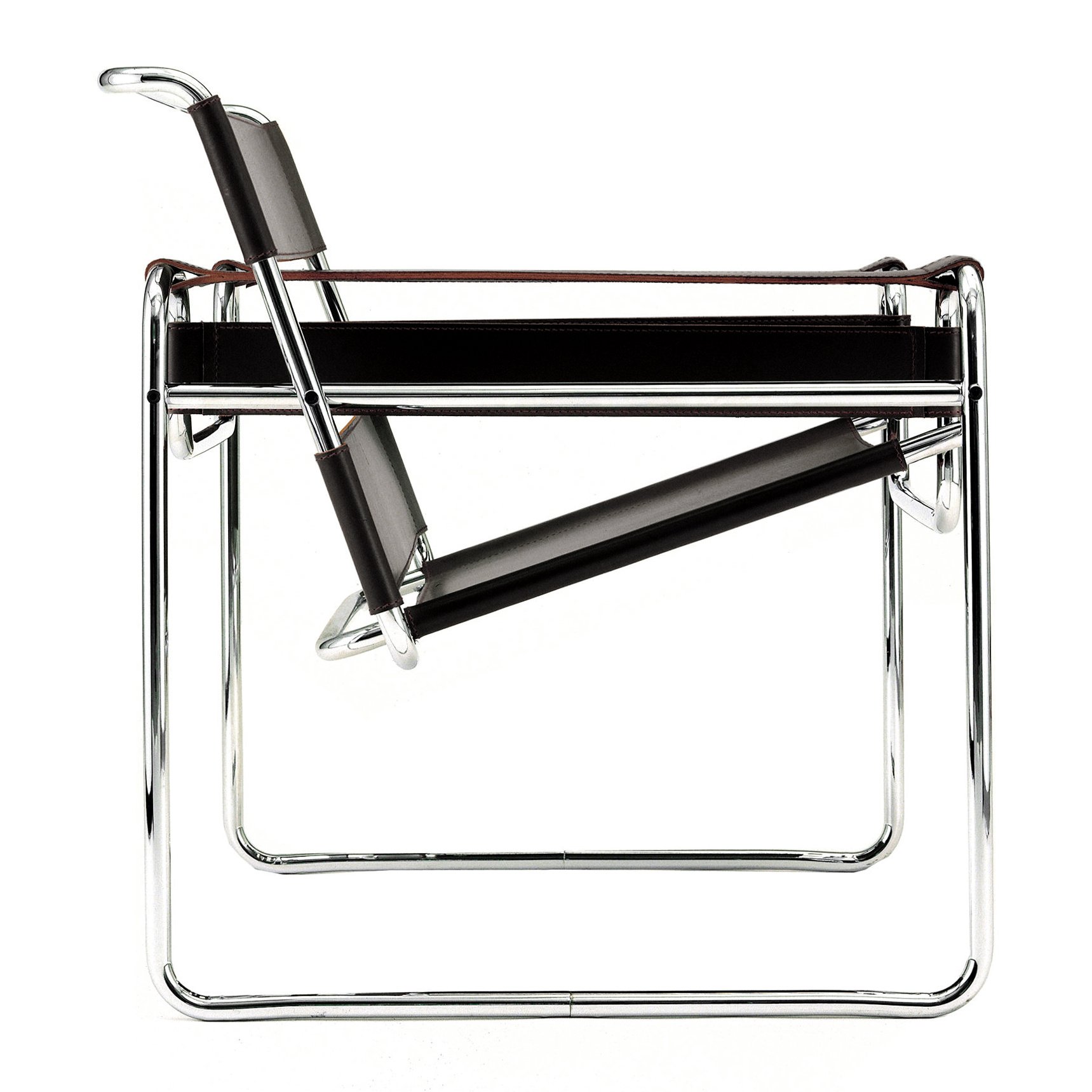
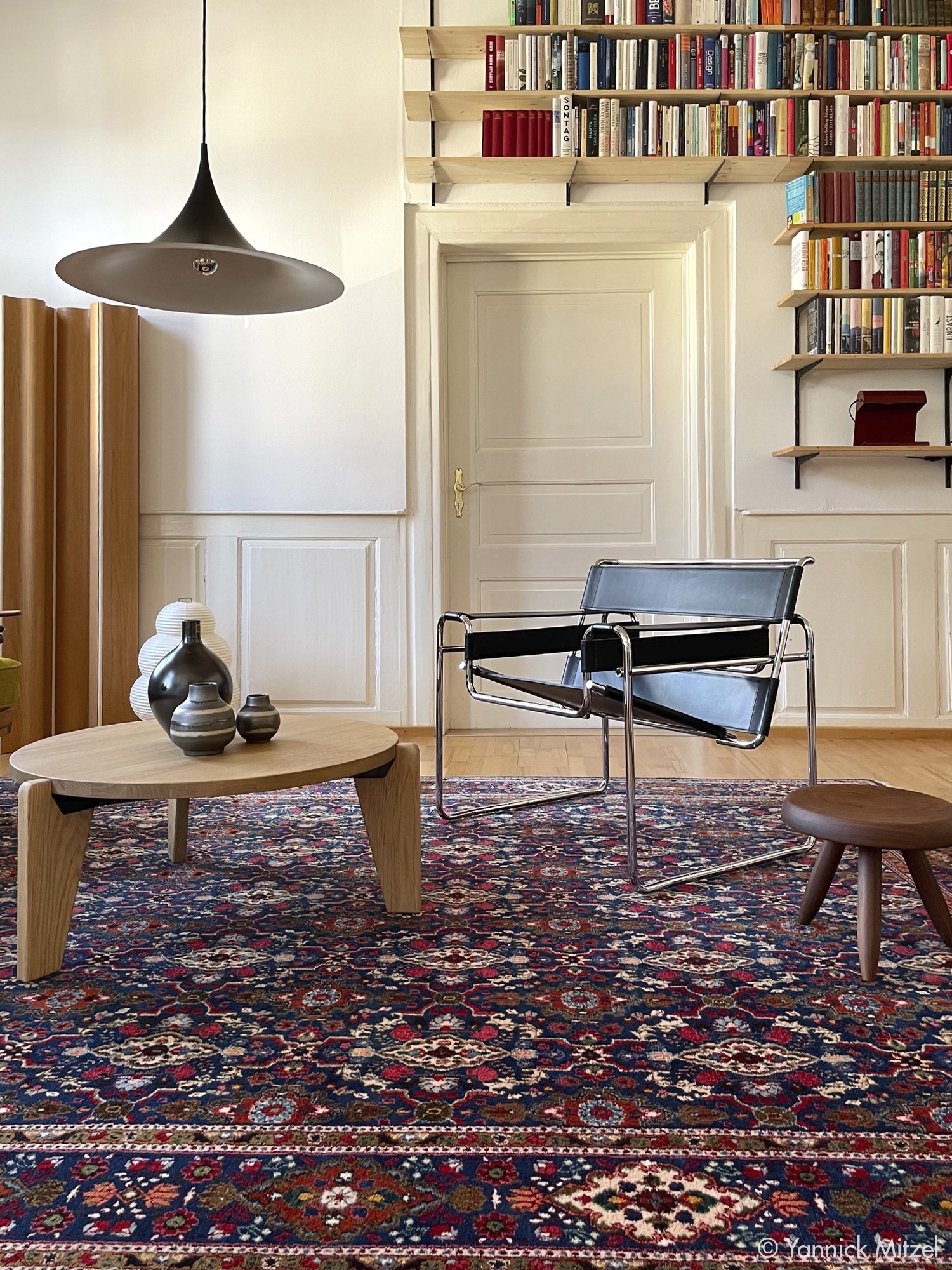
Wassily Chair
Bauhaus Origin, Gavina NameDesigner — Marcel Breuer, at the Bauhaus, 1925.
Materials — Bent nickeled (now chromed) tubular steel frame; strap seat, back, and arms.
Signature Details
- Inspired by his Adler bicycle’s handlebars
- Named for Kandinsky in Gavina’s 1962 reissue
- Knoll absorbed Gavina — and the name — in 1968
Spotting an Original
- Knoll production documentation
- Tube bends and welds — originals flow
- Strap material and tensioning
Production
1925 design; reissued 1962; Knoll from 1968
Licensed Today
Knoll
12. Cesca Chair – Marcel Breuer, 1928
The Cesca is the cantilever that conquered the dining room: Breuer’s 1928 combination of a tubular steel frame with a beech-and-cane seat and back, softening industrial structure with handcraft in a way the all-steel cantilevers never managed. It shares the Wassily’s naming history — Gavina’s 1962 reissue named it for Breuer’s daughter Francesca — and it shares a production lineage with this site’s oldest obsession: the caned seats descend from the bentwood-and-cane trade Thonet built, and Thonet itself has produced Breuer’s cantilevers for decades alongside Knoll’s Cesca.
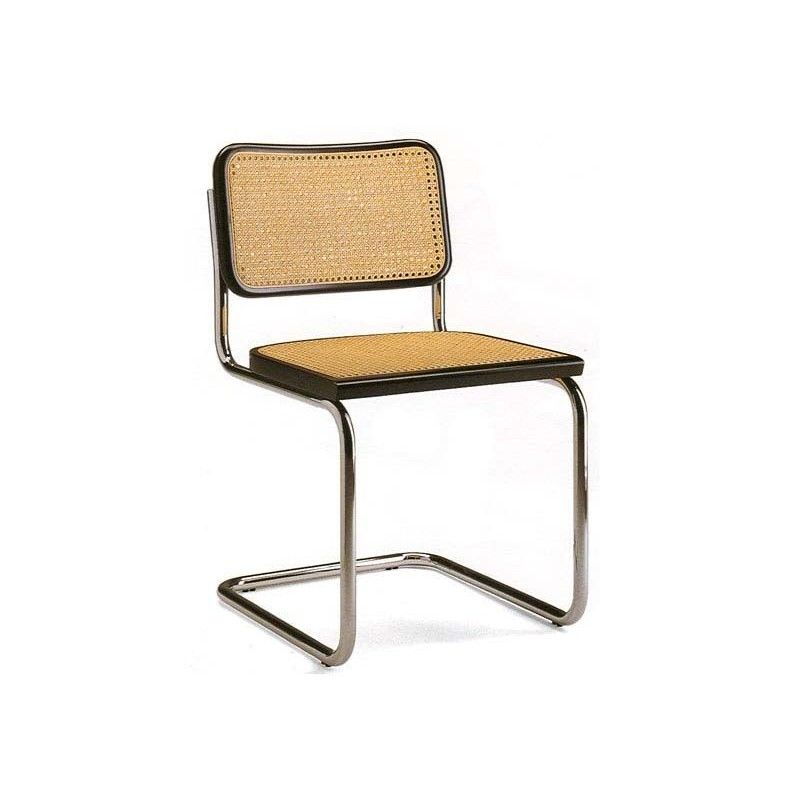
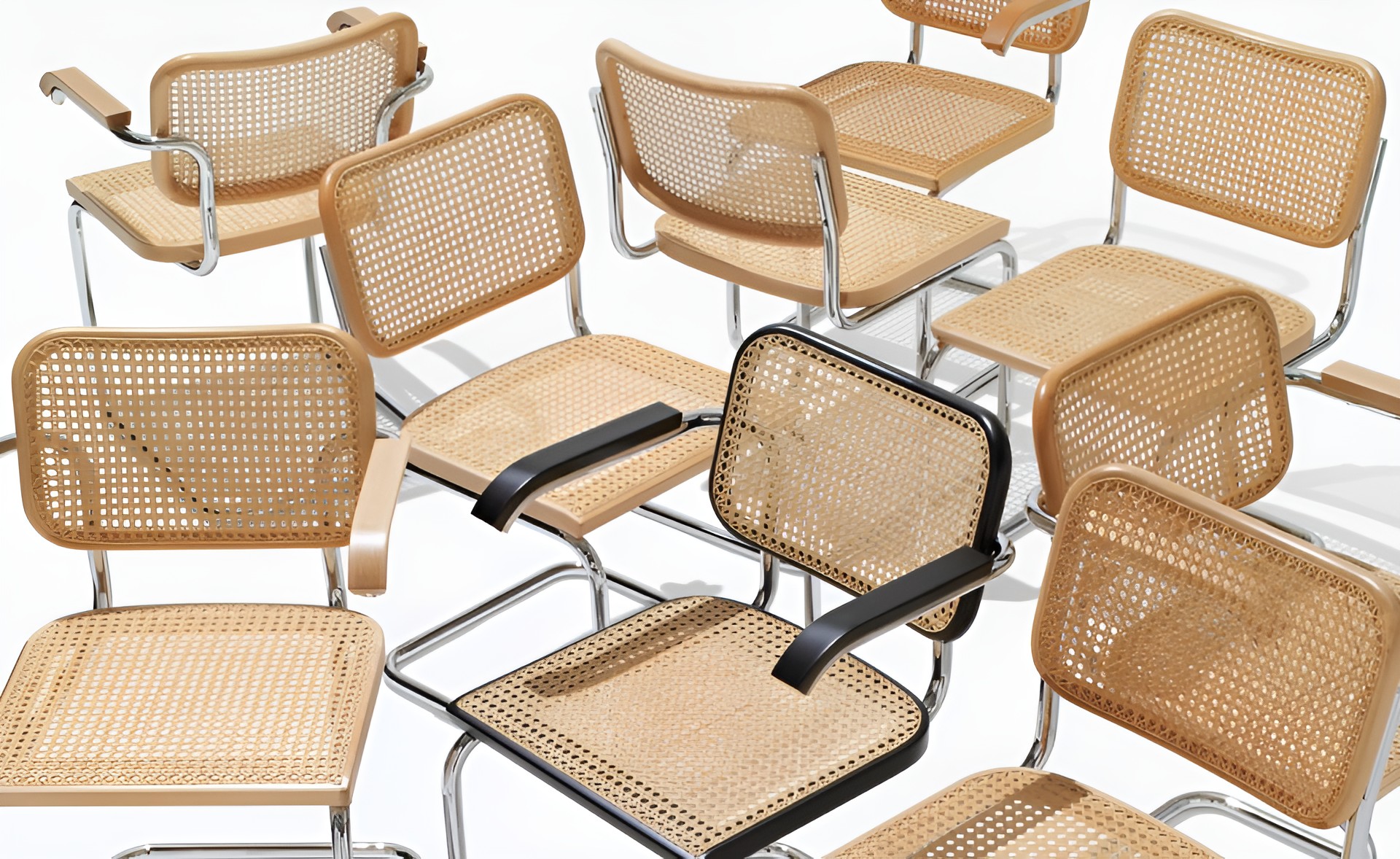
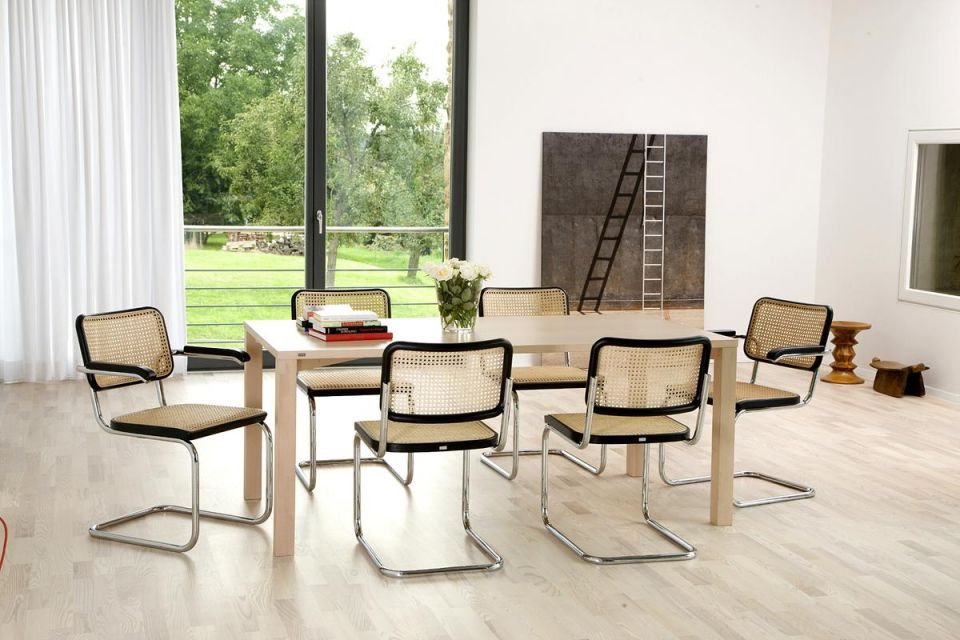
Cesca Chair
The Cantilever at DinnerDesigner — Marcel Breuer, 1928; named for his daughter Francesca in 1962.
Materials — Tubular steel cantilever with beech frame and hand-caned seat and back.
Signature Details
- Steel structure softened by handcraft
- Caning descends from the Thonet trade
- Continuous production across two licensed houses
Spotting an Original
- Knoll or Thonet (S 32/S 64) markings
- Hand caning versus machine sheets
- Cantilever ride — copies sit dead
Production
1928 design; continuous
Licensed Today
Knoll; Thonet
13. Bertoia Diamond Chair – Knoll, 1952
The Diamond Chair is drawing in the air: Harry Bertoia, sculptor first and designer by invitation, bent welded steel wire into a lattice seat for Knoll in 1952 and described the result as chairs mostly made of air, like sculpture. The seat’s comfort surprises skeptics — the wire grid flexes — and the optional pad answers the rest. Bertoia’s royalties from the wire collection funded the rest of his life as a sculptor, which may be the happiest designer-manufacturer story on this list.
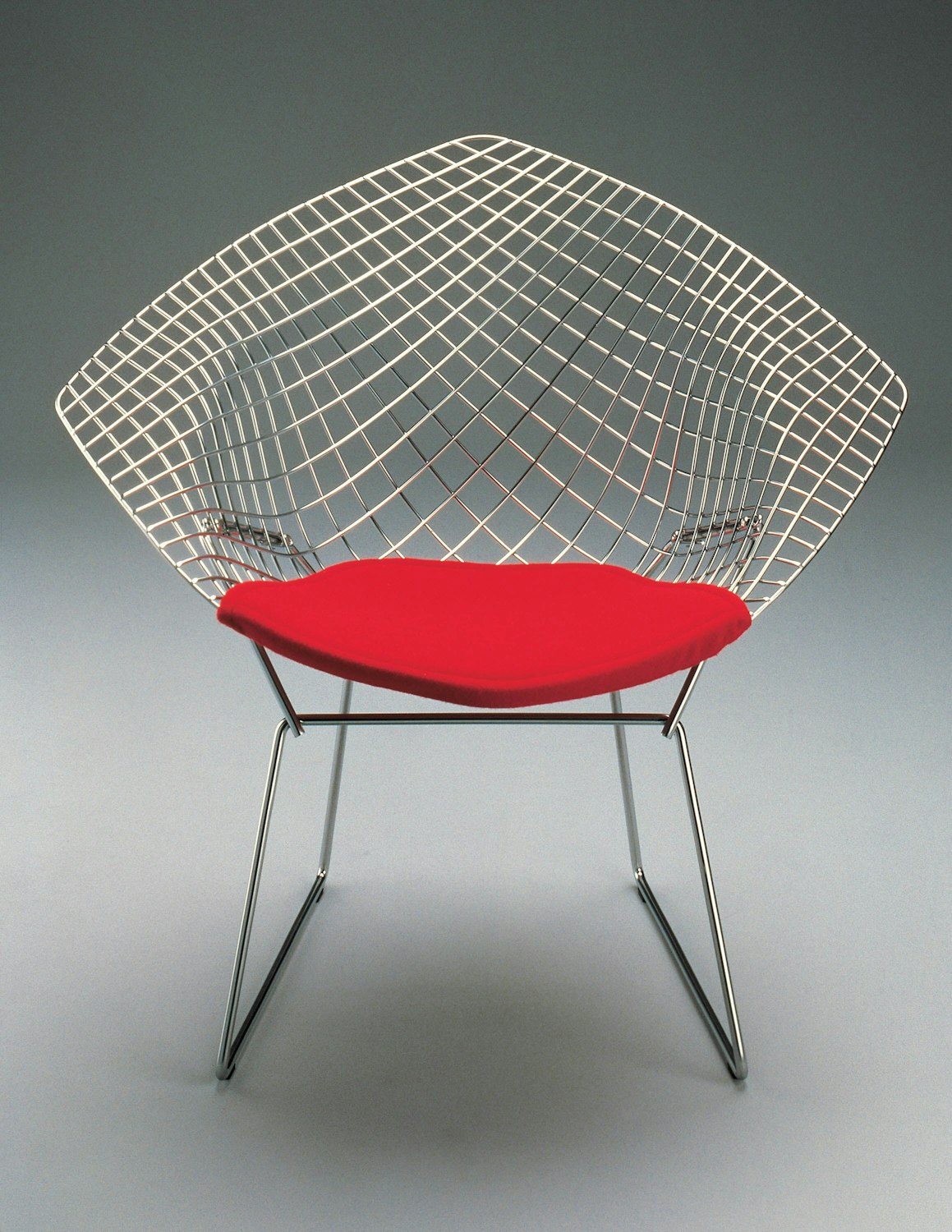

Bertoia Diamond Chair
Sculpture Mostly of AirDesigner — Harry Bertoia for Knoll.
Materials — Welded steel wire lattice, chrome or coated; optional seat pad.
Signature Details
- A sculptor’s single furniture masterwork
- The wire grid flexes — comfort surprises
- Royalties funded Bertoia’s art career
Spotting an Original
- Knoll markings
- Weld count and cleanliness at every intersection
- Wire gauge — replicas run thin
Production
1952 onward
Licensed Today
Knoll
14. Butterfly Chair (BKF) – Bonet, Kurchan and Ferrari Hardoy, 1938
The Butterfly is the most copied chair on a list defined by copying: designed in Buenos Aires in 1938 by Antonio Bonet, Juan Kurchan, and Jorge Ferrari Hardoy — three architects out of Le Corbusier’s studio — as a steel frame with a leather sling, its first two American examples going to Fallingwater and to MoMA. Knoll took US rights in 1947, sued the imitators, lost, and dropped the chair in 1951; an estimated five million copies followed in the 1950s alone, while Ferrari Hardoy tallied the designers’ royalties at eleven dollars and thirty-seven cents. The design became a public good the way the Monobloc did — by force. Authentic production today: artisanal makers in Buenos Aires continue the original leatherwork; no exclusive license survives.
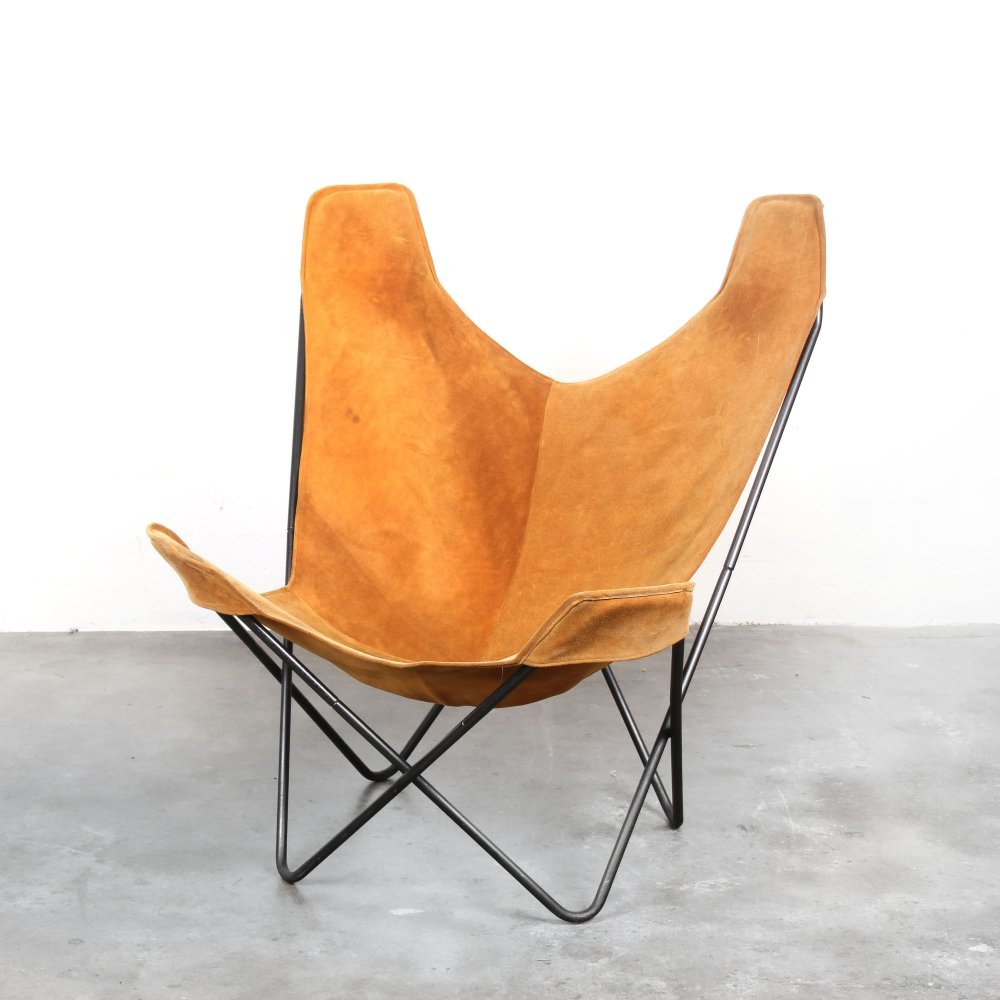
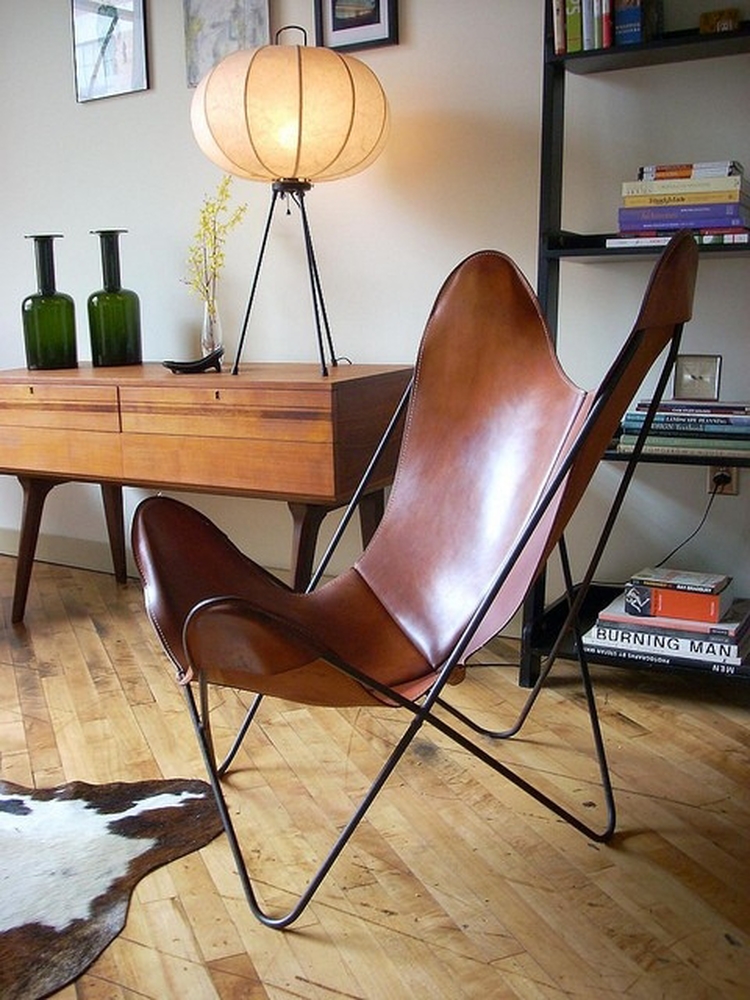
Butterfly Chair (BKF)
Most Copied on the ListDesigner — Antonio Bonet, Juan Kurchan, Jorge Ferrari Hardoy — Buenos Aires, 1938.
Materials — Bent steel rod frame, leather or canvas sling.
Signature Details
- First US pair went to Fallingwater and MoMA
- Knoll lost the copyright suit, dropped it in 1951
- Five million copies estimated in the 1950s alone
Spotting an Original
- Pre-1951 Knoll or Artek-Pascoe provenance
- Saddle-grade leather with craft edge detail
- Frame rod gauge and weld positions
Production
1938 design; rights lapsed 1951
Licensed Today
No exclusive license; Buenos Aires artisans
15. Platner Arm Chair – Warren Platner, Knoll, 1966
The Platner Arm Chair turned structure into ornament honestly: Warren Platner welded hundreds of vertical steel rods into a shimmering cylinder that is simultaneously the leg, the frame, and the decoration, produced by Knoll from 1966. Platner said he wanted to design the kind of decorative, gentle furniture the modern movement had banished; the collection’s moiré shimmer is that argument winning. The rod count and weld quality separate the original from the many hollow tributes.
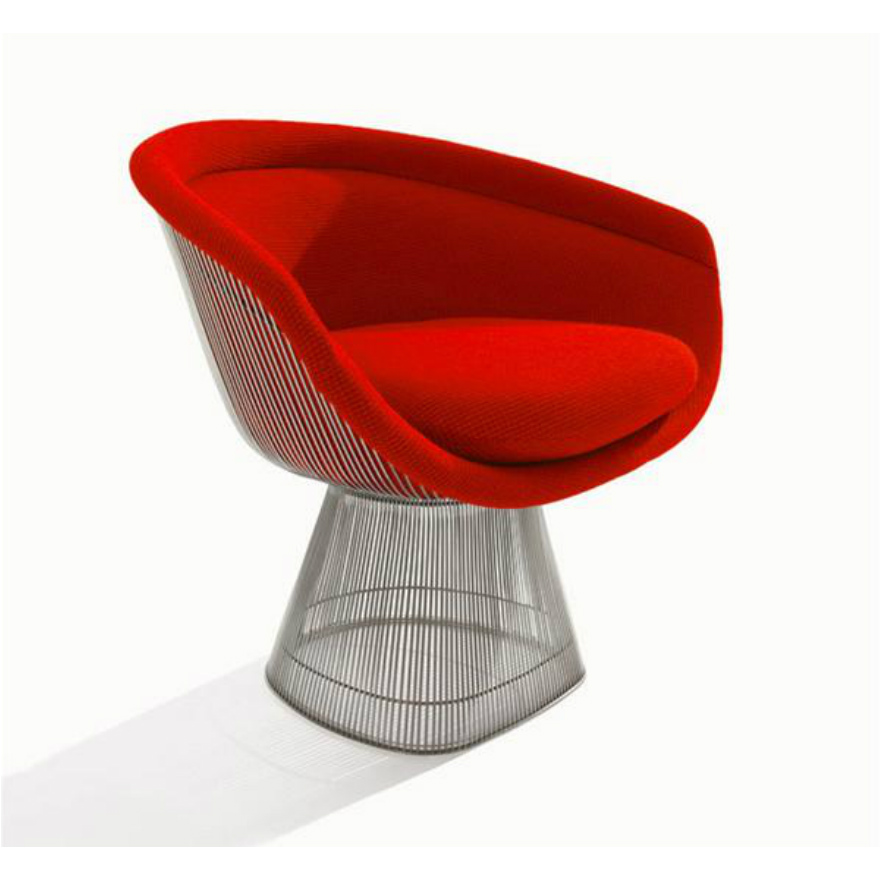
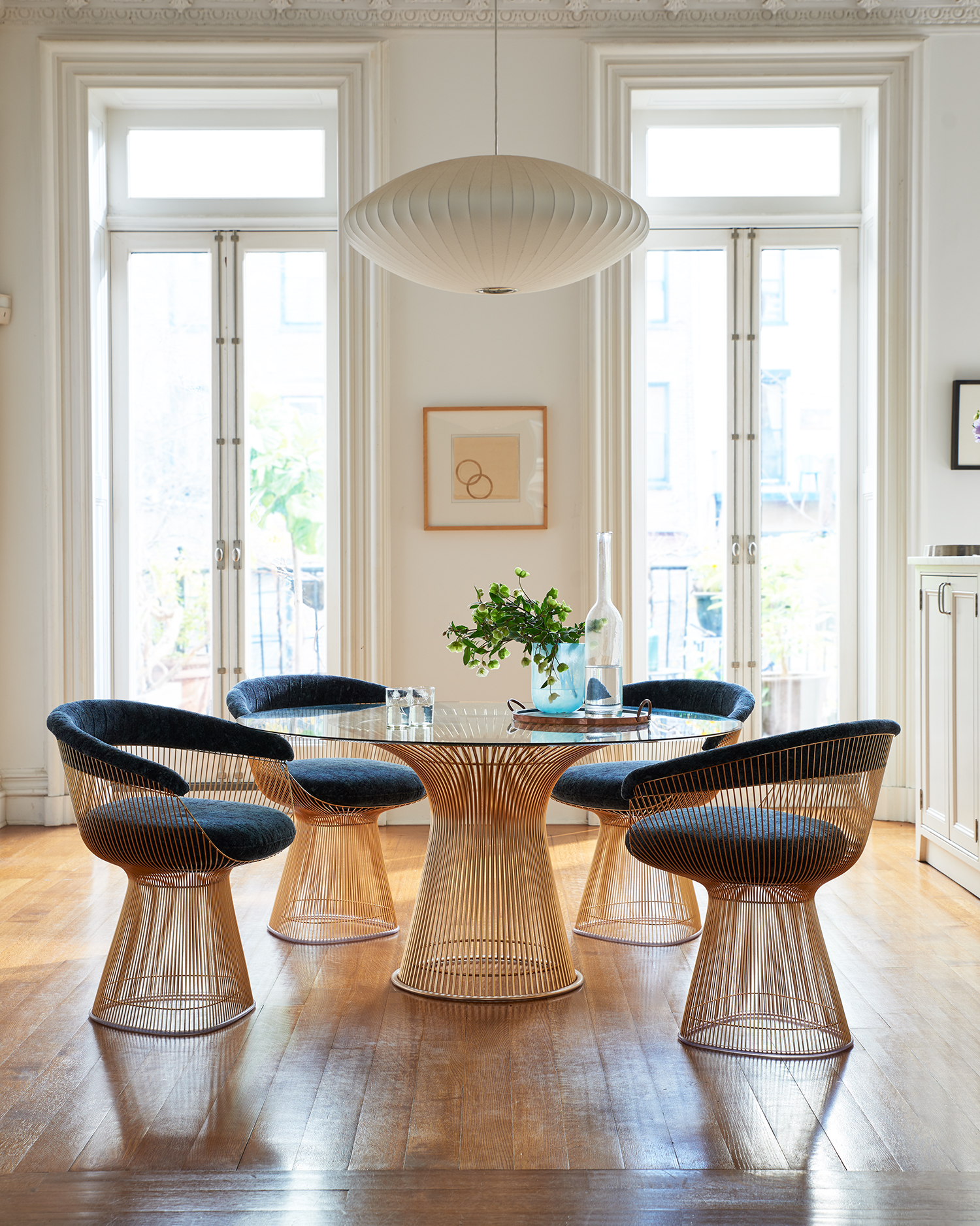
Platner Arm Chair
Structure as OrnamentDesigner — Warren Platner for Knoll.
Materials — Hundreds of vertical welded steel rods forming base, frame, and decoration at once; upholstered shell.
Signature Details
- The moiré shimmer is the structure itself
- Platner’s case for gentle, decorative modernism
- Rod cylinder doubles as pedestal
Spotting an Original
- Knoll markings
- Rod count and weld quality
- Replicas hollow the cylinder
Production
1966 onward
Licensed Today
Knoll
16. Round Chair (“The Chair”) – Hans Wegner, 1949
The Round Chair earned the definite article: Wegner’s 1949 design for Johannes Hansen — a single steamed arc of back-and-armrest on four legs, joinery exposed and celebrated — was picked by CBS to seat John F. Kennedy and Richard Nixon in the first televised presidential debate in 1960, after which the American press simply called it The Chair. It is Danish modern’s clearest statement that a chair can be reduced no further without losing its manners.
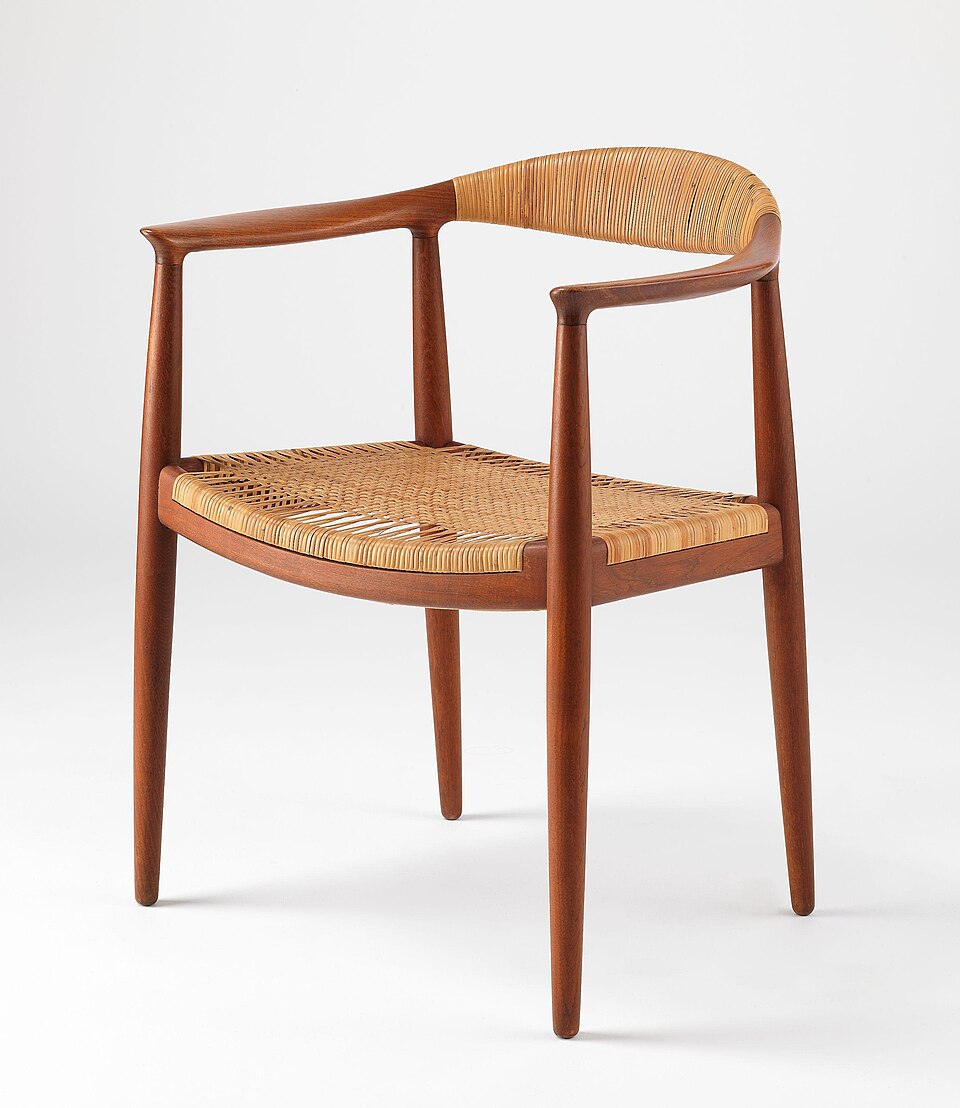
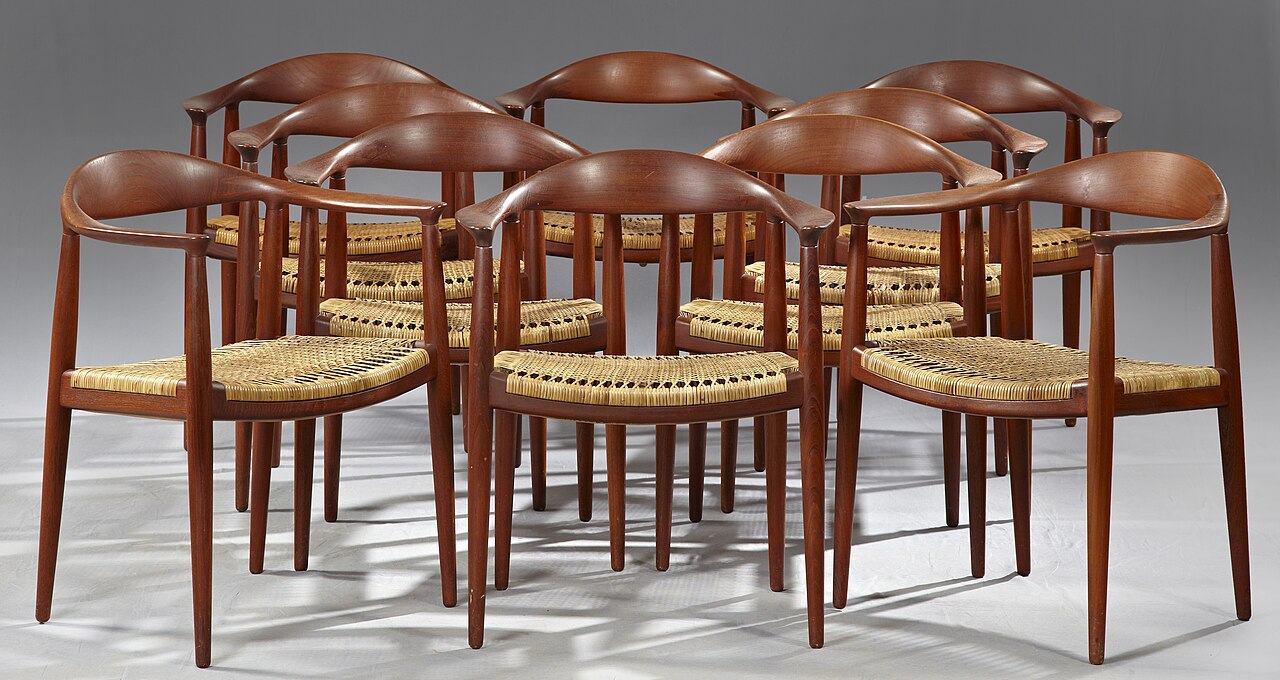
Round Chair (“The Chair”)
The Definite ArticleDesigner — Hans Wegner for Johannes Hansen, 1949.
Materials — Solid wood; one steamed arc forming back and arms; exposed joinery; woven cane or upholstered seat.
Signature Details
- Seated Kennedy and Nixon, first televised debate, 1960
- US press renamed it The Chair
- Reduction without loss of manners
Spotting an Original
- Johannes Hansen (vintage) or PP Møbler marks
- The finger-jointed arm splice
- Cane weave and seat frame detail
Production
1949 onward
Licensed Today
PP Møbler
17. Chandigarh Chair – Pierre Jeanneret, c. 1955
The Chandigarh Chair is government furniture that became auction treasure: Pierre Jeanneret, cousin and partner of Le Corbusier, designed teak-and-cane V-legged seating in the mid-1950s to furnish Chandigarh, the modernist capital the pair built for Indian Punjab. Made in workshops by the thousands, discarded as surplus decades later, the chairs were rediscovered by dealers and now sell at prices the city’s clerks would not believe — a provenance story that has also flooded the market with restorations, remakes, and outright fakes, so documentation matters here as much as anywhere on this list. Authorized today: Cassina’s Hommage à Pierre Jeanneret collection, produced with the Jeanneret estate.
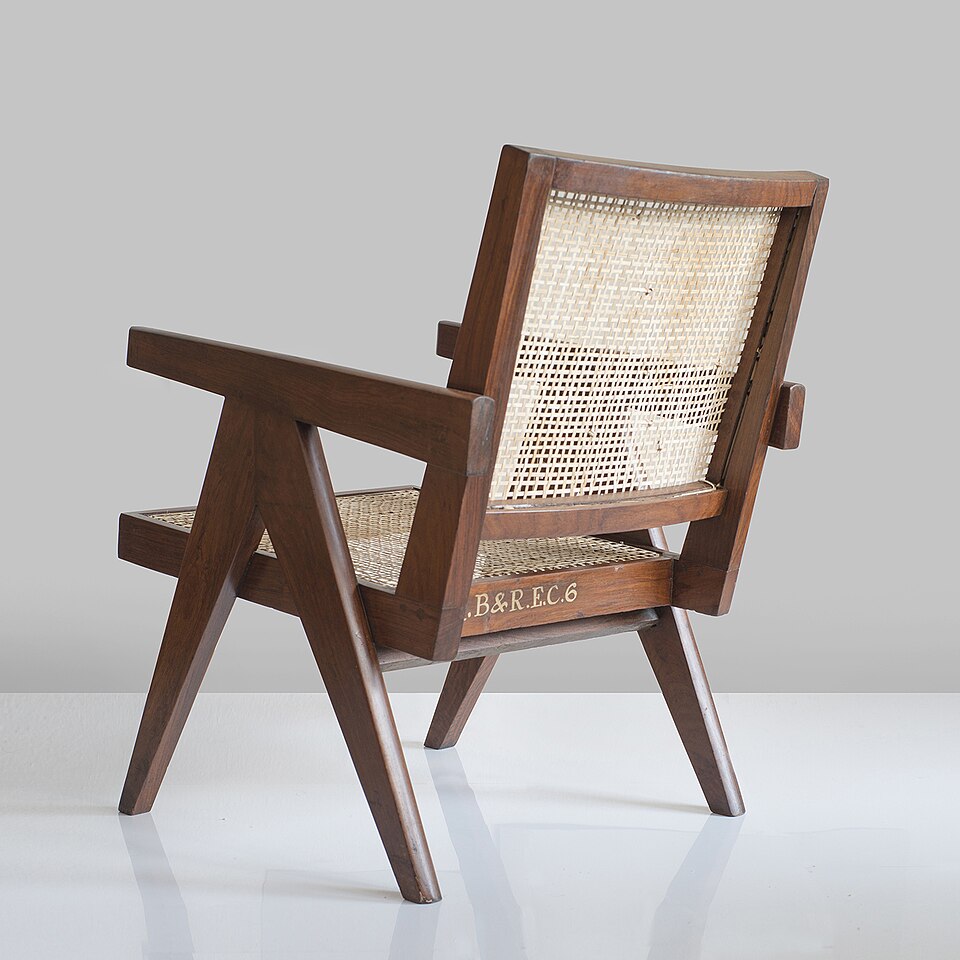
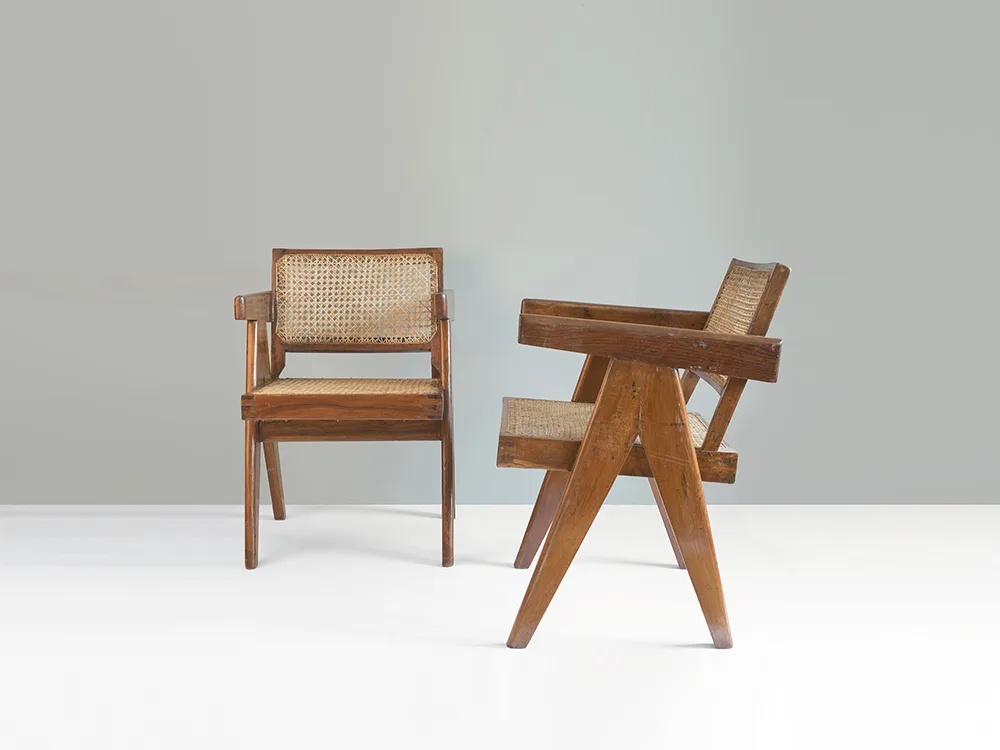
Chandigarh Chair
Government Surplus to Auction StarDesigner — Pierre Jeanneret, for the Chandigarh capital project.
Materials — Solid teak V-legs, cane seat and back.
Signature Details
- Furnished a purpose-built modernist capital
- Discarded as surplus, rediscovered by dealers
- The most actively faked corpus in the trade
Spotting an Original
- Documented Chandigarh provenance only
- Teak aging and cane wear consistent with claim
- Estate reissues carry Cassina marks
Production
c. 1955; Cassina reissue current
Licensed Today
Cassina – Estate Collection
18. Kangaroo Chair – Pierre Jeanneret, c. 1955
The Kangaroo Chair is Chandigarh’s low-slung sibling: the same teak-and-cane vocabulary folded into a lounge posture, the seat frame descending to the floor to serve as its own rear support. Jeanneret designed it for the same administrative buildings, and it carries the same market caution — the Chandigarh corpus is the most actively faked body of work in the mid-century trade.
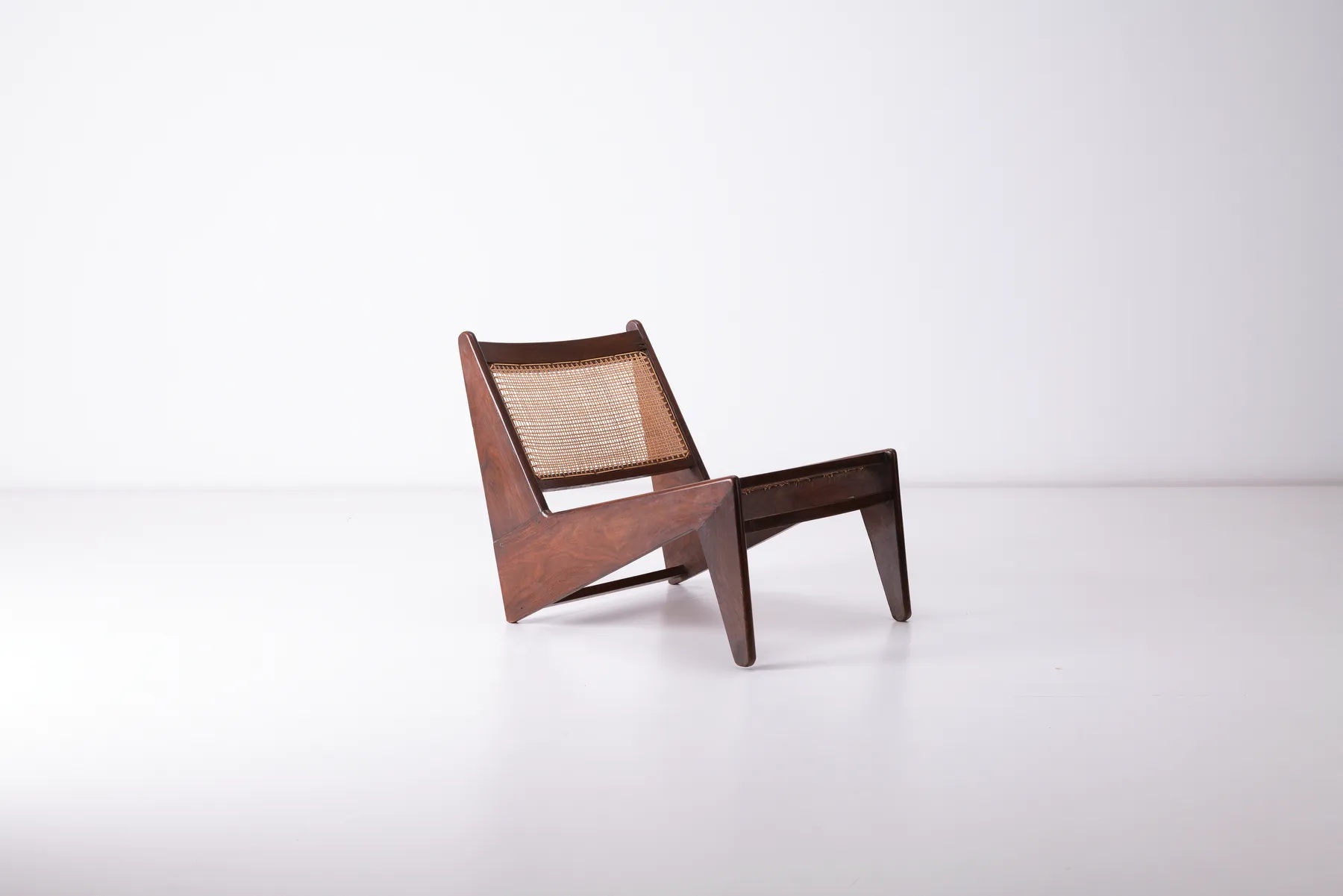
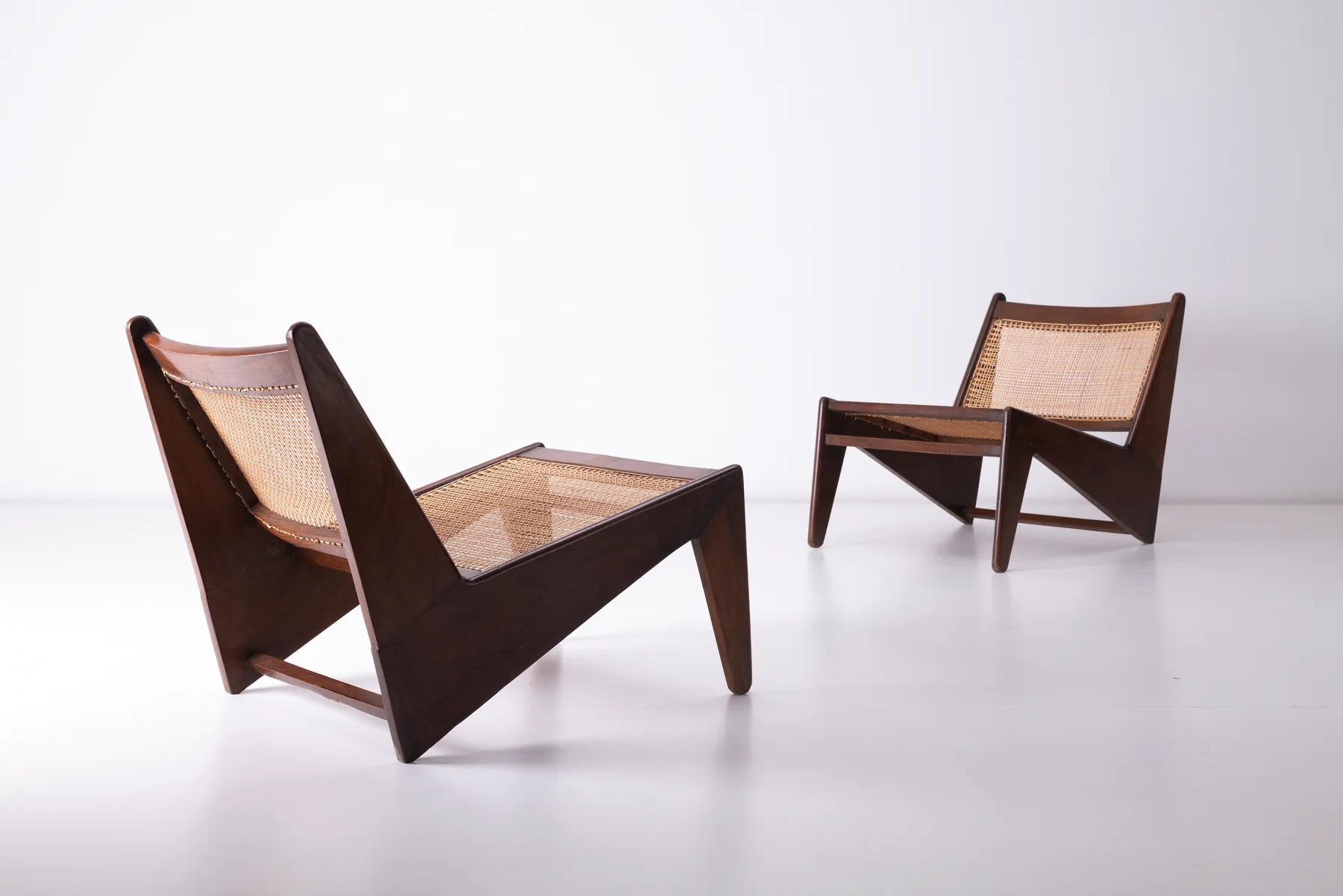
Chandigarh Chair
Government Surplus to Auction StarDesigner — Pierre Jeanneret, for the Chandigarh capital project.
Materials — Solid teak V-legs, cane seat and back.
Signature Details
- Furnished a purpose-built modernist capital
- Discarded as surplus, rediscovered by dealers
- The most actively faked corpus in the trade
Spotting an Original
- Documented Chandigarh provenance only
- Teak aging and cane wear consistent with claim
- Estate reissues carry Cassina marks
Production
c. 1955; Cassina reissue current
Licensed Today
Cassina – Estate Collection
19. Ball Chair – Eero Aarnio, 1963
The Ball Chair is the space age at domestic scale: Eero Aarnio cut a fiberglass sphere, mounted it on a swivel base, upholstered the interior, and produced a room within a room — designed in 1963 and an immediate sensation at the 1966 Cologne fair. Aarnio built the first prototype at home to his own dimensions, which is why the interior fits a reclining adult so exactly.
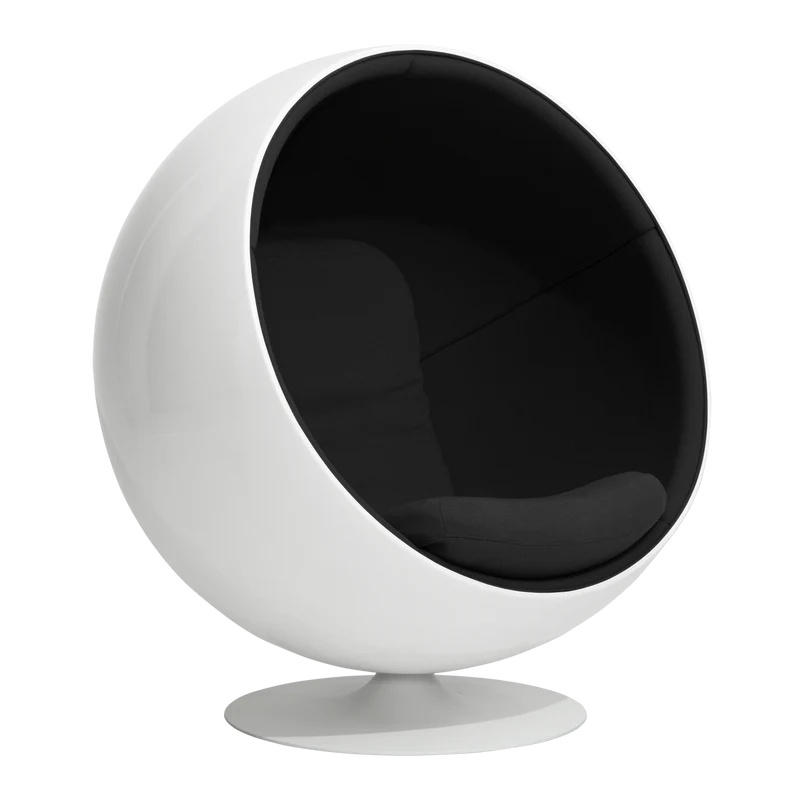
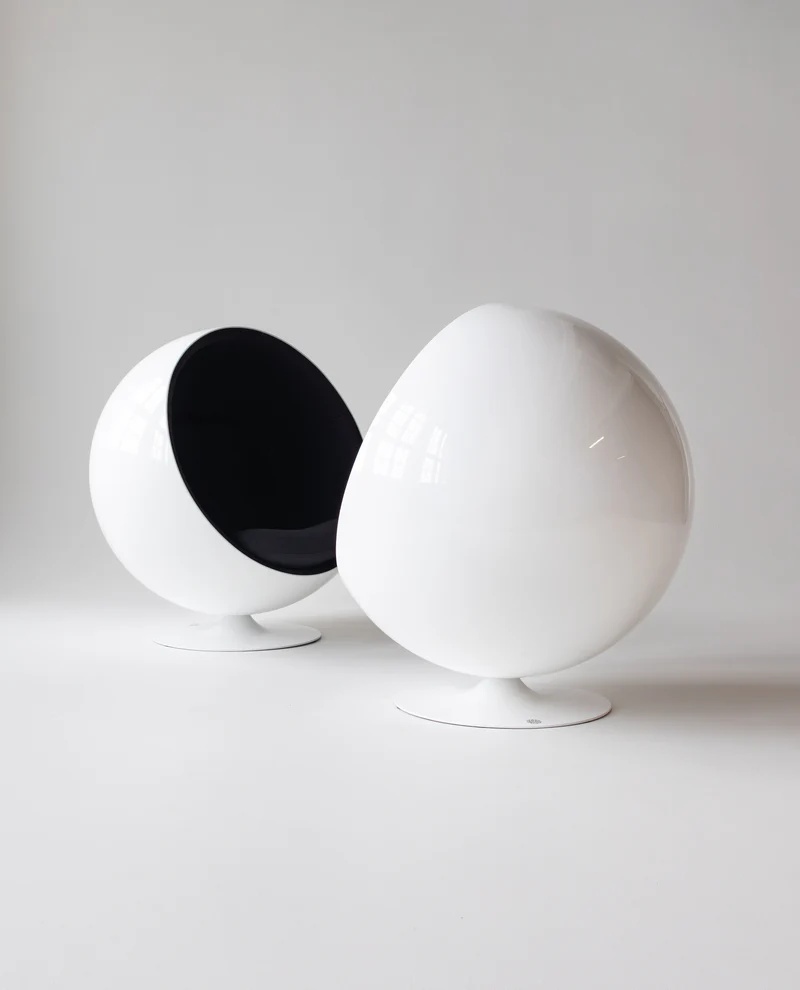
Ball Chair
A Room Within a RoomDesigner — Eero Aarnio, 1963.
Materials — Cut fiberglass sphere on aluminum swivel base, upholstered interior.
Signature Details
- Sensation of the 1966 Cologne fair
- Prototype built at home to Aarnio’s own body
- The space age at domestic scale
Spotting an Original
- Eero Aarnio Originals or period Asko provenance
- Shell layup quality and base engineering
- Interior upholstery pattern
Production
1963 onward
Licensed Today
Eero Aarnio Originals
20. Bubble Chair – Eero Aarnio, 1968
The Bubble Chair is the Ball rethought in transparency: Aarnio wanted light inside the sphere, concluded that clear acrylic could not sit on a visible base without ruining the effect, and hung the chair from the ceiling instead, in 1968. The suspended blown-acrylic hemisphere became the era’s shorthand for the future — and remains the rare icon whose installation requires a structural ceiling anchor, a detail every buyer discovers at the same moment.
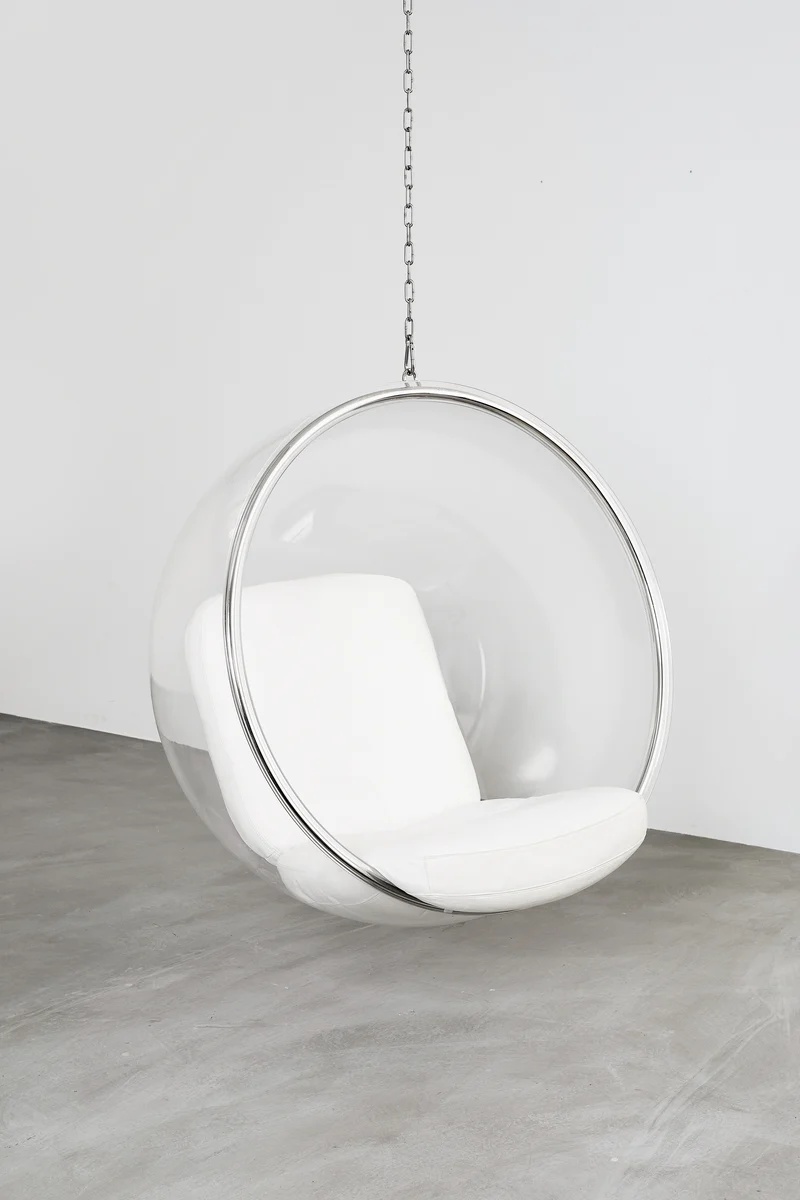
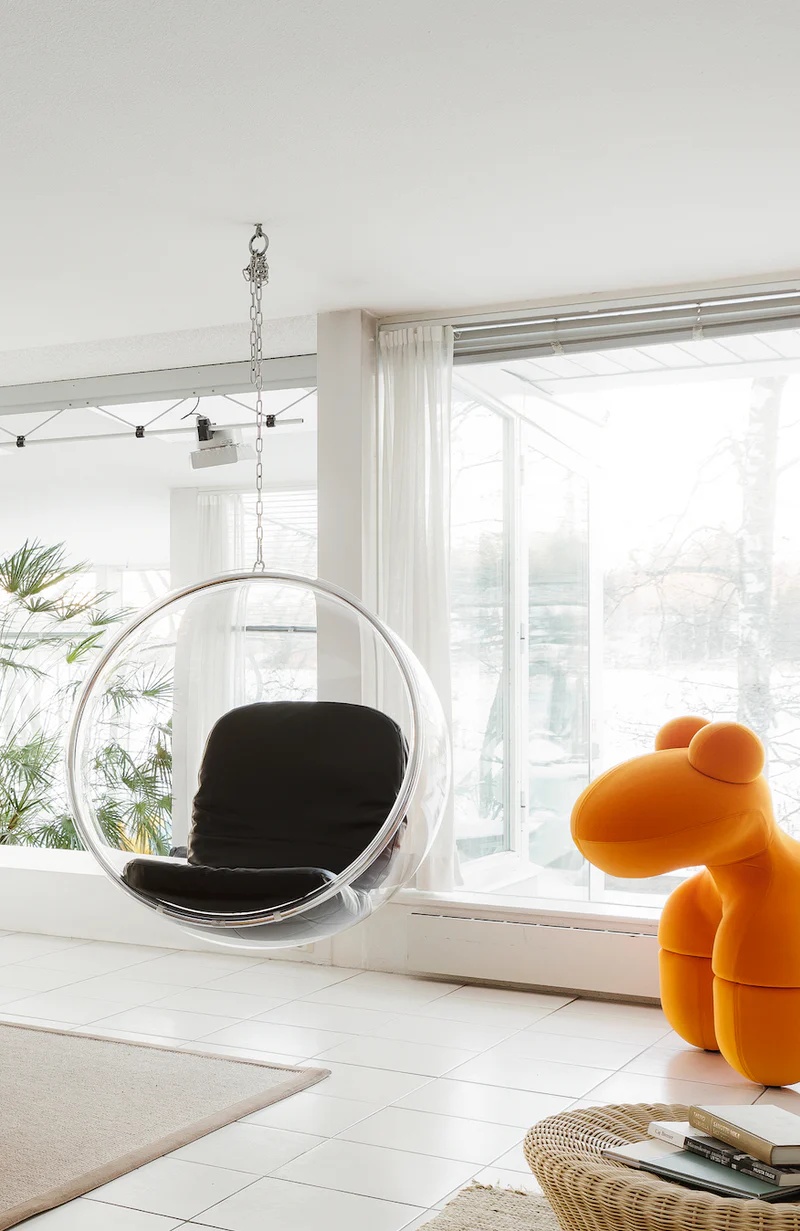
Bubble Chair
The Ball, TransparentDesigner — Eero Aarnio, 1968.
Materials — Blown clear acrylic hemisphere, steel rim, ceiling suspension.
Signature Details
- Hung from the ceiling to keep the light in
- Requires a structural anchor — by design
- The era’s shorthand for the future
Spotting an Original
- Aarnio Originals documentation
- Acrylic clarity and rim finish
- Chain and mount hardware quality
Production
1968 onward
Licensed Today
Eero Aarnio Originals
21. Paulistano Armchair – Paulo Mendes da Rocha, 1957
The Paulistano is one line of steel: Paulo Mendes da Rocha, later a Pritzker laureate, designed it in 1957 for the Athletic Club of São Paulo — a single continuous steel bar, roughly seventeen feet of it, bent into the entire frame, with a leather or canvas sling hung across. It is Brazilian modernism’s calling card in furniture, structural bravado worn casually, and its self-flexing frame gives it a ride no four-legged lounge chair matches.
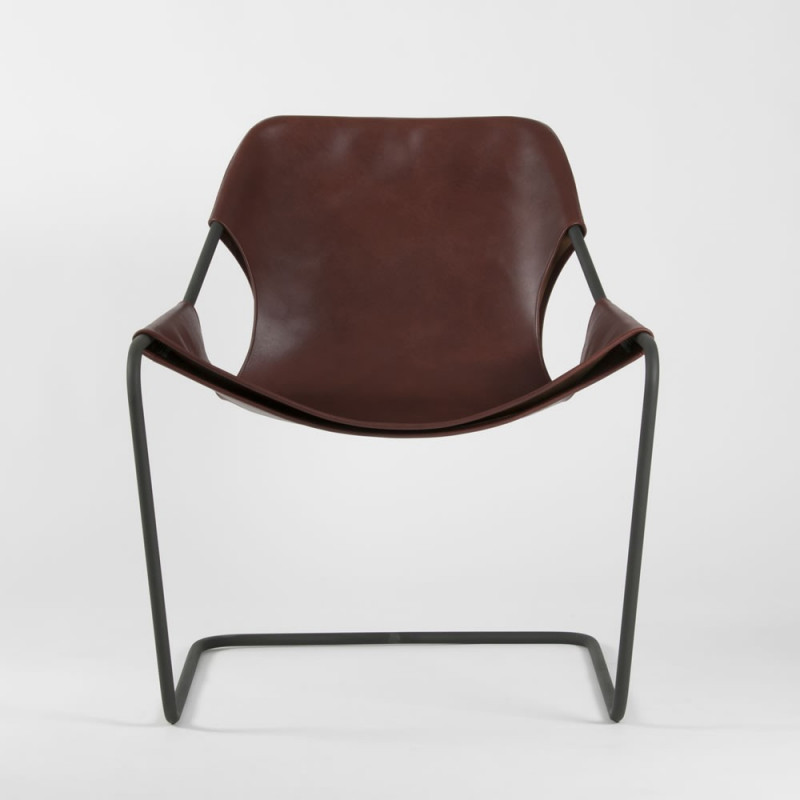
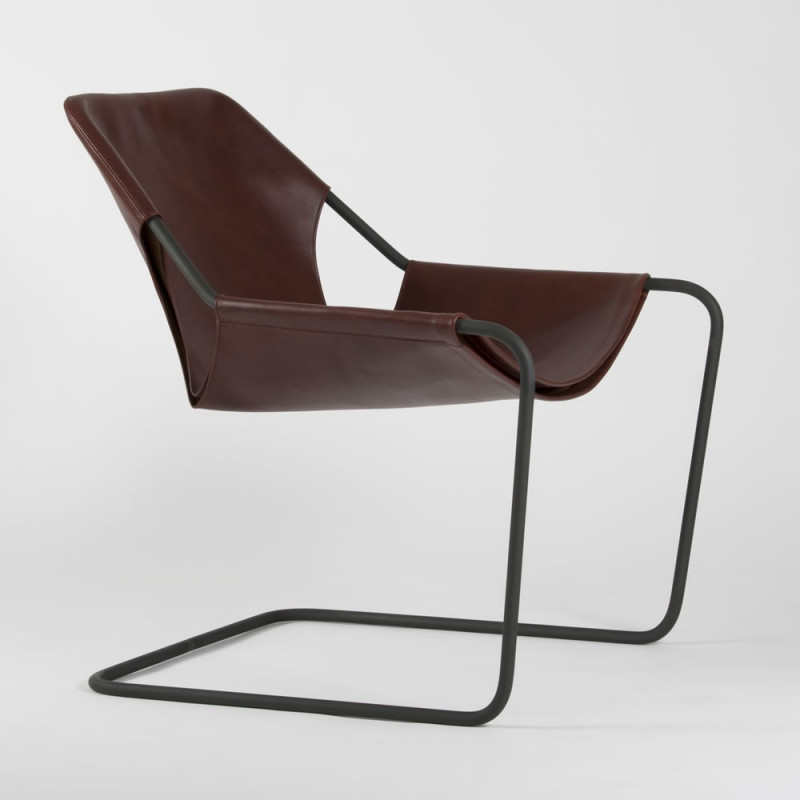
Paulistano Armchair
One Line of SteelDesigner — Paulo Mendes da Rocha, for the Athletic Club of São Paulo.
Materials — A single continuous steel bar (roughly seventeen feet) bent into the full frame; leather or canvas sling.
Signature Details
- Brazilian modernism’s furniture calling card
- Frame flexes as its own suspension
- Designed by a future Pritzker laureate
Spotting an Original
- Objekto production under the architect’s agreement
- One continuous bar — no joints anywhere
- Sling stitching and attachment detail
Production
1957 onward
Licensed Today
Objekto
22. Shell Chair (CH07) – Hans Wegner, 1963
The Shell Chair is the rejection that outlived its jury: Wegner’s 1963 three-legged lounge — wing-like plywood seat, arcing legs, the profile that earned it the smiling chair nickname — met a cold Copenhagen reception and survived only in tiny numbers until Carl Hansen & Søn relaunched it in 1998, upon which the design promptly collected the awards it had been owed for thirty-five years. Original 1960s examples are now among the most valuable Wegner productions.
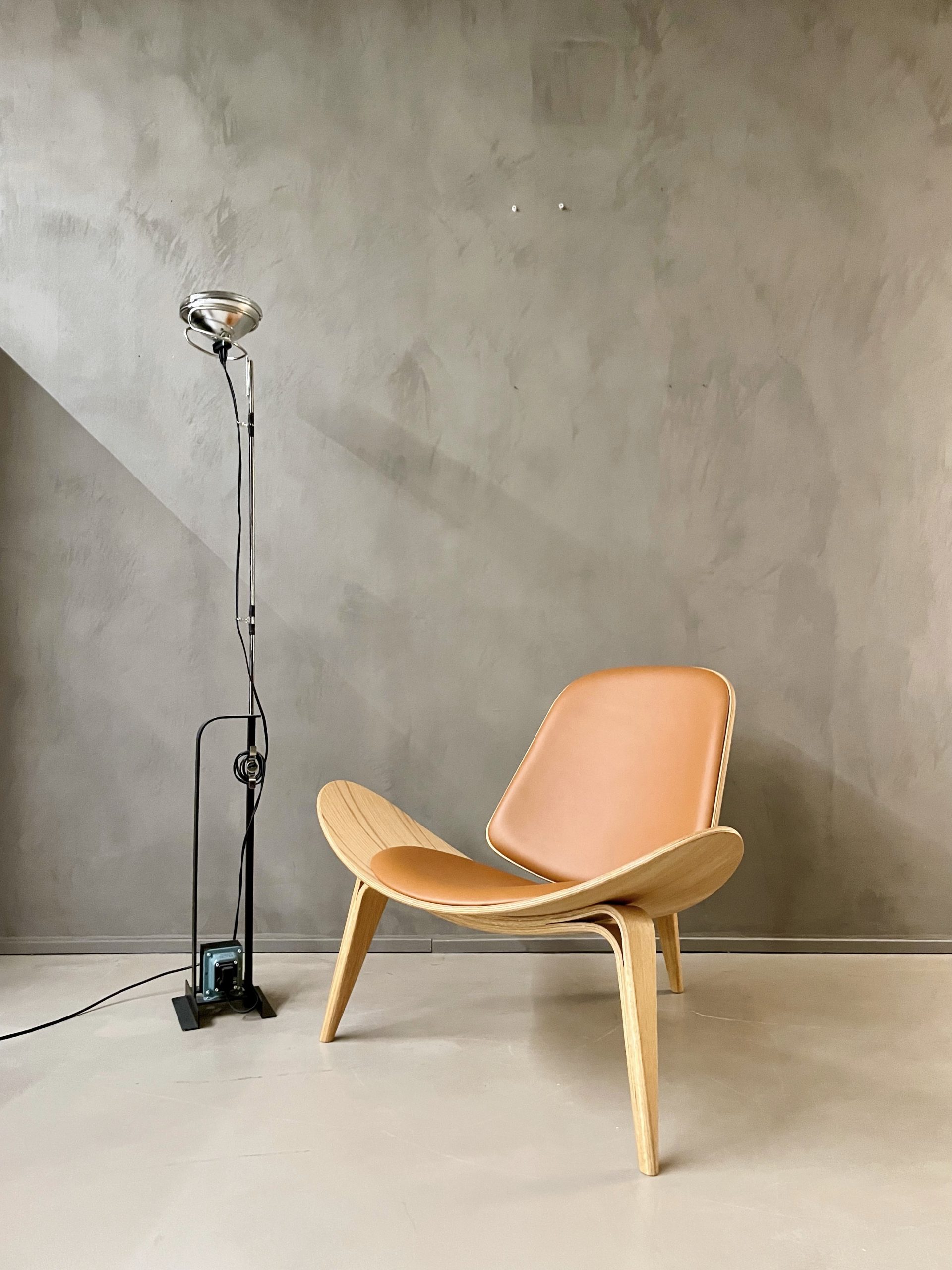
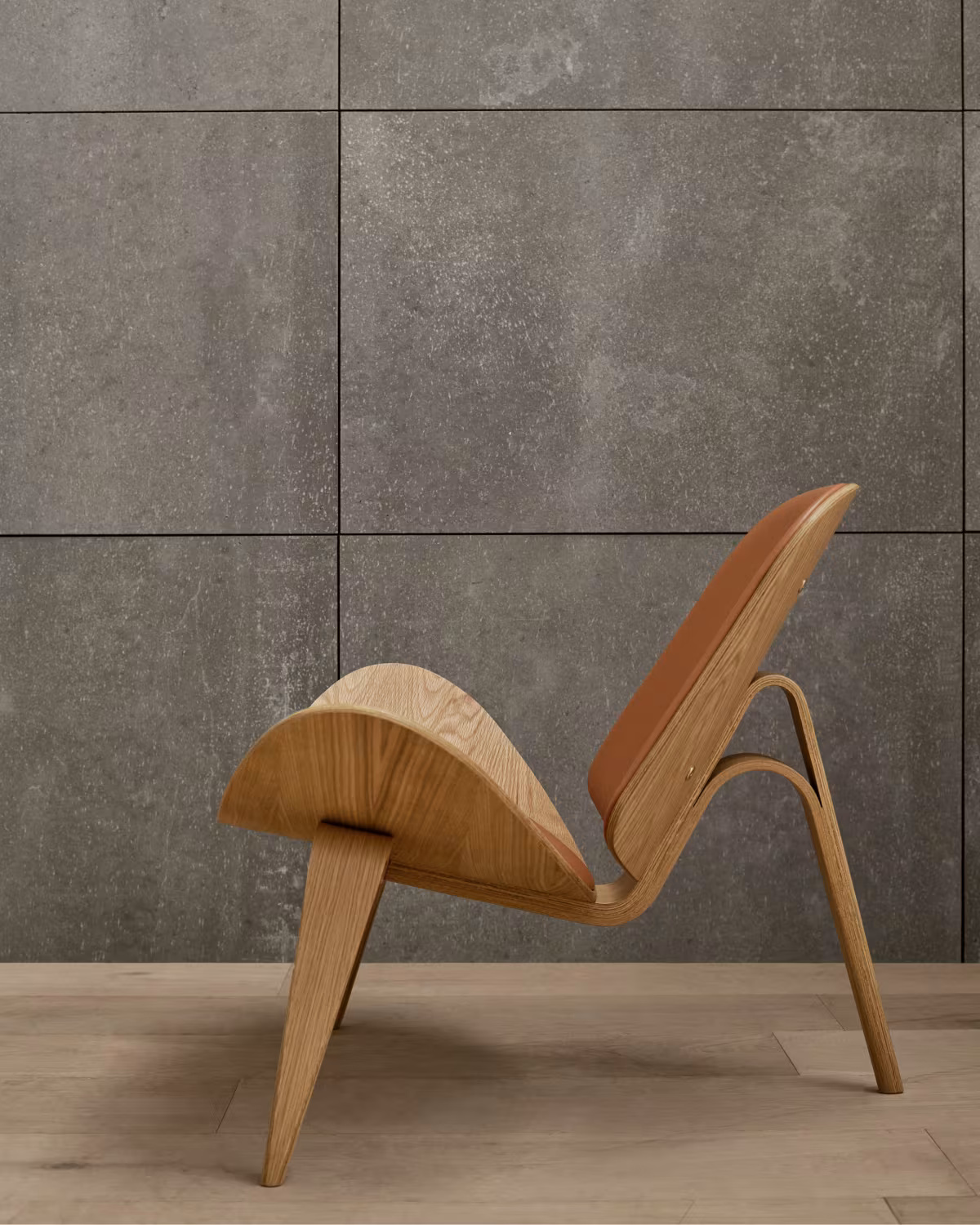
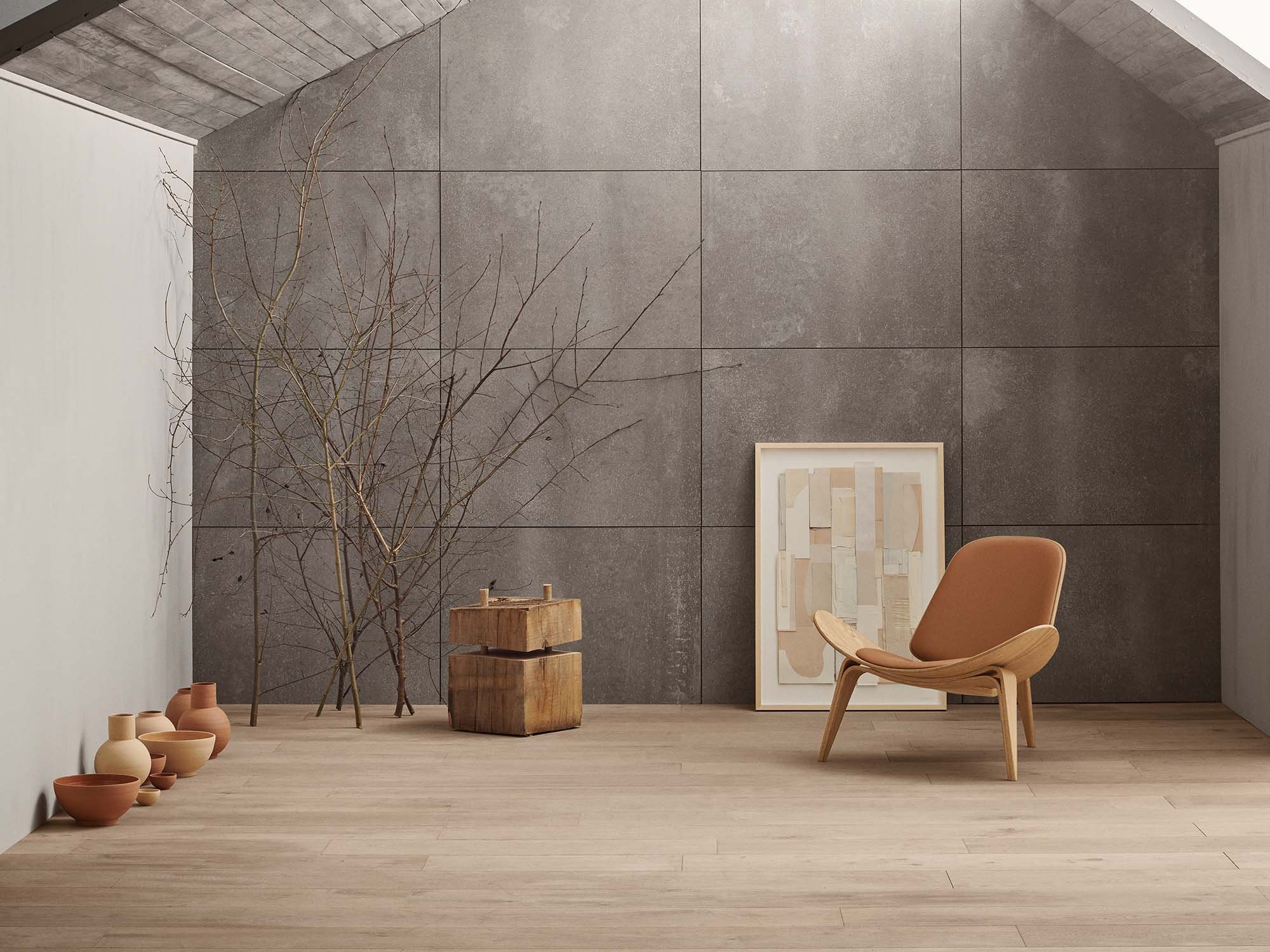
Shell Chair (CH07)
Rejected, Then VindicatedDesigner — Hans Wegner, 1963.
Materials — Wing-form molded plywood seat, three arcing laminated legs.
Signature Details
- Cold Copenhagen reception, tiny first run
- Relaunched by Carl Hansen in 1998 to acclaim
- 1960s originals now among top Wegner values
Spotting an Original
- 1960s examples: rarity-grade provenance
- Carl Hansen markings on current production
- Lamination and edge finish on the wings
Production
1963; relaunched 1998
Licensed Today
Carl Hansen & Søn
23. Sawbuck Chair (CH29) – Hans Wegner, 1952
The Sawbuck Chair closes the list with carpentry made eloquent: Wegner took the X-form of the sawbuck — the workbench trestle — and refined it into angled solid-wood legs meeting a shaped seat, designed in 1952 for Carl Hansen & Søn. In two-tone oak and walnut builds, the joinery reads as the ornament, and the chair states Wegner’s standing rule that a chair should be beautiful from every side, since no chair sits against a wall forever. It rewards knowing your walnut color from your oak at ten paces.
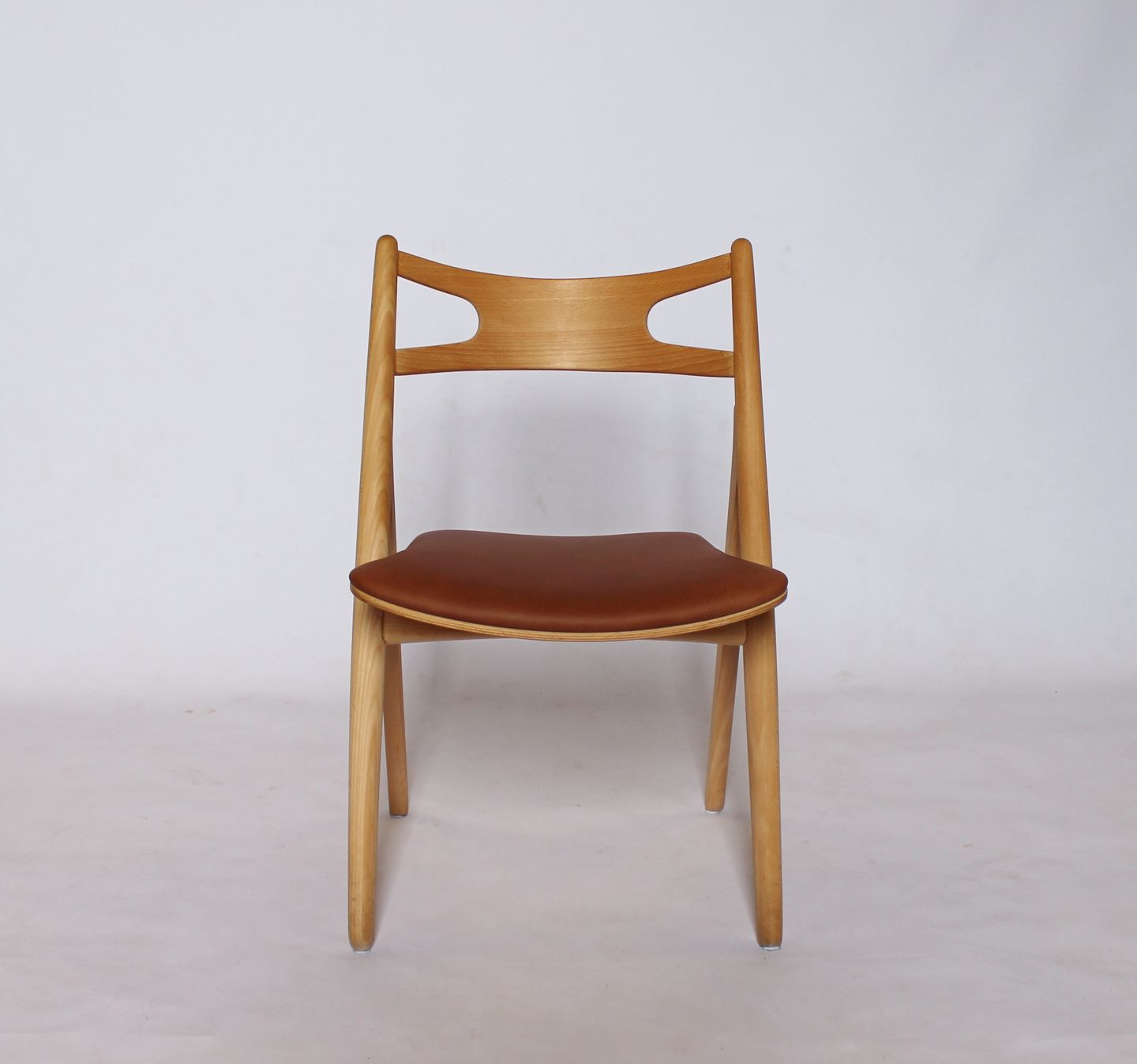
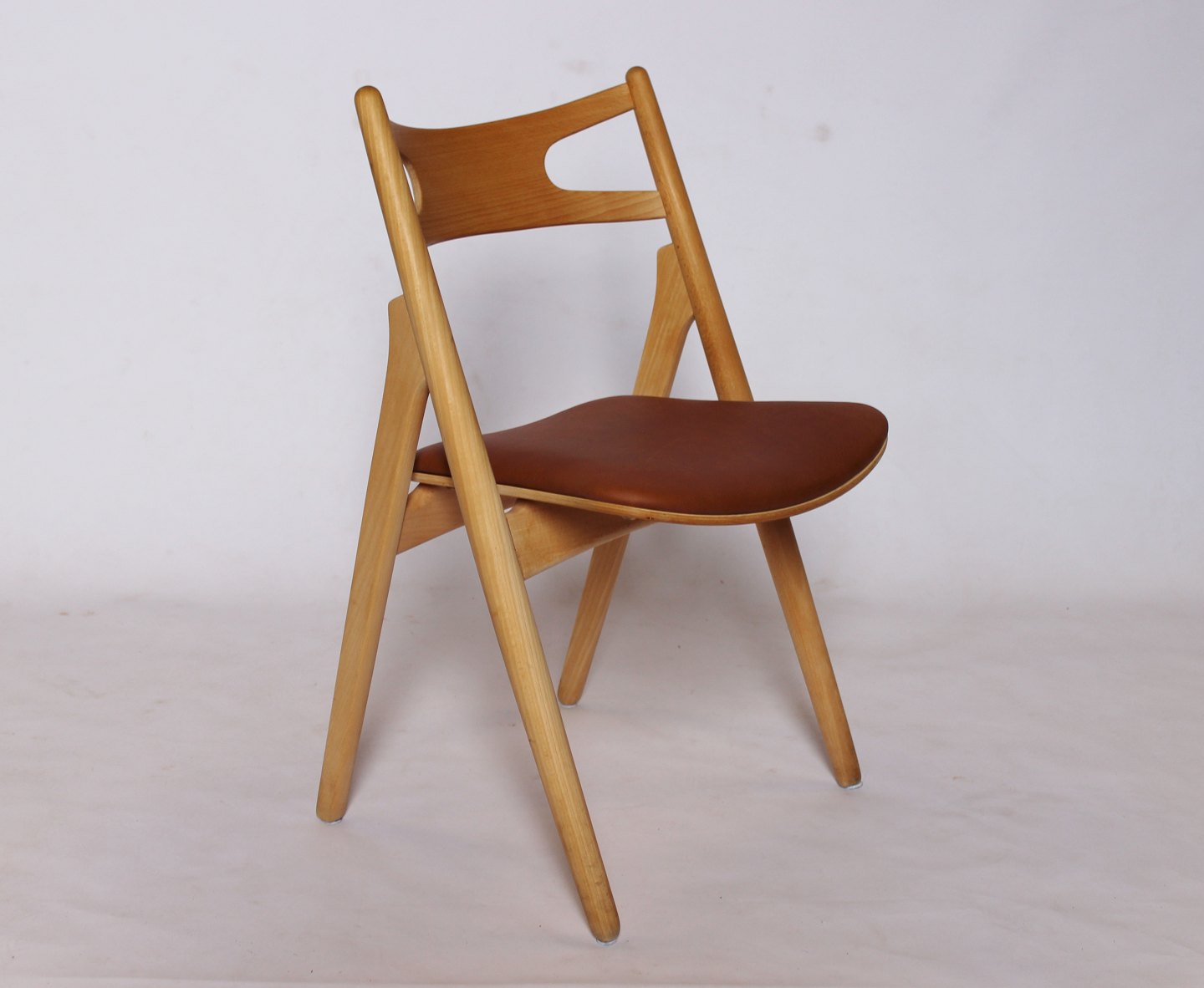
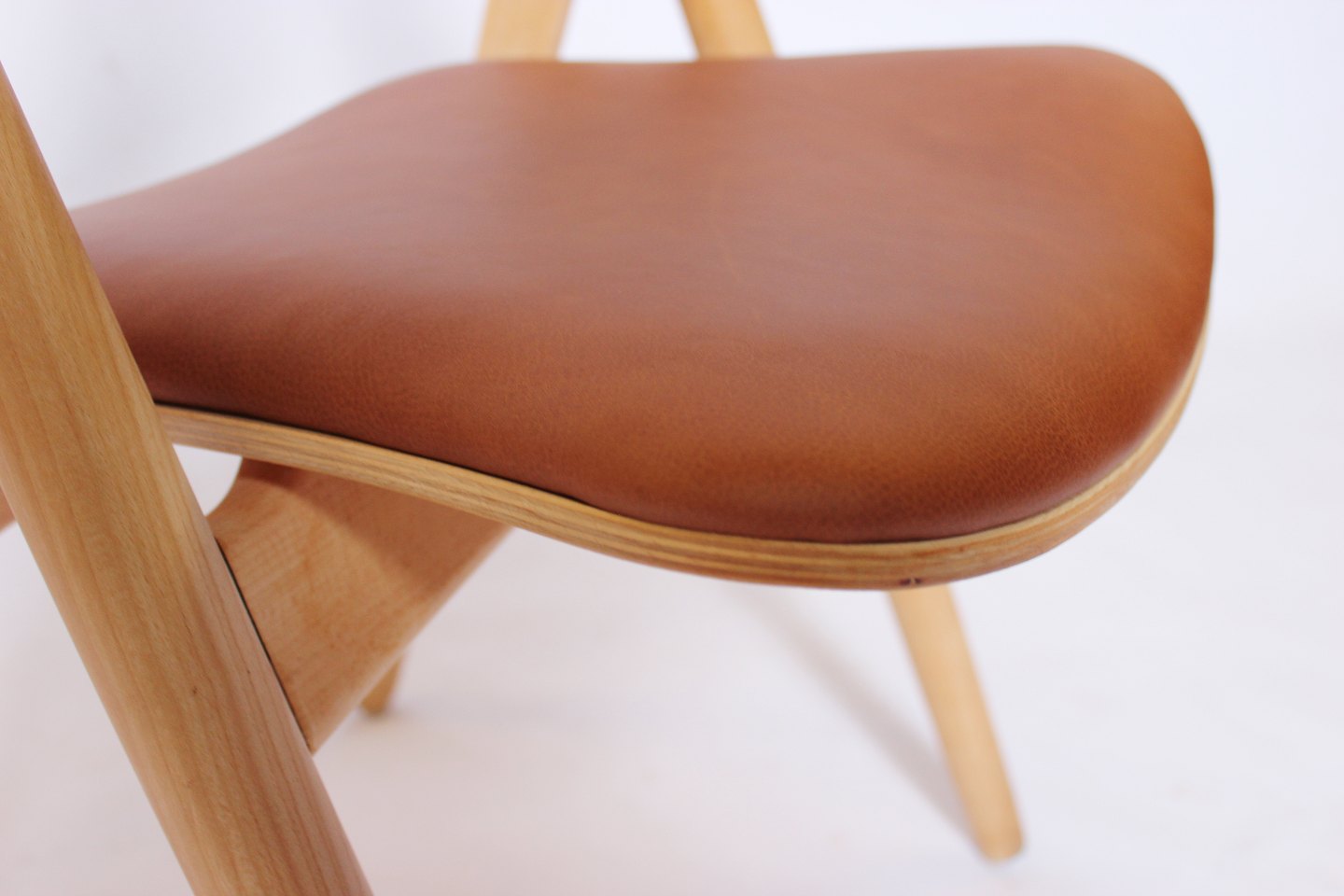
Sawbuck Chair (CH29)
Carpentry Made EloquentDesigner — Hans Wegner for Carl Hansen & Søn, 1952.
Materials — Solid wood X-form legs from the sawbuck trestle; shaped seat; two-tone oak and walnut builds.
Signature Details
- The workbench refined into dining seating
- Joinery is the ornament
- Beautiful from every side, per Wegner’s rule
Spotting an Original
- Carl Hansen markings
- Wood species honesty — oak and walnut, not stains
- Leg-to-seat joint execution
Production
1952 onward
Licensed Today
Carl Hansen & Søn
Licensed, Reissued, or Replica
Every chair above exists in at least two economies, and the difference is worth stating plainly since this page will be read by buyers. The licensed piece — Herman Miller, Vitra, Knoll, Fritz Hansen, Carl Hansen, PP Møbler, Cassina, Objekto, Eero Aarnio Originals — carries the estate’s royalties, the original engineering, and resale value; the replica carries the silhouette. Between them sits the honest middle the Butterfly and the fiberglass Eames illustrate: designs whose rights lapsed or fractured, where unlicensed production is legal and quality varies from respectable to disposable. The full anatomy of that market — who copies, why the law allows it, and when a copy built the icon it imitated — is the subject of the most imitated chair in design history and its companion on the story of the monobloc chair. For the buying side, our survey of the best places to buy furniture online maps where licensed, vintage, and honest-replica sellers each operate; and the pieces that hold value across all three economies share the traits we collect in timeless furniture pieces — construction that can be inspected, documentation that can be checked.
What makes a chair “mid-century modern”?
Design between roughly 1945 and 1970 in the movement’s language — organic or geometric shells, honest structure, new materials used as themselves (molded plywood, fiberglass, tubular and rod steel), and ornament earned through construction rather than applied. Four chairs on this list predate the window; mid-century production canonized them.
What is the most famous mid-century modern chair?
The Eames Lounge Chair, by most measures that matter — recognition, continuous production since 1956, museum presence, and the size of the replica economy trailing it. The Wishbone leads on units among wooden chairs, and the Series 7 on units overall.
Which mid-century chairs are still in production?
Nearly every design on this list, which is much of why the list exists: Herman Miller and Vitra (Eames), Knoll (Saarinen, Mies, Breuer, Bertoia, Platner), Fritz Hansen (Jacobsen), Carl Hansen & Søn and PP Møbler (Wegner), Vitra (Panton), Cassina (Jeanneret), Objekto (Mendes da Rocha), and Eero Aarnio Originals all build their designs today under license or estate agreement.
How can you tell an original mid-century chair from a replica?
Start with the maker’s marks — every licensed manufacturer above labels its work — then construction: weld quality and rod count on wire and steel designs, shell thickness and material texture on molded chairs, joinery and wood species on the Danish pieces. Provenance documentation outweighs a seller’s story, and on the most faked bodies of work — Chandigarh above all — it is the only evidence worth paying for.
Are replica mid-century chairs worth buying?
As furniture, sometimes; as investment, no. A well-made unlicensed Butterfly or fiberglass shell serves honestly where rights have lapsed. A replica sold under a protected design’s name at a tenth of the price serves the seller. The distinction is disclosure — the honest replica market names itself, and the dishonest one borrows names, a difference our chair essay treats at length.
Resources
- Vitra — Panton Chair Design History and Production Records
- MoMA — B.K.F. Chair, Collection Record (Bonet, Kurchan, Ferrari Hardoy, 1938)
- Knoll — Barcelona, Saarinen, Breuer, Bertoia and Platner Collection Documentation
- Fritz Hansen — Arne Jacobsen Design Archive
- Carl Hansen & Søn — Hans J. Wegner Production History
- Herman Miller — Eames Lounge Chair and Molded Chair Archives
- Life of an Architect — Knoll and the Hardoy Butterfly Chair
- Cassina — Hommage à Pierre Jeanneret Collection
- Architecture Lab — The Most Imitated Chair in Design History
- Architecture Lab — The Story of the Monobloc Chair
- Architecture Lab — Timeless Furniture Pieces


