

Architectural symbols are the graphic and visual signs of construction drawings, the tags, lines, hatches and blocks that stand for doors, windows, walls, materials, electrical outlets, smoke detectors and other objects. These symbols appear on a floor plan, an MEP sheet or a reflected ceiling plan, the RCP. The United States National CAD Standard organizes them and ISO 7519:2025 sets the presentation principles internationally, but adoption of the NCS is voluntary, so every blueprint set keys its own symbols in a legend and the same letters can change meaning between disciplines. WP is waterproofing on a VA architectural sheet and weatherproof on a Los Alamos electrical legend. Line weight and pattern say what each line is, the scale turns paper length into building length, markers link one sheet to another, and the legend sheet explains any special symbols a set adds.
Architectural Symbols
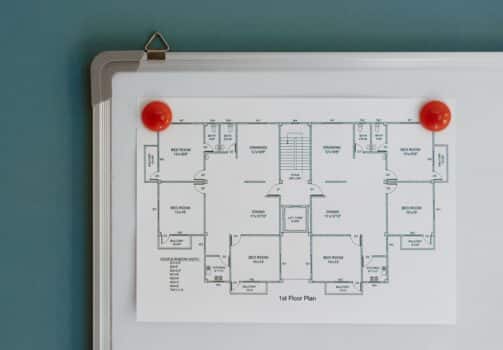
Understanding Scales
Architectural and construction drawings are drawn to scale, which turns a length on paper into a length on the building. Architect’s scales such as 1/4″ = 1′-0″ and 1/8″ = 1′-0″, the ones used for structures and buildings, set inches against a foot, whereas metric scales such as 1:50 and 1:100 use the same unit on both sides of the ratio.
The symbols in a legend do not all follow the drawing’s scale, because under the A/E/C CAD Standard symbols such as electrical outlets and smoke detectors are blocks that represent an object, while a 30 in. by 50 in. desk, 762 by 1,270 mm, or a 3 ft-0 in. door is a block placed at the actual size of the item whatever the scale of the drawing.
The most common architect’s scale is 1/4 inch to the foot. Standard architect scales run 3/32, 1/8, 3/16, 1/4, 3/8, 1/2, 3/4, 1 and 1 1/2 inches to the foot, and practitioners also work at 1/32, 1/16 and 3 inches to the foot. In metric drawings, 1:500 and 1:200 locate the building and its services on the site, and 1:20 down to 1:1 show the detail of components and assemblies.
The scale is normally given in the title block in the lower right-hand corner, but it may appear anywhere on the plans, and a sheet with enlarged details can carry more than one. ISO 5455 puts the main scale in the title block and the others next to the detail or section reference, written as the word SCALE followed by the ratio. On VA drawings the scale sits under each drawing’s title, as in 1 1/2″ = 1′-0″, and graphic scales take the same form, for example 1/8″ = 1′-0″.
How Do You Read an Architectural Scale?
An architectural scale reads paper length against real length, so at 1/4″ = 1′-0″ a quarter inch on the drawing stands for one foot of building and the drawing is 1/48 size, and at 1/8″ = 1′-0″ it is 1/96 size. At 1:100, one unit on paper stands for 100 of the same unit in the building, and ISO 5455 recommends the reduction scales 1:2, 1:5, 1:10, 1:20, 1:50, 1:100, 1:200 and 1:500 and beyond, extendable by whole-number powers of 10. Written dimensions always take precedence over measurements scaled off a print, because reproduction can resize the image to fit the paper.
| Architect scale | Ratio | Nearest ISO 5455 scale |
|---|---|---|
| 1/16″ = 1′-0″ | 1:192 | 1:200 |
| 1/8″ = 1′-0″ | 1:96 | 1:100 |
| 3/16″ = 1′-0″ | 1:64 | 1:50 |
| 1/4″ = 1′-0″ | 1:48 | 1:50 |
| 1/2″ = 1′-0″ | 1:24 | 1:20 |
| 3/4″ = 1′-0″ | 1:16 | 1:20 |
| 1″ = 1′-0″ | 1:12 | 1:10 |
| 1 1/2″ = 1′-0″ | 1:8 | 1:10 |
| 3″ = 1′-0″ | 1:4 | 1:5 |
Ratios are arithmetic at 12 inches to the foot. The ISO column gives the nearest scale in the ISO 5455 recommended series, also by arithmetic, and a pair such as 1:48 and 1:50 is close, not equal.
Different Types Of Symbols In Construction Drawings
1. Architectural Drawing Symbols
The weight and pattern of a line say what it shows, so line types are the first thing to learn when reading blueprints. The US Army Corps of Engineers’ A/E/C CAD Standard, a Department of Defense implementation of the National CAD Standard, sets five line widths, from 0.18 mm for patterning to 0.70 mm for sheet borders. Hidden lines are short, evenly spaced dashes and center lines alternate long and short dashes, and VA drawings add lines for contract limits, demolition, existing work to remain, new work, property lines and fire-resistive ratings of 1, 2, 3 and 4 hours.
| Line width | mm | in | Typical use |
|---|---|---|---|
| Fine | 0.18 | 0.007 | Patterning and material indications |
| Thin | 0.25 | 0.010 | Dimension lines, leaders, grid lines, hidden objects, center lines |
| Medium | 0.35 | 0.014 | Object lines, text, property lines |
| Wide | 0.50 | 0.020 | Major object lines, cut lines, section cutting plane lines, property lines, titles |
| Extra wide | 0.70 | 0.028 | Footprints, match lines, schedule outlines, sheet borders |
Line widths of the A/E/C CAD Standard Release 6.0, August 2015, in its millimeter and inch values.
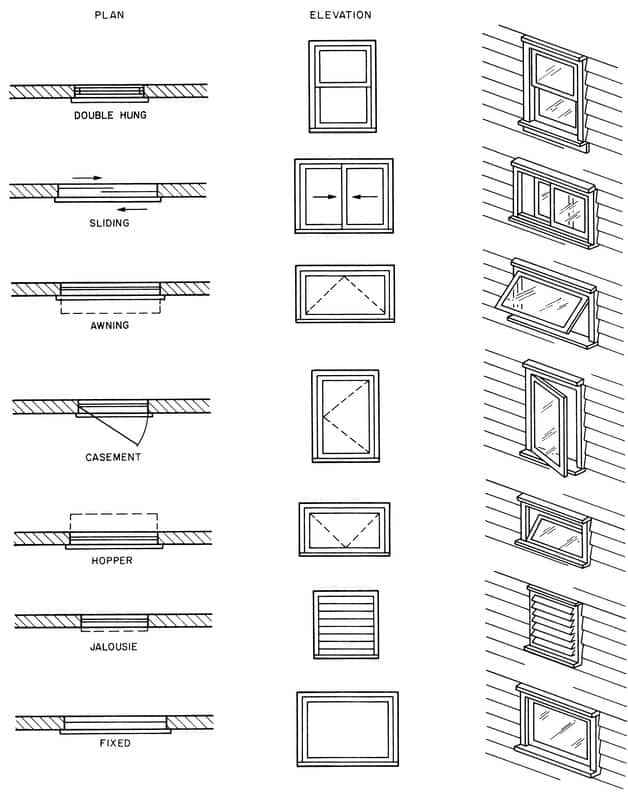
Doors and windows have their own symbols by type and by wall. DEWALT’s symbol set gives double-hung, casement, slider, fixed-glass and awning or hopper windows separate plan and elevation symbols, with the elevation marking a window’s hinge side, and varies the opening symbols for frame walls, brick veneer walls, masonry walls and interior partitions. US Navy blueprint practice likewise draws the window sash one way in a frame wall and another in a masonry wall.
A. Material Symbols
Material symbols, also called hatches or hatching patterns, show what an element is made of in plan, section and elevation. VA drawings carry hatches for concrete, earth, base course, rigid insulation and batt insulation, other common hatches cover brick, concrete masonry unit, steel, aluminum, plywood, wood framing and finish wood, and offices keep their own standards. Because one pattern can serve several materials, a hatch means what the set’s legend says it means. AutoCAD’s standard ANSI31 hatch is defined for iron, brick and stone masonry, and in mechanical drawing practice the general-purpose section line used in most section views is that of cast iron.
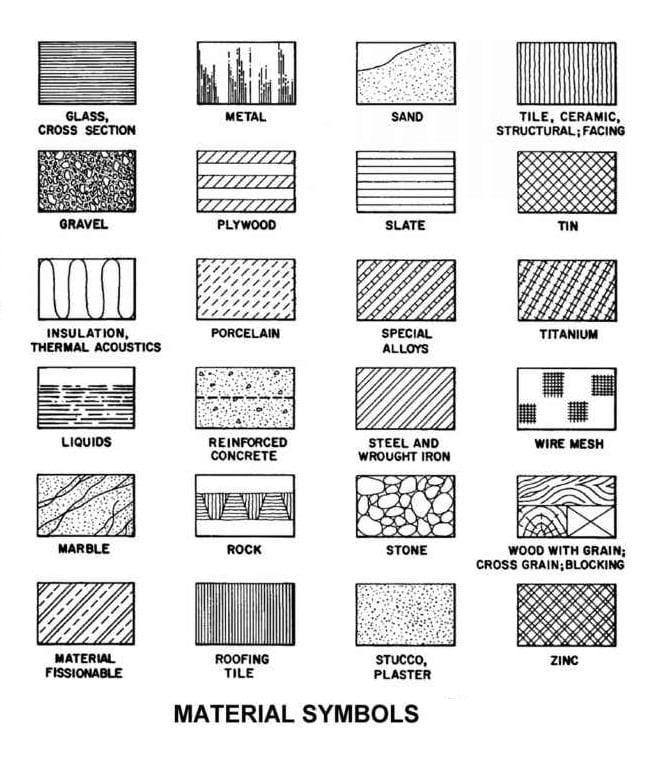
The same material can also be drawn one way in a section and another in elevation. In DEWALT’s material set, brick, stone, wood, concrete, concrete block, glass, insulation, structural steel, plaster, tile and plywood each have separate plan, elevation and section indications, though some views simply repeat the plan symbol or are indicated by note. In a section the cut part takes diagonal parallel section lines, and adjacent parts are crosshatched at different slants, while VA drawings also separate existing construction to remain, existing construction to be removed, drawn dashed, and new construction.
B. Section, Elevation and Detail Markers
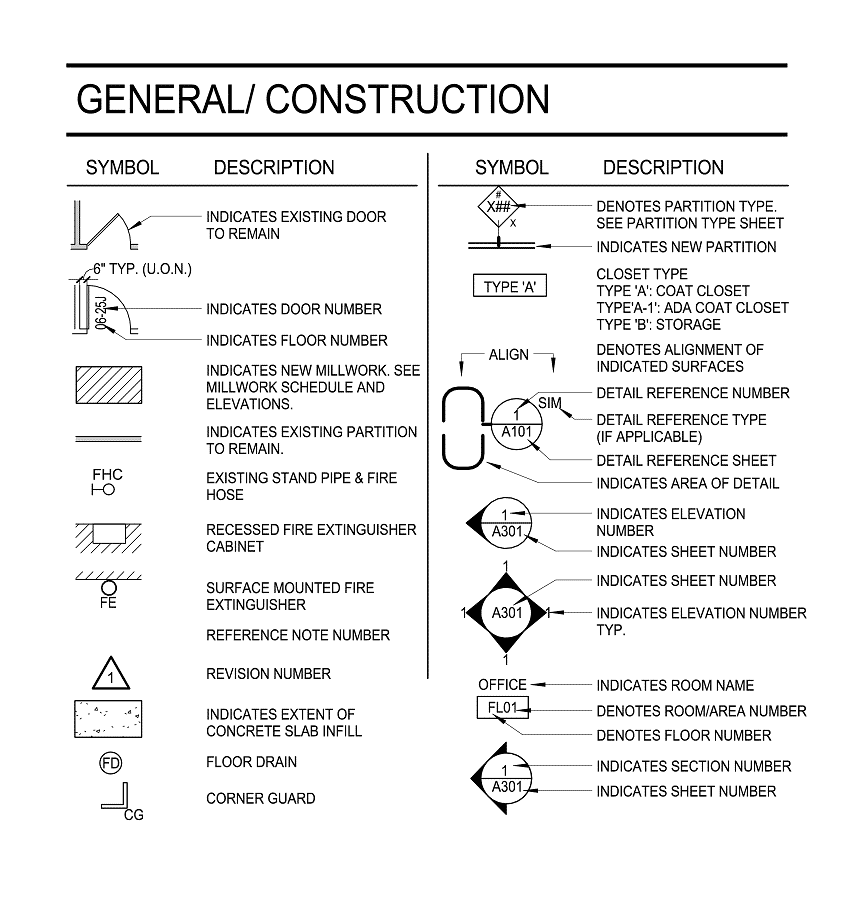
Section, elevation and detail markers are the callouts that link one drawing to another. On VA drawings the detail indicator, the building section indicator and the exterior and interior elevation indicators are circles split into a view number over a sheet number, such as A4 over A-201, and practitioners read building sections, wall sections, details and elevations the same way, drawing number on the top line and sheet number on the bottom.
A level or datum marker gives the height of a level line, a control point or datum, and drawings separate a new or required point elevation from an existing point elevation such as 461.0′. In Revit, levels are horizontal reference planes for floors, ceilings and roofs, and VA drawings abbreviate datum as DAT, elevation as EL and finish floor elevation as FF EL, while FF alone means finish face.
| Marker | Drawn as, VA standard | What it carries |
|---|---|---|
| Detail indicator | Circle split in two | Detail number over sheet number, plus the sheet where it is referenced |
| Building section indicator | Circle split in two | View number over sheet number |
| Exterior elevation indicator | Circle split in two | View number over sheet number |
| Interior elevation indicator | Circle split in two, single or multiple view | View numbers over sheet number |
| Keynote | Number in a hexagon | Keynote number |
| Door opening identifier | Number in an oval, set in the door swing | Door opening number |
| Room name and number | Room name over a boxed number | Room name and room number |
| Wall or partition type | Letters in a square on a leader | Wall or partition type |
| Furniture, fixture and equipment indicator | Number in an elongated hexagon | Furniture, fixture or equipment number |
| Level or datum marker | See the sheet legend | Level line elevation, EL or FF EL on VA sheets |
Shapes follow VA standard details SD000115-25 and SD000115-26, December 2008. Tag shapes vary by office and owner standard, and the sheet legend governs.
C. Legends and Abbreviations
An architectural legend is the key to a set’s symbols, notation and abbreviations, and the A/E/C CAD Standard reserves the general information sheets, the GI series, for the drawing index, the code summary and the symbol legend. The legend governs because abbreviations change meaning between disciplines and owners. RCP is a reflected ceiling plan on VA sheets and reinforced concrete pipe on a DEWALT plumbing legend, and FD is a floor drain among VA abbreviations and a fire damper on VA ductwork symbols.
AbbreviationsCommon abbreviations on architectural, electrical and plumbing sheets, and where each meaning is defined
| Abbreviation | Meaning | Where it is defined |
|---|---|---|
| A/C UNIT | Air conditioning unit | VA electrical abbreviations |
| AC | Alternating current or armored cable | VA electrical abbreviations |
| AFF | Above finished floor | VA architectural abbreviations |
| CL | Center line | VA architectural abbreviations |
| CLG HT | Ceiling height | VA architectural abbreviations |
| DAT | Datum | VA architectural abbreviations |
| DW | Dishwasher | VA architectural abbreviations |
| EL | Elevation | VA architectural abbreviations |
| EQ | Equal | VA architectural abbreviations |
| EQL SP | Equally spaced | VA architectural abbreviations |
| FD | Floor drain | VA architectural abbreviations |
| FD | Fire damper | VA ductwork symbols |
| FF | Finish face | VA architectural abbreviations |
| FF EL | Finish floor elevation | VA architectural abbreviations |
| GFCI | GFCI rated receptacle | Los Alamos electrical legend |
| HB | Hose bibb | VA architectural abbreviations |
| RCP | Reflected ceiling plan | VA architectural abbreviations |
| RCP | Reinforced concrete pipe | DEWALT plumbing legend |
| SIM | Similar | VA architectural abbreviations |
| TYP | Typical | VA architectural abbreviations |
| UON | Unless otherwise noted | VA architectural abbreviations |
| WG | Weatherproof and GFCI | Los Alamos electrical legend |
| WH | Water heater | VA architectural abbreviations |
| WP | Waterproofing | VA architectural abbreviations |
| WP | Weatherproof, in-use cover | Los Alamos electrical legend |
Meanings as each owner standard or reference defines them. A set's own legend governs.
2. Floor Plan Symbols
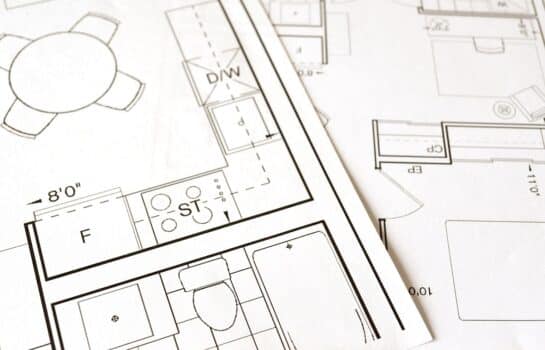
A floor plan is a view of a house or any other building cut by a horizontal plane and seen from above, which makes it a section as well as a plan. Cut heights are given differently even within one course, 1 meter above the floor in one passage and 4 feet, about 1.22 m, in another, where objects are sorted by whether they sit below, at or above that line. The plan carries walls, doors, windows, stairs, furniture and appliances, each drawn with its own symbol or line.
A. Compass
The compass, or north arrow, shows which way north lies on the plan and so the orientation of the property, and a north point goes on each floor plan, generally in the lower right-hand corner of the drawings. Revit keeps two norths apart. Project north is typically based on the predominant axis of the building geometry, while true north is the real-world north direction from the site conditions, used for site representation, solar studies and energy analysis, so directions read off a plan drawn to project north can differ from true north.

Download the North Compass Symbols for Architecture.
B. Doors
Door symbols on a floor plan show the opening in the wall and the swing of the door. In US Navy blueprint practice the door leaf is drawn as a line at right angles to the wall and its swing as a quarter-circle arc, which traces the floor space the door sweeps as it opens, for single and double doors opening in or out in masonry and frame walls. DEWALT’s symbol set covers exterior, interior, bifold, pocket sliding, bypass sliding, double action and accordion doors, with openings drawn for the same wall types.

Download the doors and windows plan CAD Blocks.
Doors are numbered with a tag, and its shape belongs to the office standard. On VA drawings the door identifier is a number in an oval set in the door swing and the hexagon marks a keynote, Los Alamos drawings use a door number tag, and some practitioners number each door after the room it leads to.
C. Windows
A window is drawn as thin lines inside the wall opening for the glazing and sash, and the pattern changes with the window type and the wall, with casement windows also showing the sash swing in US Navy practice. A window type tag carries a number that identifies the window type or the glass type, and Los Alamos drawings carry one among their architectural symbols. Window dimensions often carry abbreviations of their own, EQ for equal spaces, EQL SP for equally spaced and CL for a center line.
D. Stairs
Stair symbols on a floor plan are drawn as a series of tread lines, with the risers dashed because the tread and nosing hide them, the handrail often in two lines and the higher steps above the cut plane in fine dashed lines. An arrow gives the direction of travel with the riser count, as in Up 17R, and stairs up and stairs down are drawn apart.
E. Walls

Every wall the plan cuts, interior or exterior, takes the heaviest line and is often filled solid, the poché, while doors and windows stay unfilled and furniture, appliances and symbols take thin lines. Fire-resistive rated walls carry their own line types for 1, 2, 3 and 4 hours on the VA standard, and existing construction to remain, construction to be removed and new construction are drawn apart from one another.
F. Appliances
Plumbing fixtures such as toilets, sinks and bathtubs have symbols by type. In DEWALT’s symbol set, water closets, or toilets, are drawn with a tank or a flush valve, lavatories as vanity, wall, counter or pedestal units, kitchen sinks with a single or twin basin and a single or double drainboard, and baths, showers and urinals in several forms, with the dishwasher lettered DW, laundry trays LT and service sinks SS. US Navy blueprint practice draws lavatories, or sinks, and bathtubs as plain outlines, a shower stall as a square crossed by an X and a shower head as a triangle, and a small house’s floor plan drawn that way shows where the bathroom’s fixtures and piping sit.
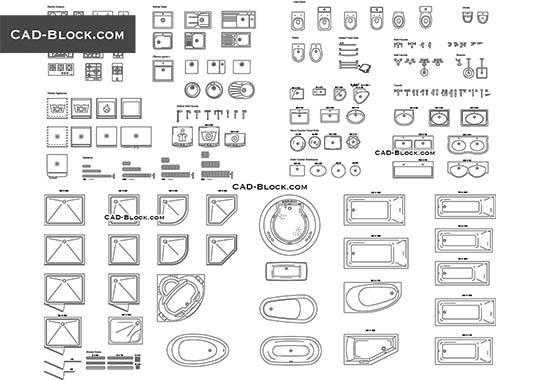
Download the appliances CAD Blocks.
Dashed lines on a floor plan mean an item is above the cut plane or hidden, as with upper cabinets drawn in fine dashed lines and the part of a dishwasher under the countertop, and the VA standard gives features above and hidden features their own line indicators.
3. MEP (Mechanical, Electrical, and Plumbing)
MEP drawings show the mechanical, electrical and plumbing systems with their own symbols and legends, from the receptacles and switches of an electrical legend to the duct symbols of HVAC sheets and the pipe connection symbols of piping prints. Electrical drawings on Los Alamos sets are treated as diagrammatic, indicating the general arrangement of work and systems, and the trades are to coordinate rough-in and installation requirements with one another.
A. Electrical Symbols
Electrical symbols for architecture and building construction are published in IEEE/ANSI Y32.9-1972, Graphic Symbols for Electrical Wiring and Layout Diagrams, which revised the 1962 edition and remains active, reaffirmed in 1989. Electrical signs and symbols can differ from one set to the next, so a set with electrical symbols carries a symbol legend sheet that explains any special symbols it uses.

Download the Electrical Symbols CAD Blocks.
Lighting arrangements are shown through the switches, marked on Los Alamos legends by subscript, 2 for double pole, 3 for three way, 4 for four way, K for key operated and OS for occupancy sensing, and a lowercase subscript ties a switch to the particular loads it controls.
Receptacle subscripts follow the same pattern, GFCI for GFCI rated, WP for weatherproof with an in-use cover and WG for weatherproof and GFCI, and a plus sign with a number, such as +84, gives a non-standard mounting height in inches above the finished floor, 84 inches being about 2,134 mm. Outlets other than receptacles carry their own symbols, and the Los Alamos drafting symbols include a TV wall outlet, a telecommunications outlet and an intercom outlet beside duplex, single and floor receptacle outlets.
B. Plumbing Symbols
Plumbing drawings abbreviate the pipe material, and VA drawings use CU for copper, CI for cast iron, GALV STL for galvanized steel, GI for galvanized iron and PVC for polyvinyl chloride, a plastic, while DEWALT’s plumbing legend adds DI for ductile iron and CT for clay tile. Fixtures and equipment carry abbreviations too, such as FD for floor drain, HB for hose bibb and WH for water heater.
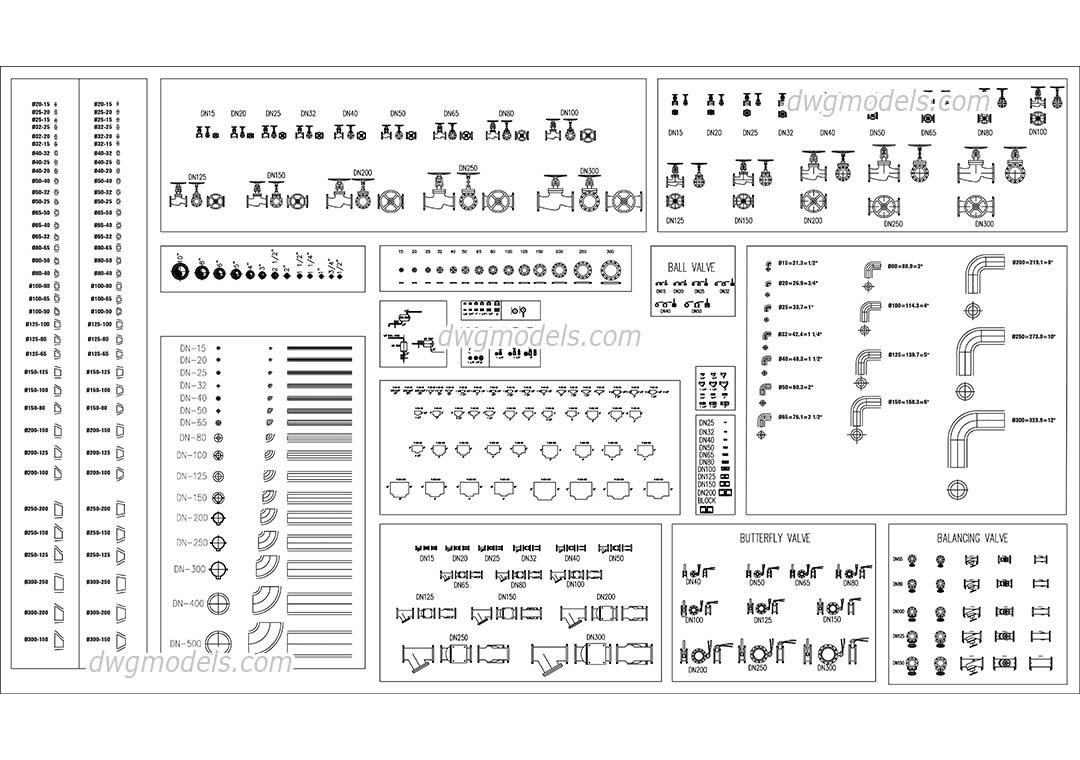
Download the Plumbing Fixtures and Fittings CAD blocks.
A pipe is drawn as a single line, and the connection type is marked across it. In the MIL-STD-17B symbols of US Navy blueprint reading, one short cross line marks a screwed end, two mark a flanged end, a curve marks a bell-and-spigot end, an X marks a welded or brazed end and a dot a soldered end. A simpler convention uses a heavy dot for a permanent connection and a single thick line for a detachable one, leaving the specification or a general note to say whether the fittings are flanged or threaded. Gas piping is lettered on the line by pressure in DEWALT’s piping symbols, G for low pressure, MG for medium pressure and HG for high pressure, with LPG for liquid petroleum gas.
Fittings and valves have symbols of their own, including unions, caps, strainers, concentric and eccentric reducers and elbows looking up or down. The US pipe fitting symbol standard ASME Y32.2.3-1949 is now available for historical reference only, and ISO 4067-1:1984, the international symbols for plumbing, heating, ventilation and ducting, was withdrawn in 2005.
C. Mechanical Symbols
Mechanical symbols on construction drawings cover heating, ventilating, air-conditioning and refrigerating systems, while fire alarm and fire protection symbols have a standard of their own, NFPA 170. The A/E/C CAD Standard cites the two side by side among its symbol references, ANSI/ASHRAE Standard 134-2005 for HVAC&R graphic symbols and NFPA 170 for fire safety and emergency symbols, alongside ANSI Y32.9-1972 for electrical wiring and layout.
I. Heating, Ventilation, and Air-conditioning Symbols (HVAC)
ASHRAE’s graphic symbols standard for HVAC&R systems, ANSI/ASHRAE 134-2005, went out for withdrawal public review in October 2017, and in January 2018 its standards committee pointed to the 2017 ASHRAE Handbook of Fundamentals, Chapter 38, Abbreviations and Symbols, for the same content.
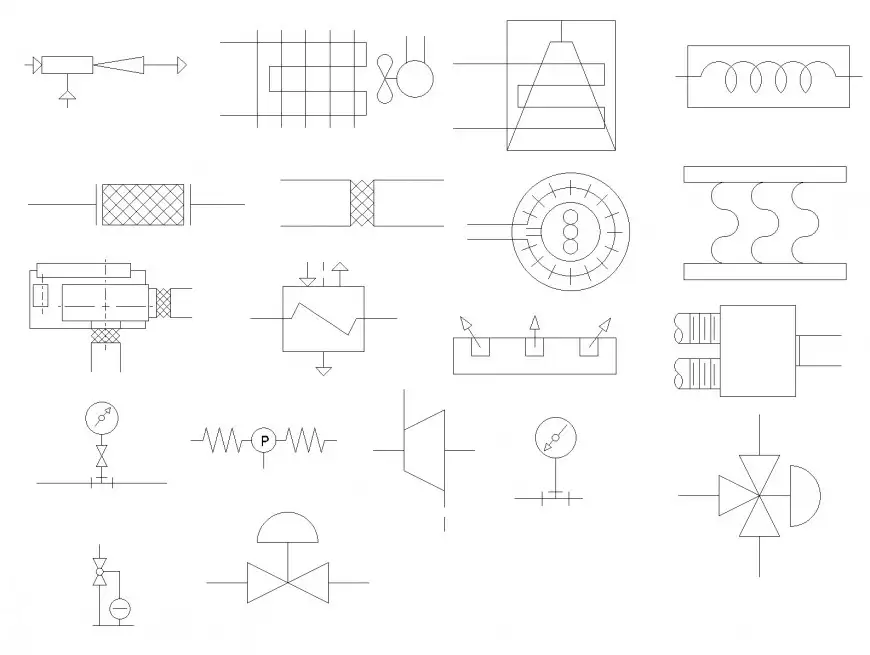
Download the Mechanical HVAC Symbols blocks.
HVAC plans show where the ducts run and where they turn, with separate VA ductwork symbols for supply, exhaust and return ducts turning up and down, ceiling diffusers, registers and grilles, inclined rises and drops in the direction of air flow and new duct connected to existing. Each new duct is tagged with its inside dimensions, width by depth, as in 10×8, and dampers are abbreviated FD for fire damper, VD for manual volume damper and BDD for back draft damper. Among VA electrical abbreviations an air conditioning unit is A/C UNIT, while AC stands for alternating current or armored cable.
II. Fire Alarm System Symbols
Fire alarm symbols are set by NFPA 170, the Standard for Fire Safety and Emergency Symbols, current in its 2024 edition, with a 2027 edition in development. Its 2009 edition gives Chapter 6 to symbols for use in architectural and engineering drawings and insurance diagrams, with sections for fire alarms, detection and related equipment, fire extinguishing systems, means of egress and smoke and pressurization control. The Los Alamos drafting symbols include a manual pull station, a photoelectric duct smoke detector, a magnetic door holder, a valve supervisory switch and a fire alarm control panel among their electrical symbols.
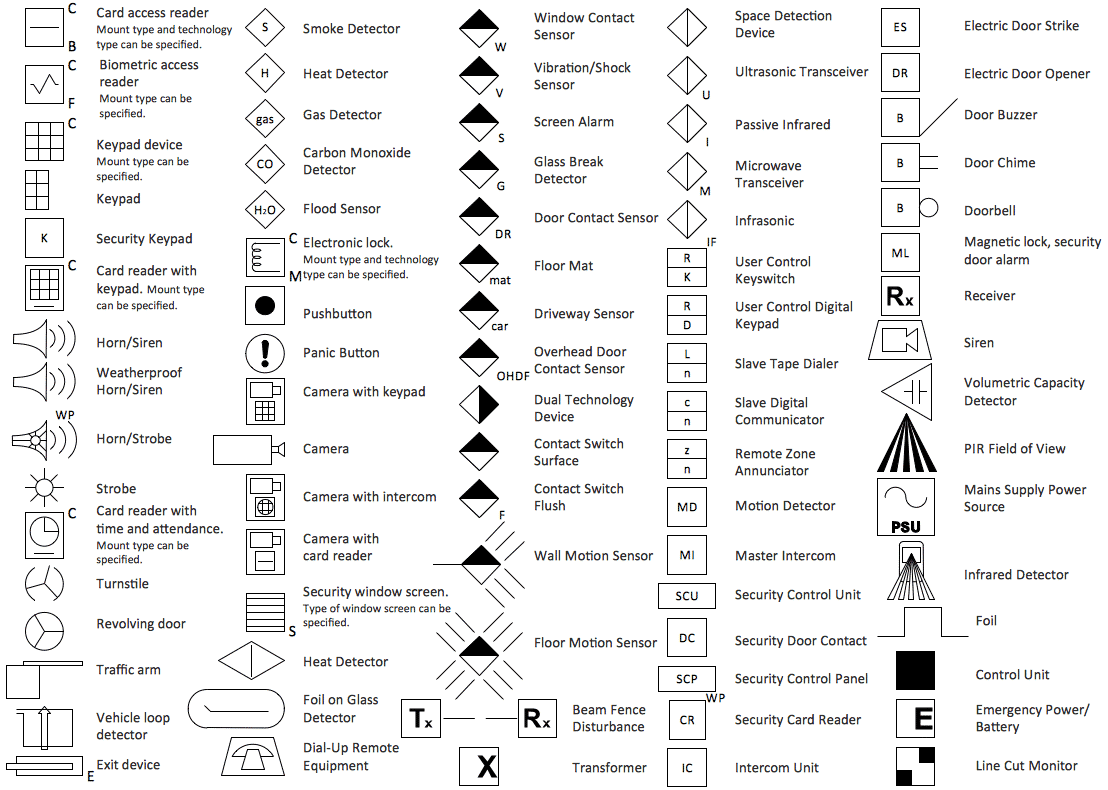
4. Reflected Ceiling Plan (RCP)
Reflected ceiling plans show the ceiling of each room, with lighting fixtures, junction boxes and partitions as symbols, and give the ceiling type and its height above the finished floor. The ceiling is drawn as if reflected in mirrors laid on the floor, and a Revit ceiling plan view looks up in the same way, with the model viewed as if looking down at a mirror.
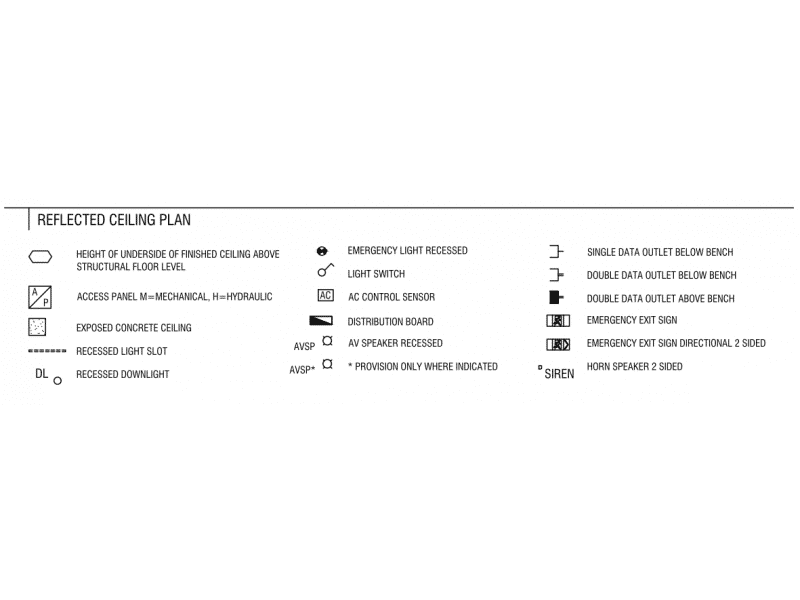
Download the Reflected Ceiling Plan Symbols Legend.
5. Miscellaneous Symbols
Symbol lists are a guide and a starting point for each office. DEWALT’s set, for one, collects the most common symbols by frequency of use among the architectural offices surveyed, and each office is expected to extend it with the symbols it uses. Where an item is not covered by the standards, the responsible party designs a suitable symbol and explains it in a note.
A. Component Symbols
Component symbols show the furniture, fixtures and equipment in a room and are drawn in thin lines. VA drawings number them with a furniture, fixture and equipment indicator in an elongated hexagon, and the A/E/C CAD Standard places furniture such as a desk at its actual size, which shows on the plan how much floor space the piece takes.
B. Specialist Symbols
Specialist trades such as welding use their own symbol systems. A welding symbol is built on a reference line and an arrow that points to the location of the weld, with the basic weld symbols and supplementary and finish symbols placed in standard locations on it, and a tail that calls up a certain process, specification or other reference.
Which Standards Define Architectural Symbols?
In the United States, architectural symbols are organized by the United States National CAD Standard, whose V7 combines the American Institute of Architects’ CAD Layer Guidelines, the Construction Specifications Institute’s Uniform Drawing System, Modules 1-8, and the National Institute of Building Sciences’ BIM Implementation and Plotting Guidelines. The Uniform Drawing System carries a Symbols module and a Terms and Abbreviations module, and the Department of Defense implements the standard through the A/E/C CAD Standard, Release 6.0 of August 2015.
Internationally, ISO 7519:2025 sets the presentation principles for construction drawings, and ISO 128-2:2022 and ISO 128-3:2022 the lines, views, sections and cuts. Two British standards have gone. BS 1192:2007+A2:2016, a code of practice for the collaborative production of architectural, engineering and construction information, was withdrawn in January 2019, and BS 8888:2017, written principally for manufacturing and engineering disciplines such as mechanical, automotive and aerospace, was withdrawn in December 2019.
Standards mapUS, ISO and British standards for drawing symbols, with editions and status
| Standard | Covers | Status as published |
|---|---|---|
| US National CAD Standard V7, NIBS | CAD layers, the Uniform Drawing System with its Symbols module, BIM and plotting | Voluntary adoption |
| A/E/C CAD Standard Release 6.0 | Department of Defense implementation of the NCS, ASHRAE and NFPA standards | Release 6.0, August 2015 |
| IEEE/ANSI Y32.9-1972 | Electrical wiring and layout diagrams in architecture and building construction | Active, reaffirmed 1989 |
| IEEE/ANSI 315-1971 | Electrical and electronics diagrams | Superseded, the A/E/C CAD Standard cites IEEE Std 315-1975 |
| ASME Y32.2.3-1949, R1999 | Pipe fittings, valves and piping | Historical reference only |
| ANSI/ASHRAE 134-2005 | Graphic symbols for HVAC&R systems | Withdrawal public review in 2017, content in the 2017 Handbook of Fundamentals, Chapter 38 |
| NFPA 170 | Fire safety and emergency symbols | 2024 edition, 2027 edition in development |
| ISO 7519:2025 | Presentation of construction drawings | Edition 3, February 2025 |
| ISO 128-2:2022 | Types of lines, with a construction annex in the 2020 edition | New version of 2022 |
| ISO 128-3:2022 | Views, sections and cuts | Edition 2, August 2022 |
| ISO 5455:1979 | Scales and their designation | Confirmed 2025 |
| ISO 4067-1:1984 | Plumbing, heating, ventilation and ducting symbols | Withdrawn 2005 |
| BS 1192:2007+A2:2016 | Collaborative production of construction information | Withdrawn January 2019 |
| BS 8888:2017 | Technical product documentation for manufacturing and engineering | Withdrawn December 2019 |
Status as each standards body lists it, as of October 2026. Local adoption and the project's own standard decide which edition governs a set.
Final Words
On diagrammatic electrical drawings, an undimensioned symbol shows the general arrangement of the work, and written dimensions always take precedence over measurements scaled off a print. Outlets and smoke detectors are representative symbols, doors and desks are drawn at actual size, and the legend sheet explains a set’s special symbols.
Related Links
Architecture or Achiterror | 13 Challenges Every Architect Faces Today
Draw Like an Artist | Buildings & Architectural Forms by David Drazil
17 Best Landscaping Design Software [Free & Paid]

very educative in well illustrated