

Frank Gehry, the legendary architect who redefined architectural form through sculptural design and digital experimentation, died on December 6, 2025, at age 96, at his home in Santa Monica. Gehry’s international influence spans projects such as the Guggenheim Museum Bilbao, Walt Disney Concert Hall in Los Angeles, and Fondation Louis Vuitton in Paris. The summary traces his career from early material experiments in California to global recognition through formally complex, technologically advanced structures. His use of aerospace-derived software like CATIA helped realize expressive, non-linear buildings that resisted repetition and embraced movement. Gehry’s approach, rooted in humanism and spatial emotion, expanded architecture’s cultural presence beyond traditional modernist boundaries. He won the Pritzker Architecture Prize in 1989 and the Presidential Medal of Freedom in 2016. His buildings shaped urban identities across continents and defined a new public architecture. Late works include the Forma towers in Toronto and the still-developing Guggenheim Abu Dhabi. Gehry remained active until his death, maintaining an unwavering commitment to pushing architectural limits. His work continues to inform architectural discourse and digital design practices globally.

Frank Gehry, the architect whose sculptural and digitally-aided buildings transformed contemporary architecture, died on December 6, 2025, at the age of 96. His death was confirmed by his chief of staff, Meaghan Lloyd. Gehry passed away at his home in Santa Monica, California, following a short respiratory illness. Born Frank Owen Goldberg in Toronto in 1929 to Russian-Jewish parents, Gehry relocated to Los Angeles in 1947. He studied at the University of Southern California, graduating in 1954, and briefly attended Harvard’s Graduate School of Design in 1956. In 1962, he established his own practice, which became Gehry Partners, known for pushing architectural conventions through experimentation with form and material.
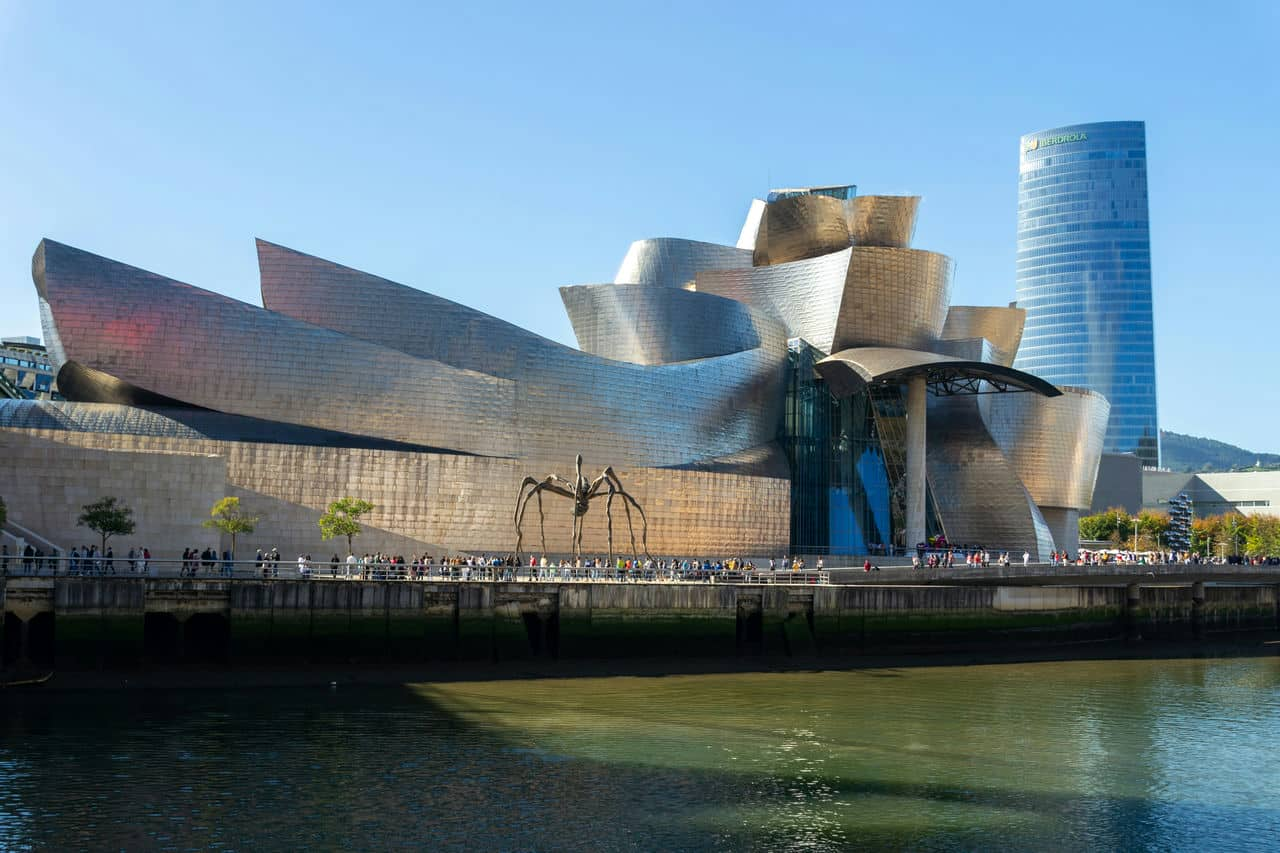
Gehry’s early recognition stemmed from the redesign of his own Santa Monica residence in 1978. Using unconventional materials like corrugated steel and chain-link fencing, he signaled a new direction away from the orthodoxy of postwar modernism. His approach evolved into a distinct formal language marked by asymmetry, fluidity, and a sculptural quality that drew influence from his lifelong fascination with fish forms and movement. His international breakthrough came with the 1997 opening of the Guggenheim Museum in Bilbao. Designed with curving titanium panels and innovative digital modeling, the project generated global attention for its cultural and economic impact, referred to as the “Bilbao effect.” Gehry later designed other landmark projects, including the Walt Disney Concert Hall in Los Angeles, the Fondation Louis Vuitton in Paris, and the Jay Pritzker Pavilion in Chicago.

Gehry adopted CATIA software, originally developed for aerospace design, to model his complex geometries. In 2002, he founded Gehry Technologies to help integrate this digital process into wider architectural practice. The firm was acquired by Trimble in 2014. Throughout his career, Gehry received major honors, including the Pritzker Architecture Prize in 1989, the Wolf Prize in 1992, the AIA Gold Medal in 1999, the RIBA Royal Gold Medal in 2000, and the Presidential Medal of Freedom in 2016, awarded by President Barack Obama. Gehry’s portfolio extended across typologies and continents. His projects include the Vitra Design Museum in Germany, the Dancing House in Prague, the Stata Center at MIT, the Weisman Art Museum in Minneapolis, and 8 Spruce Street in New York City. He also designed academic, civic, and commercial spaces, such as the business school at the University of Technology Sydney and the Facebook campus in Menlo Park.

In interviews, Gehry often emphasized the emotional and experiential dimensions of architecture. He described his designs as joyful and optimistic, in contrast to what he saw as the lifelessness of modernist rationalism. His methodology, often misunderstood, was not based on randomness but derived from a rigorous process of sketching, modeling, and computational refinement. Gehry remained active until the end of his life. Recent projects included the Luma Arles tower in France, the YOLA Center in Los Angeles, and the under-construction Guggenheim Abu Dhabi. The Forma Towers in Toronto, his hometown, are nearing completion.

He appeared in popular media, most notably voicing himself in a 2005 episode of The Simpsons, a portrayal he later regretted for trivializing his design process. Nevertheless, Gehry maintained a public persona that combined irreverence with intellectual depth. He once remarked, “98 percent of what gets built and designed today is pure shit,” expressing dissatisfaction with prevailing trends in architecture. Gehry is survived by his wife, Berta Isabel Aguilera, their sons Alejandro and Samuel, and two daughters, Leslie and Brina, from his first marriage. His work remains a central reference in architectural education and practice. Through a career that spanned over six decades, Gehry introduced a new spatial vocabulary rooted in complexity, emotion, and technological innovation.


