

Alberto Campo Baeza is a Spanish architect and the founder of Estudio Arquitectura Campo Baeza, based in Madrid, and one of the most famous Spanish architects to date. Born in 1946 in Valladolid and raised in Cádiz—where he developed an acute sensitivity to light—Campo Baeza has been a professor of architectural design at the ETSAM (Madrid) for over thirty years and is recognized globally for his rigorous, poetic architecture. His notable works include the celebrated House of the Infinite on the Atlantic shore and the Caja Granada Headquarters—projects through which he explores essential concepts such as gravity that constructs space and light that constructs time. Awarded the Arnold W. Brunner Memorial Prize, the Heinrich Tessenow Gold Medal, and a RIBA International Fellowship, among others, Campo Baeza remains committed to crafting architecture as “a built idea”—where clarity, reason, and yearning for beauty converge.
What inspires you?
I have pursued beauty vigorously. I have sought beauty with tireless dedication. I have chased after beauty desperately. I have searched and still search and will continue to search for beauty unto death or until I kill her. When I kill her with love on finding her, because I have put my heart and soul into it.
Because the search for beauty always speaks of the search for freedom. Seeking in architecture the freedom arising from the radicalism of undeniable reason, agreed with the desirable dream, always leads to truth, resulting in beauty.
The English poet Keats encapsulated it to perfection in the well-known lines of his Ode on a Grecian Urn:
“Beauty is truth, truth beauty, –that is all / Ye know on earth, and all ye need to know.”

What inspired you to become a designer?
My grandfather was an architect. A very good architect who built very beautiful buildings. His daughter, my mother, inoculated the architectonic virus in me. In such a way that I never had any doubt about becoming an architect.
How would you describe your design philosophy?
My philosophy is to serve our society with my best labor. The most creative and rigorous work using all my knowledge in the best possible way. I push my students to become wise architects. Wisdom in Architecture is not reserved for genial people. You can, you must be wise.
I try to be radical, deep, rational, and logical.
What is your favorite project?
It is my last built project: the Library for Le Lycée Français in Madrid. It is a box of light, une boîte à lumière dirait Le Corbusier. The tri‑edrus of light is really wonderful! The day when we removed the horizontal opaque protection, when I entered there, I cried. Someone said: there is more light inside than outside! I am very happy with the result.


What is your favorite detail?
The constructive detail for this tri‑edrus of the Library of the French Lycée in Madrid is my favorite.


Do you have a favorite material?
No. Every material has infinite possibilities. Like words in Poetry. But, at this moment, I must recognize that I am working in a very special way with translucent white glass. For its capacity of absorbing and reflecting the light, multiplying the effects and producing miracles, miracles of light. Like in my Library or in my Retable, also in Madrid.
What is your process for starting a new project?
To think. I need a lot of time. Like a doctor, I study the patient very well. I listen to every symptom, I visit the place, I study the history, and so on. Sometimes the inspiration arrives soon. Or sometimes it takes a lot of time. In any case, I only advance when I have a clear idea. I never continue a design if it is not clear in my mind. A building is a built idea.
How do you fuel your creativity?
My library of Poetry is bigger than my Library with books on architecture.
What inspired the House of the Infinite?
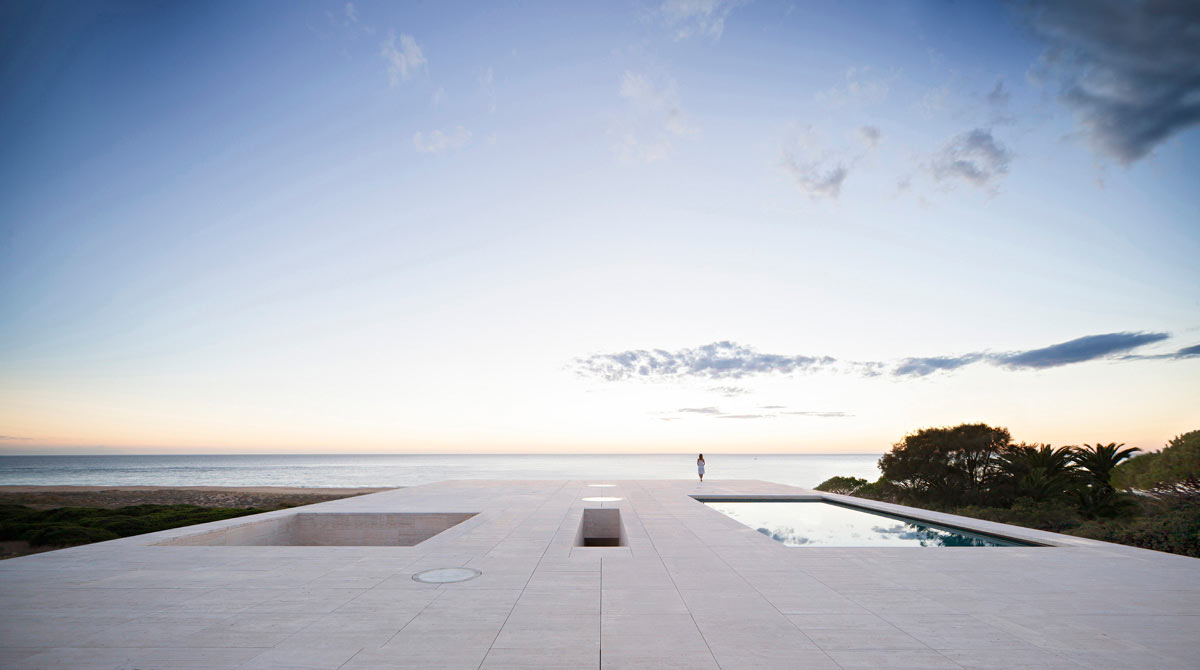
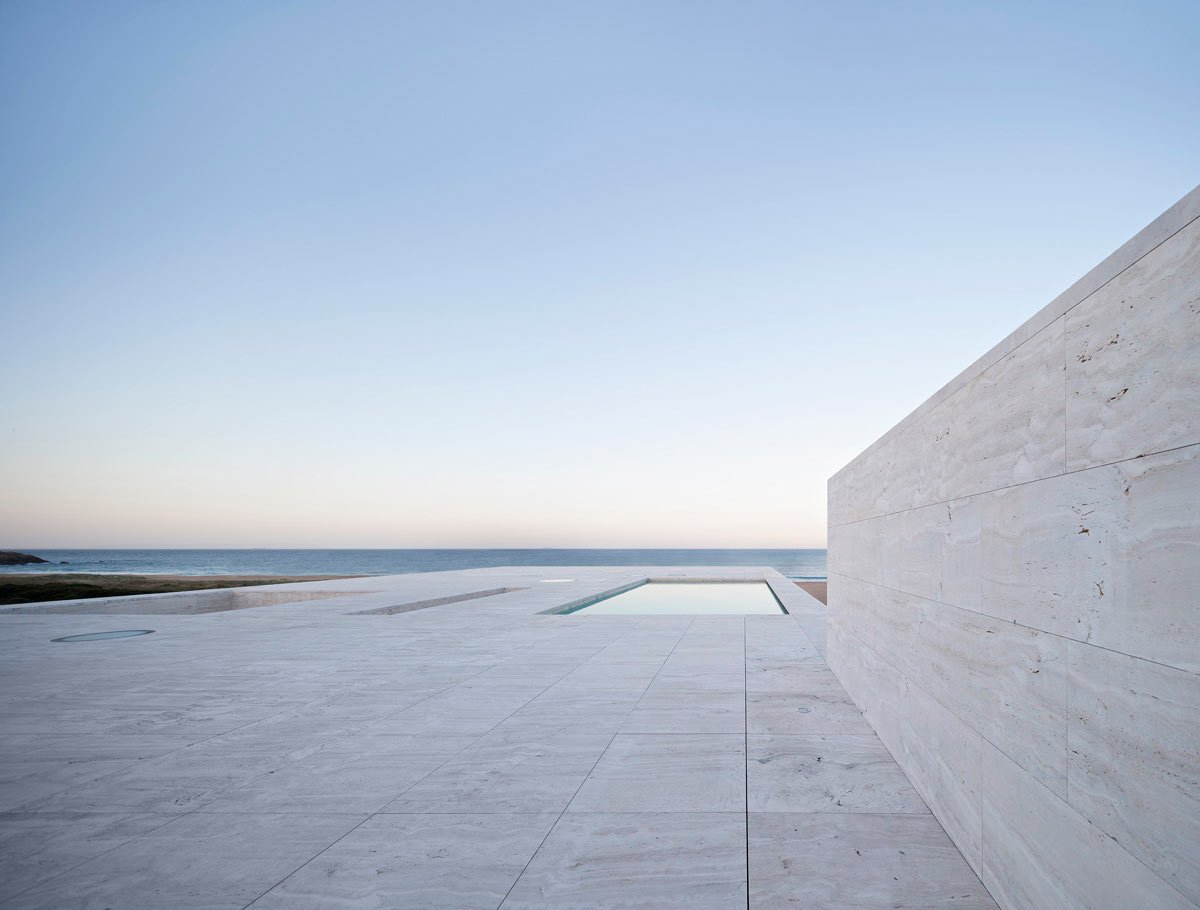
I know and I love the Atlantic Ocean, the sea! I knew the place for so long! It was not difficult to be inspired and to propose a temenos, a platform to be in front of the ocean. The platform should be parallel to the line of the infinite, to the horizon. Very clear. And because there was an ancient Roman place, I decided to use Roman travertine – travertino oniciato – to be with the same color as the sand. The temenos is placed on the sand in a very natural way. I am very happy with the result.
How did materiality shape the Caja Granada Headquarters?
I tried to materialize the strength of this bank. And I did it, and I got it.


How did the public embrace Andalucía’s Museum of Memory?
The public embraced Andalucía’s Museum of Memory embraced the new piece very well. I tried to be in continuity with the bank, and I used logical mechanisms to do it. And I think I got it. And Granada is very happy with this building.

What advice would you give to young architects?
To work, to work, and to work. I continue working and I am happy with architecture, the most beautiful labour all over the world. To dream and to have the possibility to materialize your dreams. And to be happy, I am.

