

Lyndon Neri and Rossana Hu are Chinese architects and co-founders of Neri&Hu Design and Research Office, an interdisciplinary architectural practice established in 2006 and based in Shanghai, with additional studios in London, Paris, and Milan. Educated in the United States and shaped by cross-cultural experience, Neri and Hu have developed a research-driven practice that operates across architecture, interiors, urbanism, and design, consistently engaging cultural, historical, and urban contexts as generative frameworks. Their work investigates the dynamic interplay between experience, material, detail, form, and light, often addressing themes of adaptive reuse, memory, and the everyday as a shared cultural ground. Supported by a diverse, international team, Neri&Hu has realized projects across Asia, Europe, and the Americas, and their work has been widely recognized through major international awards and publications for its conceptual rigor and cultural resonance.
What inspires you?
Our inspiration is deeply rooted in the everyday, the ordinary, and the mundane.
The essential fabric of Shanghai, with its intricate urban life and daily rituals, has always been a fundamental source of our creative language.
As our practice now extends to projects across different cities worldwide, our core approach remains: we seek and translate the unique meaning of the everyday within each specific cultural context. It is in these common threads of local life that we find our most authentic forms of expression.
What inspired you to become a designer?
Rossana Hu
For me, it came much later. For Lyndon, it was — I think he was born to be an architect. I didn’t focus early on what I wanted to study. I was interested in many subjects, all at once. The first architecture studio course at the University of California at Berkeley just brought on such fascination that it became the perfect major to do in school because it encompassed so many subjects, all at once. Professionally, it became natural at first that I practice what I studied, but it also turned out to be a thoroughly enjoyable profession. I love all aspects of architecture and design — with each project, it is like solving a new puzzle or going on a new journey. It is very rewarding to see a project built and take on its own life.
Lyndon Neri
Growing up in a typical Asian household, art was never an option, and it wasn’t even a subject for discussion. Yet, I’ve loved to draw and paint since I was young. For a long time, I assumed everyone could draw the same way everyone can walk or see. So when I learned realistic drawing, it felt natural, and I thought it was a universal skill. I always wanted to be an artist. When I moved to the States at fifteen, that dream grew, but it was a secret I kept from my father. His vision for me was clear: I would become a lawyer or an engineer. So I lied. In my first two years of college, I quietly majored in fine arts, spending my days drawing and painting. Then one day, my father called. “I think I might move to America to be closer to you,” he said. In that moment, I panicked. The lie I’d been living was about to unravel. As a fine arts major, switching directly to engineering seemed impossible. Architecture, however, became my happy medium and a field my father could understand and relate to. He saw it through the lens of real estate, especially during the booming ’80s in America. “Wow, my son is going to be great,” he’d say, imagining a future of financial success. I let him believe that. What he didn’t realize was that my path in architecture would be far from what he had pictured. But it’s been an amazing ride, and over time, he has come to accept not just the lie, but the passion I found along the way.
How would you describe your design philosophy?
Our core philosophy consistently navigates the delicate tension between human impermanence and our profound need for meaning. This is best encapsulated by a guiding principle for our practice from Saint-Exupéry: “We don’t ask to be eternal beings, but we ask that things do not lose all their meaning.”
This sentiment finds a powerful echo in the political philosophy of Hannah Arendt, particularly her seminal work, The Human Condition. Arendt distinguishes between the transitory life of mortals and the potential for enduring meaning through our creations and actions. This human-made world is meant to be durable; it is to outlast our individual lives and provide a stable context for future generations to appear, act, and remember.
Our work is fundamentally an act of stewardship for this human world. When we engage in adaptive reuse projects, we are directly confronting the modern crisis Arendt identified: the potential erosion of this common world. We are not merely preserving brick and mortar; we are actively resisting the loss of meaning by re-animating these spaces for contemporary life. This is where Svetlana Boym’s concept of “reflective nostalgia” becomes so crucial in our methodology. Unlike a “restorative nostalgia” that seeks a literal, and often false, return to a lost past, reflective nostalgia is prospective. It cherishes the patina of time, the fragments of memory, and the layers of history, not to recreate a museum, but to spark a new dialogue between past and future.
In practice, this means we approach a building not as a sacred relic, but as a palimpsest of human action and stories. We see our role as what Arendt would call “action,” which is the capacity to begin something new and unexpected within an existing framework. We insert new life, new functions, and new narratives into old structures, ensuring they remain a vibrant part of the public realm. We are creating the conditions for new stories to be told, while honoring the old ones.
What is your favorite project?
It’s difficult to choose a favorite, as every project holds its own importance. Yet, one that was truly pivotal in manifesting our ideology, and particularly around adaptive reuse, is our first architectural project: the Waterhouse.
For us, it was essential that the hotel’s design drew inspiration from the neighborhoods of Shanghai, but not in a literal or touristic manner. Instead, we aimed to offer guests an abstracted, interpreted experience of the city. We embedded distinct features of Shanghai into the design in subtle, unexpected, and sometimes uncanny ways.
The spatial experience is strongly influenced by Shanghai’s traditional nongtang lanes, where the boundaries between interior and exterior, private and public, are intentionally blurred. From guestroom windows, one might look directly into the hotel lobby or restaurant, creating a layered sense of community. Throughout the hotel, graphic installations feature quotes on travel from past Shanghainese literati, alongside local phrases about food, clothing, and daily life—familiar to residents yet intriguingly obscure to outsiders.
Even the new rooftop addition echoes its context: its architectural form and materiality reflect the ships that pass along the Huangpu River just beyond. In these ways, Waterhouse became a quiet translation of place, not a reproduction.
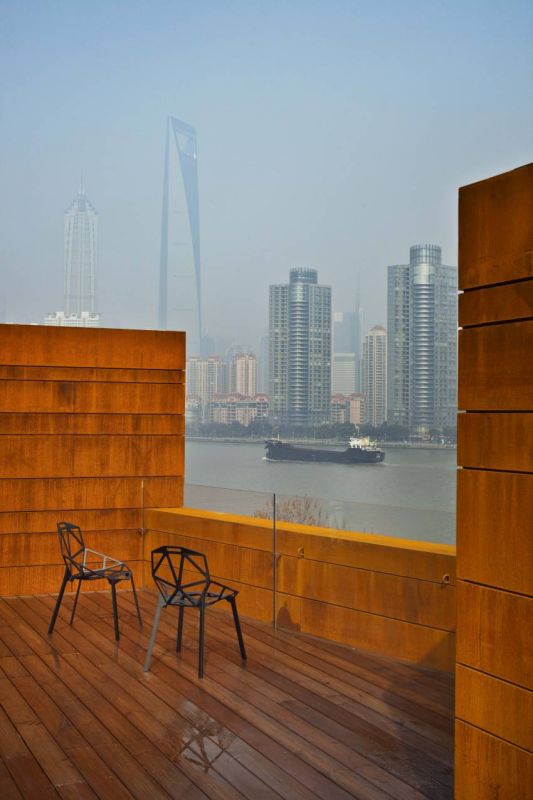
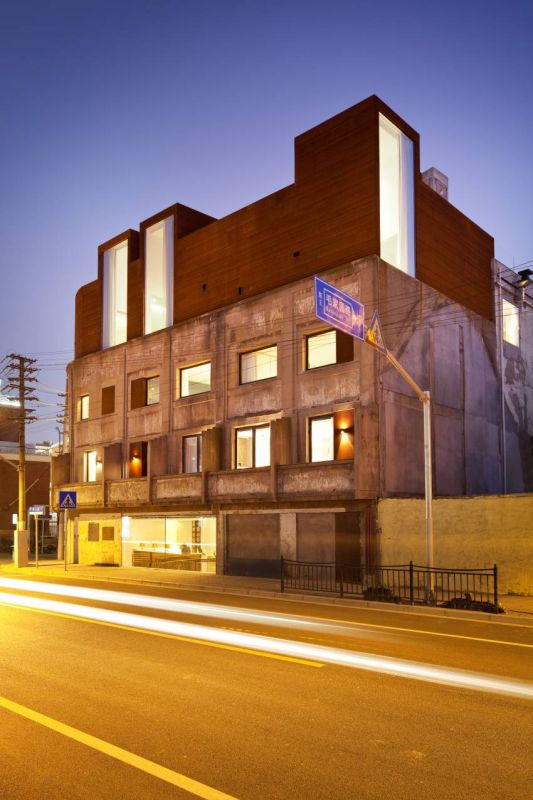

What is your favorite detail?
One of our favorite details is the way we chose to highlight, rather than conceal, the traces of time when dealing with adaptive reuse projects. This idea is particularly evident in a recent project, The Telegraph Hotel, which once served as Tbilisi’s central post office and telegraph office. Our transformative intervention is not an act of restoration but of “critical reinterpretation.” The approach is guided by Svetlana Boym’s concept of “reflective nostalgia,” which favors the fragmentary, the incomplete, and the poetic over a mythologized reconstruction of the past. Instead of plastering over the cracks of time, the design highlights them, creating a layered dialogue between the building’s raw, existing concrete structure and elegant new insertions. This method honors memory not by embalming the building as a relic, but by allowing its history to resonate through its new life.


Do you have a favorite material?
Every project presents its own material conditions—it’s difficult to articulate fixed preferences. Generally, we gravitate toward materials that feel natural, familiar to us, while exploring those that are locally sourced and proven durable over time. We prefer materials to appear in their most honest state. We often use cement with rough tactile qualities, and treat wood with oil wax to protect without concealing true texture. Metals typically receive matte or brushed finishes—though not invariably. It depends on which material best serves a particular project’s intentions.
What is your process for starting a new project?
Our process always begins with a conceptual premise. From there, we conduct research, seeking traces and signs that can guide the project. The path of inquiry is often shaped by the specific conditions and challenges each project presents.
Certain foundational themes remain constant in our exploration—layering, transparency, texture, framing, and materiality are all essential concerns that permeate our work. However, at a deeper level, we are engaged with questions of culture and aesthetic philosophy. We strive to connect what we design to the realm of the everyday, ensuring it resonates meaningfully with the public experience.
In essence, while our approach adapts to context, it is guided by a consistent pursuit of material and spatial poetry rooted in human and cultural landscapes.
How do you fuel your creativity?
Interdisciplinary research is an integral part of how we fuel our creativity. It is intertwined with every project from the start. While architecture remains the foundation for everything we do, approaching design as a holistic, multidisciplinary practice keeps our thinking fresh and continuously nourishes our creative process.
What inspired The Urban Monument?
The Urban Monument | Qujiang Museum of Fine Arts is located at the beginning section of Xi’an’s Datang Everbright City, south of the famed Giant Wild Goose Pagoda. The client asked for a new architectural icon at the East Entry of the museum. In response to the brief, our proposal takes the idea of a monolithic urban monument as the guiding concept to not only satisfy the museum’s newly expanded cultural and commercial functions, but to also serve as an anchor and a durable symbol of social history for the surrounding urban fabric.


How did materiality shape The Chuan Malt Whisky Distillery?
Winning the design competition presented us with the distinct challenge of creating The Chuan Malt Whisky Distillery, which was the inaugural home for Pernod Ricard’s first whisky in China. This project became an embodiment of the refined artistry inherent in whisky-making, engaging in a dialogue with traditional Chinese craftsmanship and material knowledge.
A palette of varied concrete, cement, and stone mixtures forms the foundational materiality, resonating with the pronounced mineral character of the site itself. Accents are drawn directly from the craft of whisky: the warm tones of copper from the distillation pots to the rich textures of aged oak from the casks. The design thus serves as a physical narrative, translating the spirit’s journey into architectural form.


How did the public embrace Aranya Art Center?
The design scheme is as much about the internal courtyard, a communal space for the residents, as it is about the exhibition being displayed in the center. The scheme maximizes its outer footprint but carves out a pure conical geometry at the center with a stepped amphitheater at the base. The central void space can be reconfigured and used in many ways, a water feature when filled with water, but also a functional performance and gathering place when the water is drained. The exhibition galleries above benefit from the public space integration, but it also makes the project much more than just a place for display; it is also a place for sharing. Within the thick mass of the building volume is a series of interlocking spaces that visitors can meander freely within, slowly ascending, enjoying a choreographed journey with directed views both inward and outward.


What advice would you give to young architects?
Architects carry a profound social responsibility. We must consciously balance our myriad roles and look beyond the surface, thinking deeply about the implications of what we build and its relationship to the city. Architecture is never merely about style or a particular look; it must always be grounded in meaning. This requires breaking from conventional practices and thinking beyond established frameworks to create work that is both innovative and genuinely purposeful.


