

Architects: Mario Cucinella Architects (MCA)
Year: 2021
Photographs: WASP
3D Printing Specialist: WASP
Municipality: Massa Lombarda
Country: Italy
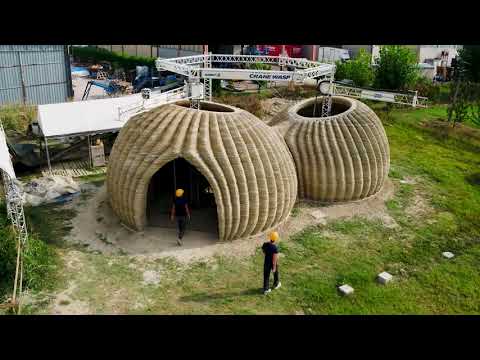
TECLA, a 3D-printed housing prototype by Mario Cucinella Architects (MCA) and WASP in Massa Lombarda, Italy, utilizes raw earth as a natural, recyclable, and carbon-neutral material. Combining “Technology” and “Clay,” the project maximizes digital fabrication with a double-dome design that serves as structure, roof, and cladding, reducing resources and construction time. Unlike conventional 3D printing, Crane WASP’s system synchronizes two robotic arms to build adaptable living modules efficiently. The prototype required 200 hours of printing, 7,000 machine codes, 350 layers of 12 mm, 150 km of extrusion, 60 cubic meters of raw earth, and consumed under 6 kW of energy. Inspired by the potter wasp, TECLA sets a precedent for scalable, sustainable architecture. Mario Cucinella describes it as “a paradigm shift in the field of architecture, meeting the needs of people and finding an answer for the ‘Earth’ within the ‘earth’.”
A collaboration between Mario Cucinella Architects (MCA) and WASP, specialists in 3D printing in Italy, has led to the creation of the first 3D-printed structure made from a fully natural, recyclable, and carbon-neutral material: raw earth. The circular housing prototype, named TECLA, was constructed in Massa Lombarda (Ravenna, Italy) using multiple 3D printers operating simultaneously in a synchronized process.


The project’s name, TECLA, is derived from the combination of the words “Technology” and “Clay” and aims to enhance the traditional use of raw earth through digital fabrication. The structure features a double-dome design that functions as the framework, roof, and cladding, streamlining construction processes, minimizing material usage, and shortening building time.


3D printing has traditionally been used to manufacture individual components and elements. However, in this project, Crane WASP employs specialized software that optimizes movement and prevents collisions, enabling two printing arms to operate simultaneously. This modular, multilevel system can be adapted to different designs, expanding the potential applications of the technology to more complex projects. According to its developers, “each printing unit has a printing area of 50 square meters, making it possible to build independent living modules of any shape and in a few days.”


The TECLA project required 200 hours of printing, 7,000 machine codes (G-code), 350 layers of 12 mm, 150 km of extrusion, 60 cubic meters of raw earth, and an average energy consumption of less than 6 kW. Inspired by the potter wasp, the prototype establishes a foundation for the development of larger and more efficient sustainable habitats. Mario Cucinella describes it as “a paradigm shift in the field of architecture, meeting the needs of people and finding an answer for the ‘Earth’ within the ‘earth.’ A collaboration that becomes the union between empathic architecture and the application of new technologies.”
Project Gallery


Project Location
Address: Massa Lombarda, 48024, Province of Ravenna, Emilia-Romagna, Italy
Location is for general reference and may represent a city or country, not necessarily a precise address.

