

Blackout curtains keep heat out modestly and measurably — the U.S. Department of Energy credits medium-colored draperies with white backings with cutting summer heat gain by about 33 percent, and the same guidance credits drawn heavy draperies with reducing winter heat loss from a warm room by up to 10 percent. Those two figures are the truthful core of a category drowning in bigger claims, and everything that determines whether your curtains reach them — color, backing, and above all installation — fits in the few minutes this page takes. A number worth clearing away first: the 25 to 30 percent energy savings figure that circulates through curtain marketing has no source in the DOE’s published guidance, and no credible measurement behind it that this publication could find. Readers who arrived shopping can go straight to our verified picks in the best blackout curtains guide; the physics below explains what those picks can and cannot do.
What the Department of Energy Actually Measures
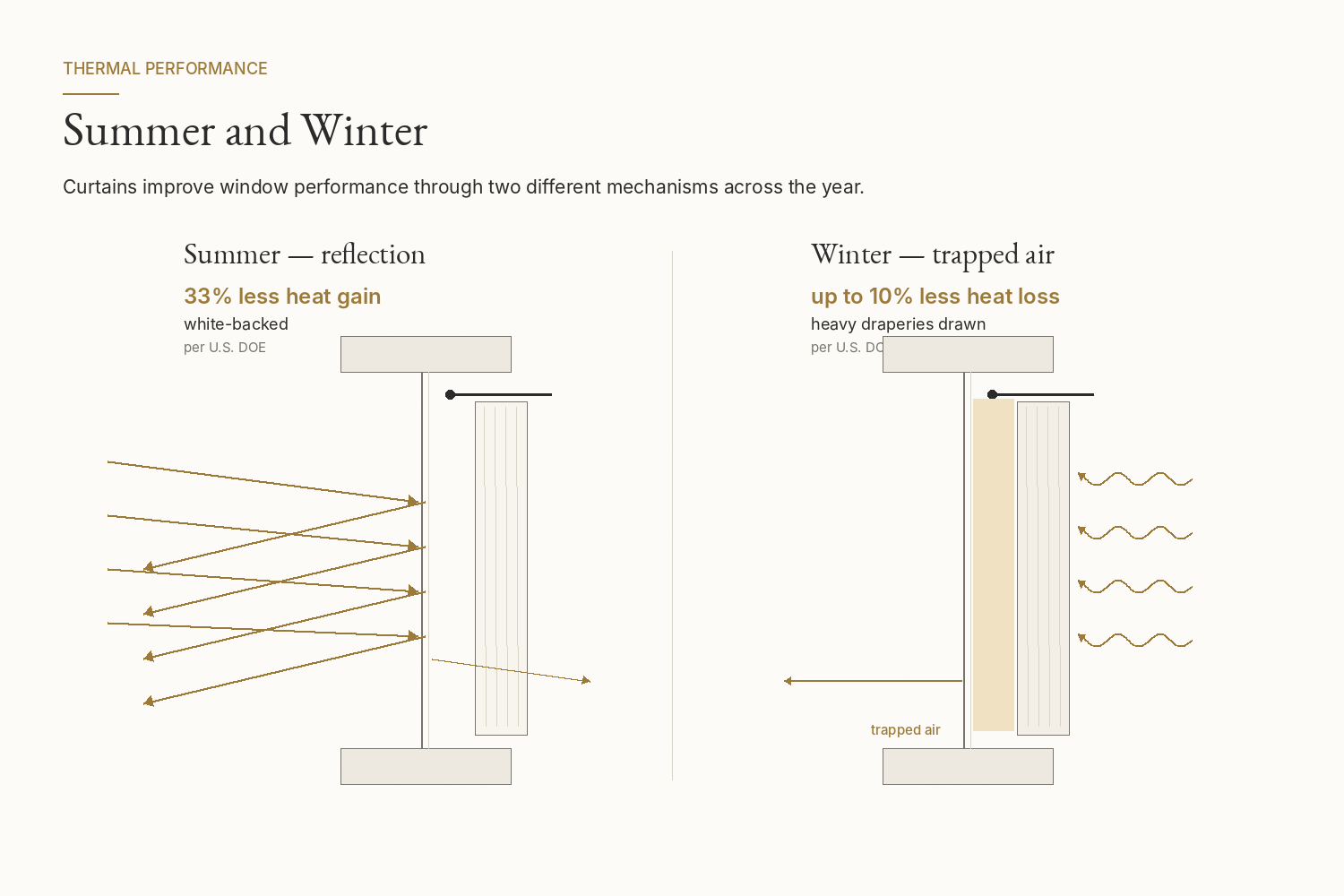
The DOE’s window-covering guidance separates two seasons and two mechanisms. In summer the enemy is solar gain — radiation pouring through glass — and fabric fights it by reflection, which is why the standout figure belongs to a specific construction: medium-colored draperies with white plastic backings, reducing heat gain by about 33 percent, the white layer bouncing solar energy back out before it becomes room heat. In winter the enemy is conduction and drafts, fabric fights by trapping still air against the glass, and the ceiling is lower — up to 10 percent less heat loss from a warm room with heavy draperies drawn. For scale, the same guidance credits smart management of window coverings overall with heat-gain reductions up to 77 percent, a figure that belongs to the whole toolkit of awnings, shades, and films working together, and that curtain marketing sometimes borrows alone.
Color Does Half the Summer Work
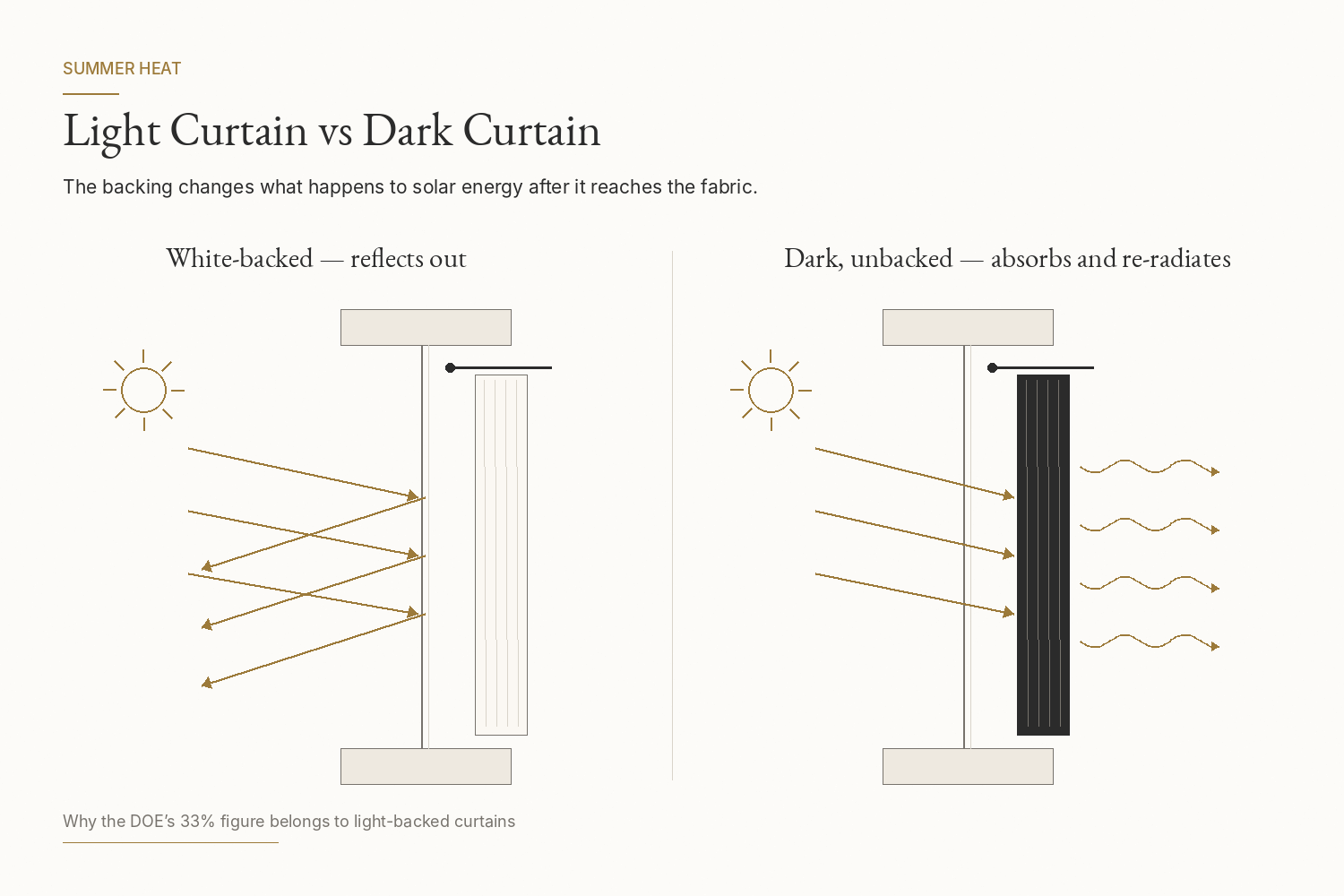
The 33 percent figure carries a specification most buyers skip past — medium colors with white or reflective backings. Color decides what happens to the solar radiation a curtain intercepts: light and reflective surfaces bounce it back through the glass, dark surfaces absorb it and re-radiate the heat into the room from six inches away, which converts a dark blackout curtain into a slow radiator on a west-facing window. Summer performance favors the light half of any line’s palette and the white-lined constructions — several picks in our guides to the best blackout curtains and best thermal curtains carry exactly that build — while winter is color-agnostic, since trapped air insulates identically behind any shade.
Blackout Curtains and UV
The ultraviolet question rides along with the heat question and earns its own answer — an opaque blackout construction blocks the UV that would otherwise pass the glass, and liner-grade builds block effectively all of it, which manufacturers state plainly on the lined products in our roundups. The practical stake is fading: UV through an uncovered window bleaches hardwood, upholstery, and art in patches that track the sun’s path, and a drawn blackout panel is the cheapest fade protection a sunny room can buy. The same color logic applies twice — the white-backed constructions that reflect summer heat also take the UV duty on their sacrificial back layer, sparing the decorative face.
Installation Decides the Result
The DOE’s own prescription for reaching its published numbers reads like a measuring lesson, because it is one — hang the fabric as close to the glass as possible, run it to the sill or the floor, cap the top with a cornice, seal the sides against the wall, and overlap the panels at center, with two layered treatments trapping a tighter air space than one. Every element closes a path that moving air would otherwise take around the fabric, and a curtain hung short, narrow, and gapped forfeits most of the benefit whatever its construction. The arithmetic that executes each of those instructions — rod extension, fullness, overlap, and the header offsets that set the drop — is the whole subject of our guide to how to measure for blackout curtains.
Where Curtains Sit on the Retrofit Ladder
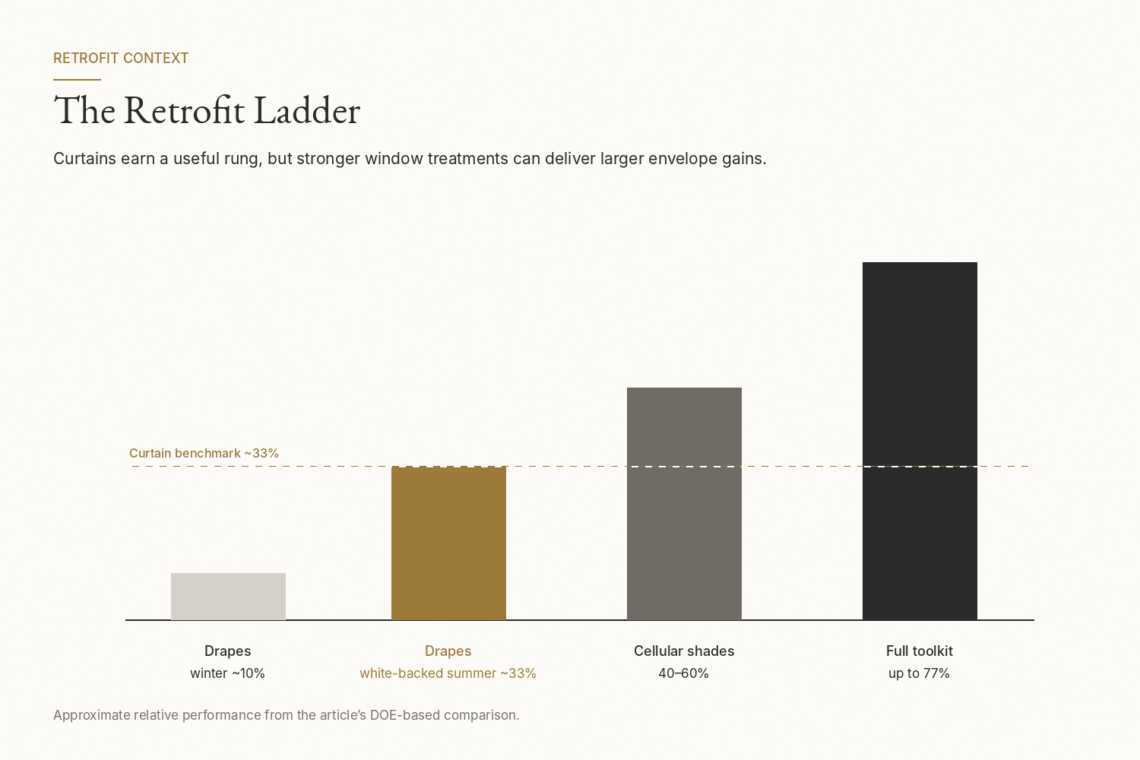
An architecture publication owes the context most curtain pages omit — windows are the envelope’s weakest surface, and curtains are the accessible layer of the fix, never the strongest one. The DOE’s figures for tightly installed cellular shades run to 40 percent less heat loss through the window itself and up to 60 percent less solar gain, roughly quadrupling what draperies manage, because sealed honeycomb cells beat hanging fabric at trapping air. The ladder climbs from there through storm windows and films to glazing itself. Curtains earn their rung on cost, reversibility, and the fact that they were coming for the light control anyway — a renter can install the 33 percent solution in an afternoon and take it to the next apartment, which no glazing upgrade will ever say.
Frequently Asked Questions
Do blackout curtains keep a room cooler in summer?
Yes — by about a third less heat gain per the Department of Energy, provided the curtain is a medium or light color with a white or reflective backing and hangs sealed close to the glass. A dark unbacked panel absorbs solar radiation and re-radiates it inward, doing a fraction of the job.
Do blackout curtains help in winter?
Yes, up to about 10 percent less heat loss from a warm room when heavy panels are drawn, per the same DOE guidance. The mechanism is trapped air, so winter results reward the installation rules — floor length, sealed sides, center overlap — more than any color choice.
What color curtain blocks the most heat?
For summer, medium and light colors with white backings — the reflective layer bounces solar energy back out the glass, and the DOE’s 33 percent figure belongs to exactly that construction. Dark colors absorb and re-radiate, which suits winter ambiance and undercuts summer performance.
Do black curtains make a room hotter?
In summer, on a sun-struck window, yes they can — dark fabric absorbs solar radiation and re-radiates the heat into the room from inches away, working as a slow radiator. The exception proves the mechanism: a black liner behind a white or light face causes no such problem, because the reflective face bounces the energy out before the dark layer ever absorbs it. Buy dark faces for winter ambiance and shaded windows; buy light or white-backed faces for the sunny side.
Do blackout curtains keep heat in during winter?
Yes — up to about 10 percent less heat loss from a warm room with heavy panels drawn, per the Department of Energy, and the same trapped-air mechanism keeps the cold out at the glass and blunts drafts at the frame. Winter rewards the installation rules over any color choice: floor length, sealed sides, panels overlapping at center.
Do blackout curtains wear out?
The construction decides the aging. Coated and foam backings fail first — sun and washing eventually craze and peel the applied layer — while woven constructions and sewn-in fabric liners age the way curtains always have, slowly and gracefully. Gentle washing per the label, and lining the sunniest windows with the white-backed builds, extends any of them; a peeling backing is the sign to replace, since the blackout leaves with the coating.
Are thermal curtains better than blackout curtains for heat?
The categories overlap more than they compete — thermal describes insulating construction, blackout describes opacity, and many products are both. For heat specifically, construction and installation decide the result at any opacity, and our best thermal curtains guide covers the builds that take the job seriously.
Resources
- U.S. Department of Energy — Energy-Efficient Window Coverings guidance
- Architecture Lab — How to Measure for Blackout Curtains
- Architecture Lab — Best Blackout Curtains
- Architecture Lab — Best Thermal Curtains

