
home/diy projects & ideas/can thermal imaging detect moisture? – what it sees & misses
DIY Projects & Ideas
Can Thermal Imaging Detect Moisture? – What It Sees & Misses
Published 5 January 2023 · Updated 18 August 2026
In brief
Thermal imaging can detect moisture indirectly, and the distinction decides how much to trust it — the camera never sees water, it sees the temperature signature water creates on a surface. Damp material reads cooler than its dry surroundings in most conditions because evaporation chills it, and a thermal camera photographs that cool patch through drywall paint, ceiling texture, or siding. The method finds hidden leaks, tracks intrusion to its source, and screens large areas in minutes — and it carries two limits every user should know before trusting a…
Thermal imaging can detect moisture indirectly, and the distinction decides how much to trust it — the camera never sees water, it sees the temperature signature water creates on a surface. Damp material reads cooler than its dry surroundings in most conditions because evaporation chills it, and a thermal camera photographs that cool patch through drywall paint, ceiling texture, or siding. The method finds hidden leaks, tracks intrusion to its source, and screens large areas in minutes — and it carries two limits every user should know before trusting a colored image: moisture with no surface temperature effect is invisible to it, and a cool patch has several possible causes until a second instrument settles the question.
The Mechanism Is Evaporation
Water changes a surface's thermal behavior three ways, and evaporation dominates. Moisture migrating through drywall, plaster, or wood evaporates at the surface, and evaporation consumes heat — the same physics that cools skin after a swim — so the damp zone runs a few degrees below its dry neighbors. Wet material also holds more thermal mass and conducts heat differently, which strengthens the signature when indoor and outdoor temperatures differ. The camera resolves these small differences easily; the sensitivity tiers in our guide to what thermal imaging is explain why serious moisture work wants cameras rated below 60 millikelvin, where a fraction-of-a-degree gradient still renders as a visible shape.
What the Pattern Looks Like
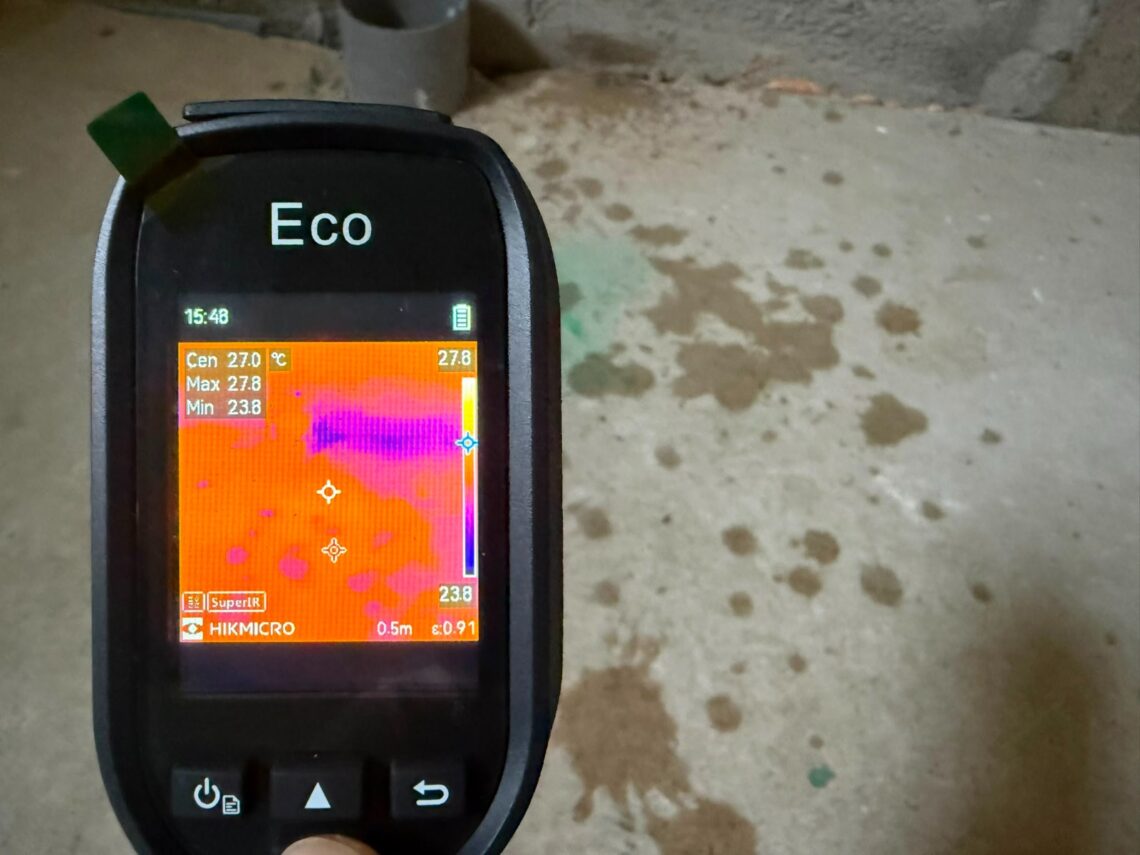
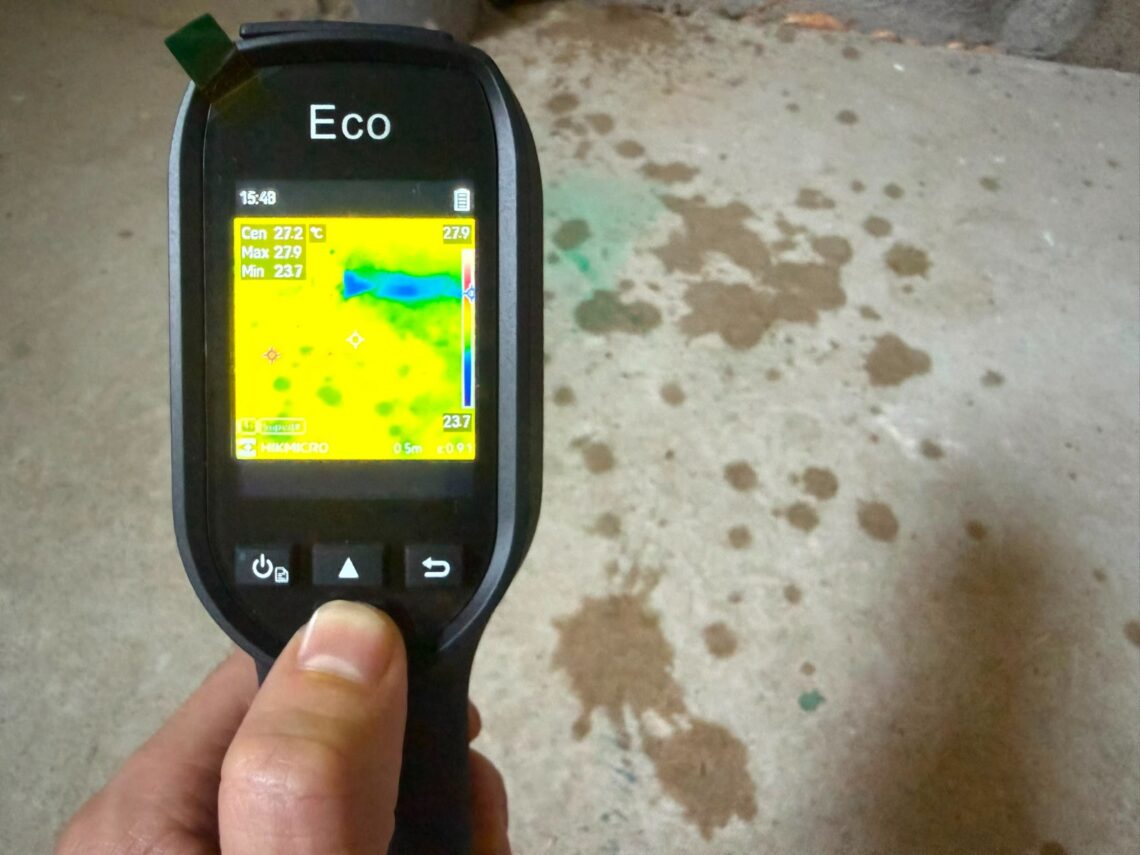
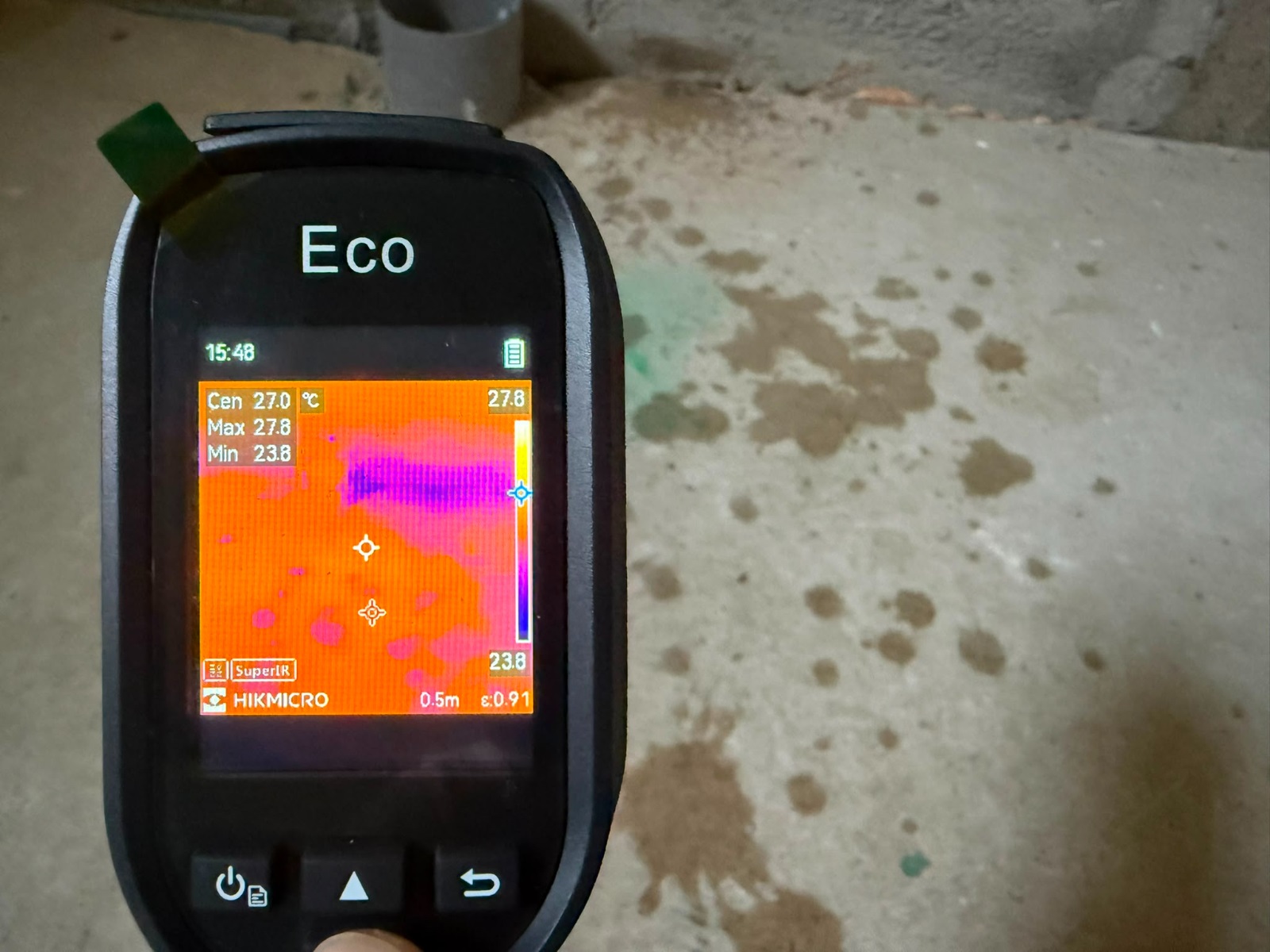
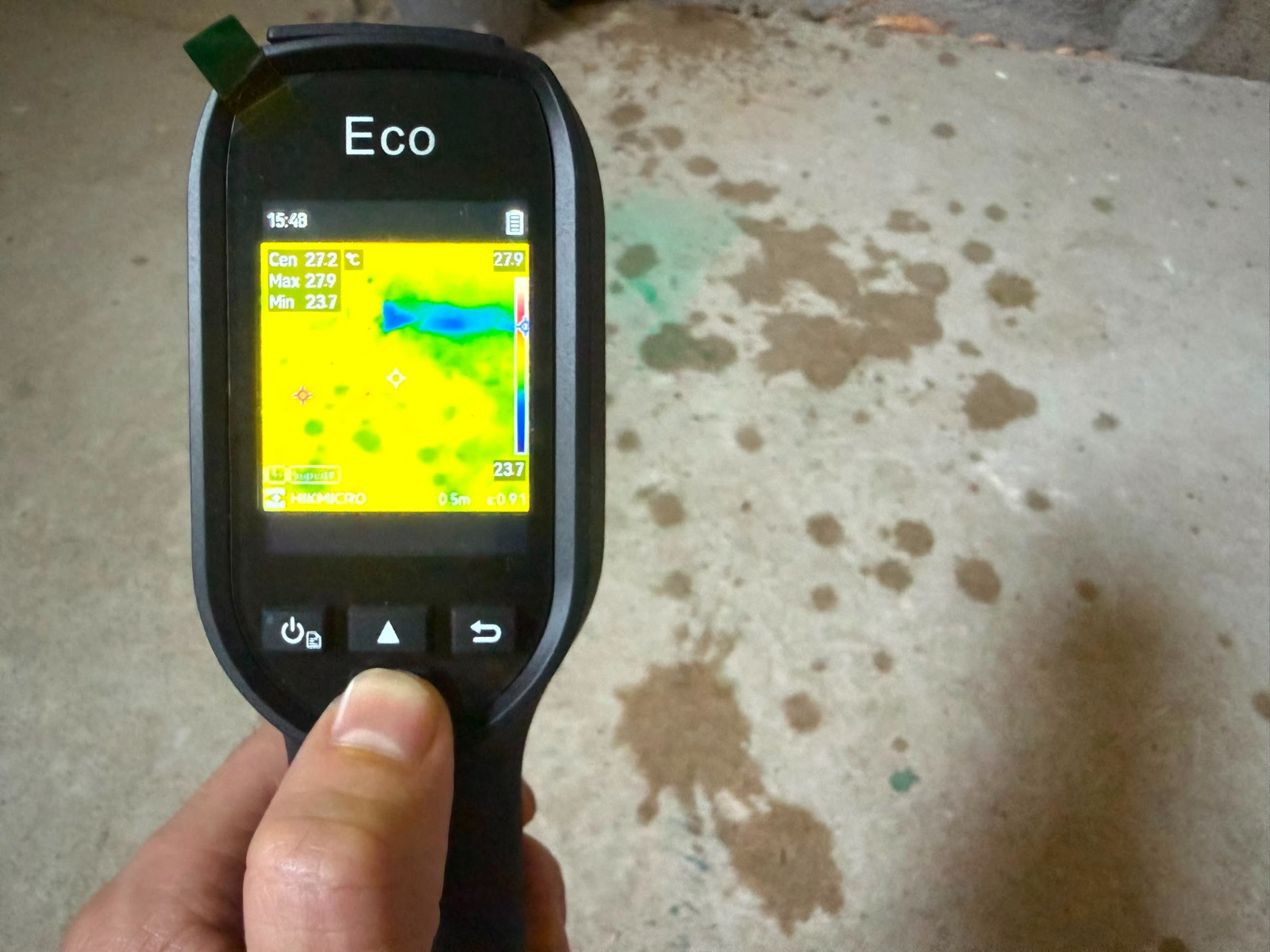
Moisture draws the least disciplined shape in building thermography, and that indiscipline is its signature. Where a missing insulation batt stays inside its framing bay and a thermal bridge draws straight lines along structure, a moisture patch ignores the framing and obeys gravity — an irregular, soft-edged bloom pooling downward from its source, crossing stud bays freely, often widest where water collects rather than where it enters. Ceiling stains trace toward roof penetrations and plumbing above; wall patterns climb from wet slabs or descend from window leaks. Telling the four building patterns apart is the core skill of our guide to how to read a thermal imaging camera, and moisture is the pattern the other three get mistaken for.
Join the Architecture Lab Collective.
What It Misses
Three limits bound the method, stated plainly. Moisture without a surface effect is invisible — water deep in a wall assembly that has not yet changed the surface temperature, or moisture in materials that mask it, simply does not appear, so a clean thermal scan is reassurance, never proof of dryness. Old stains read as nothing — the discoloration of a long-dried leak has no temperature signature, which cuts both ways: the camera will not raise false alarms on history, and it cannot date what it finds. And equilibrium hides everything — when the wet zone has reached the temperature of its surroundings, in a space with no temperature gradient to work with, the signature fades; survey conditions matter for moisture exactly as they do for the envelope work in our guide to how to use a thermal imaging camera.
The Camera Suspects, the Meter Convicts
A cool patch on a thermal image is a suspect, and treating it as a verdict is the amateur error the profession warns against — cold-water pipes, air leaks chilling a wall cavity, thermal bridges, and shadows of recent conditions all mimic the look. The professional sequence is fixed: the thermal camera finds and maps the anomaly fast, then a moisture meter measures the material directly at the suspect points and either convicts or acquits. No inspection report should say moisture on the camera's word alone, and the good news runs the other way too — the pairing is fast, non-destructive, and finds problems years before a stain would have announced them. Cameras suited to this work at every budget, with the sensitivity figures that matter for it, are ranked in our roundup of the best thermal imaging cameras.
The Water Test: Tracing a Leak to Its Entry Point
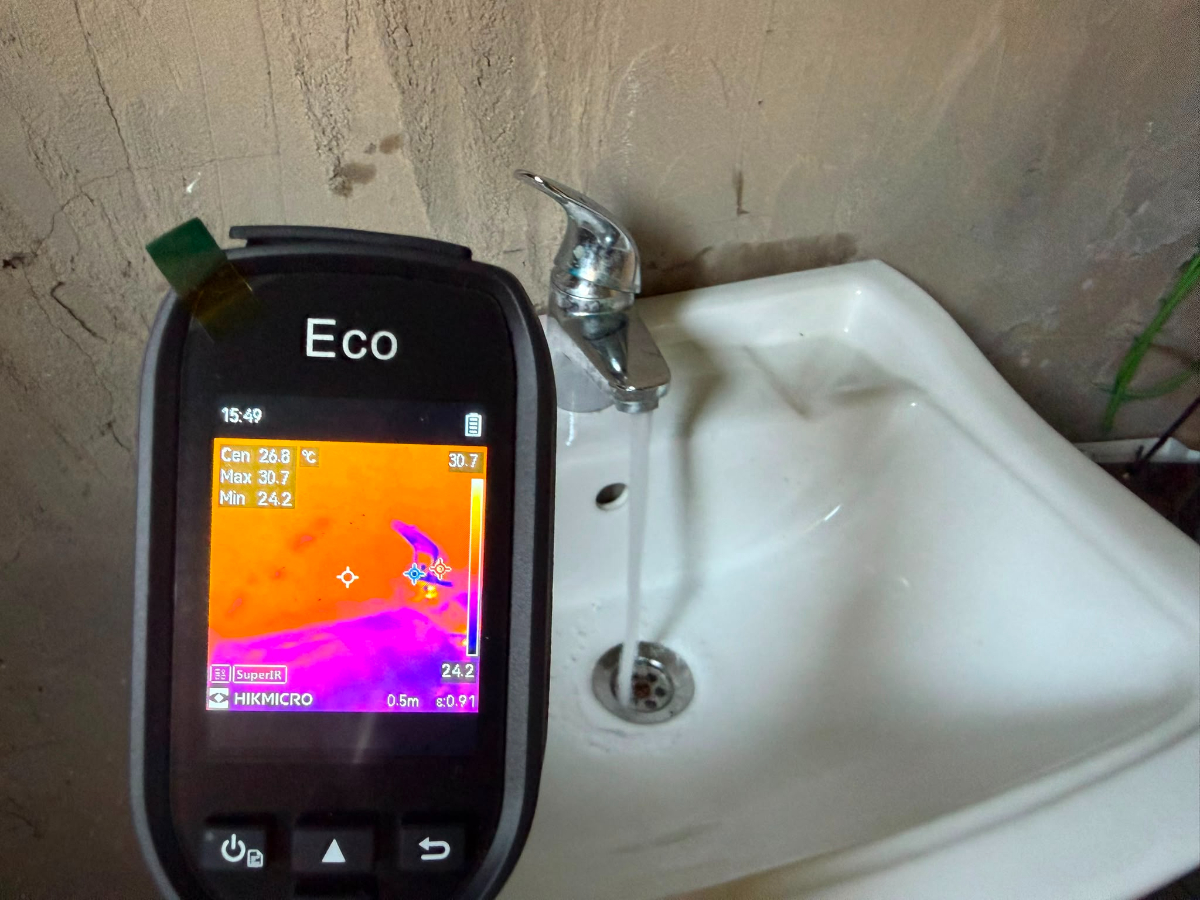
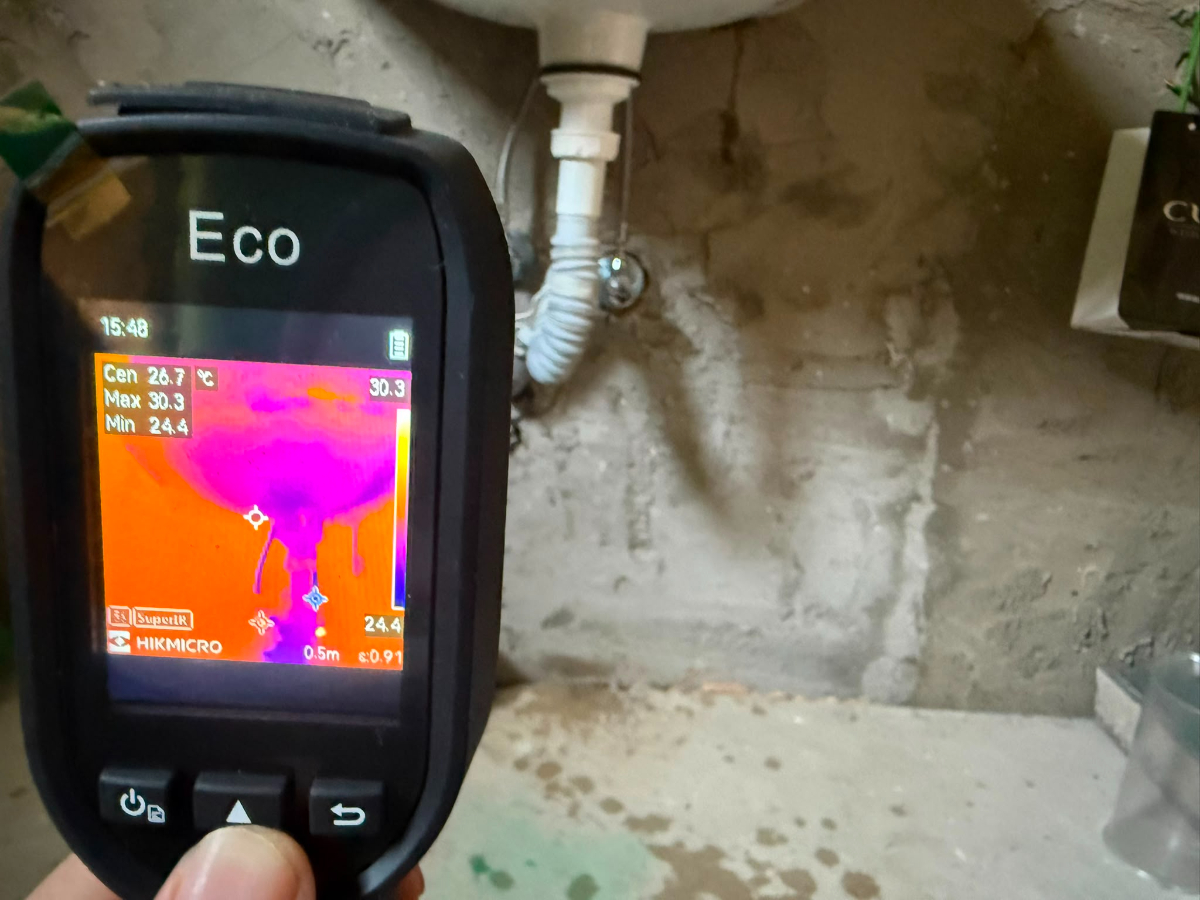
When the source stays hidden, professionals reverse the problem — instead of waiting for weather, they introduce water deliberately and watch the thermal camera catch where it enters. The controlled water test is the active version of everything above, and its discipline is zoning and time: wet one isolated area at a time, starting at the lowest suspect point and working upward, because water applied high contaminates every diagnosis below it. An observer inside watches the thermal image while water runs outside; the moment a cool bloom appears, the zone under test is the entry, and the test stops. The professional versions are standardized — the AAMA 501.2 nozzle test applies calibrated spray for about 15 minutes per test area with full sessions typically running 30 to 60 minutes, and ASTM E1105 adds a static pressure differential to simulate wind-driven rain. The homeowner's garden-hose version follows the same logic at gentle pressure — never a pressure washer, which forces water past seals that rain never would.
| Stage | Where | Duration | Watching for |
|---|---|---|---|
| Baseline | Whole suspect area, dry | 5 minutes | The before image — existing patterns, so new ones stand out |
| Zone 1 | Lowest suspect joint or component | ~15 minutes | A cool bloom appearing on the interior thermal view |
| Zone 2, 3… | Next zone up, one at a time | ~15 minutes each | The same — each zone cleared before moving higher |
| Stop | The moment moisture appears | — | Entry point identified; running longer only adds damage |
| Record | Every zone | Throughout | Start and finish times per zone, water pressure, findings |
Two cautions carry over from the field. Document the start and finish time of every zone — the interval between wetting and appearance says how deep the path runs. And respect the stop rule: the test ends when the leak shows, because water introduced past that point stops being diagnosis and starts being damage.
Frequently Asked Questions
Can a thermal camera see water inside a wall?
Not directly — it sees the cool patch evaporating moisture creates on the wall's surface. If the water has changed the surface temperature, the camera maps it precisely; if it has not, the camera sees nothing, which is why a clean scan reassures but never certifies dryness.
Can thermal imaging detect mold?
No — mold has no temperature signature of its own. Thermal imaging finds the moisture conditions mold grows in, which makes it an early-warning instrument; confirming mold requires inspection and sampling where the moisture pattern points.
What are the best conditions for finding moisture with a thermal camera?
A temperature difference between the material and its surroundings, and active evaporation — which usually means scanning when indoor and outdoor temperatures differ and the space is not saturated with humidity. A recently dried surface or a room at full equilibrium hides the signature.
Do I need a special thermal camera to find moisture?
A sensitive one — moisture gradients are subtle, and the working recommendation is thermal sensitivity below 60 millikelvin with enough detector resolution to render the patch's shape, since the shape separates moisture from its imitators. Entry-level 80 by 60 units flag gross problems; tracing needs the mid-tier and up.
How do you find the exact entry point of a leak?
With a controlled water test — wet one isolated zone at a time from the lowest suspect point upward, about 15 minutes per zone per the professional convention, while watching the interior with the thermal camera. The zone being wetted when the cool bloom appears is the entry, and the test stops there.
Can thermal imaging find roof leaks?
Yes, and it is one of the method's strongest uses — after rain or during evaporation, wet insulation and decking hold and release heat differently from dry areas, and evening roof scans map the wet zones a walkover cannot see. The confirmation rule holds on roofs as everywhere: the meter, or a core sample, makes the call.
Resources
- Architecture Lab — What Is Thermal Imaging
- Architecture Lab — How to Read a Thermal Imaging Camera
- Architecture Lab — How to Use a Thermal Imaging Camera
- Architecture Lab — Best Thermal Imaging Cameras
- Fluke and Teledyne FLIR — Building Moisture Application Guidance
Join the Architecture Lab Collective
New projects, interviews and news from Architecture Lab, in your inbox.
Article by Anton Giuroiu for Architecture Lab · Published 5 January 2023 · Updated 18 August 2026