

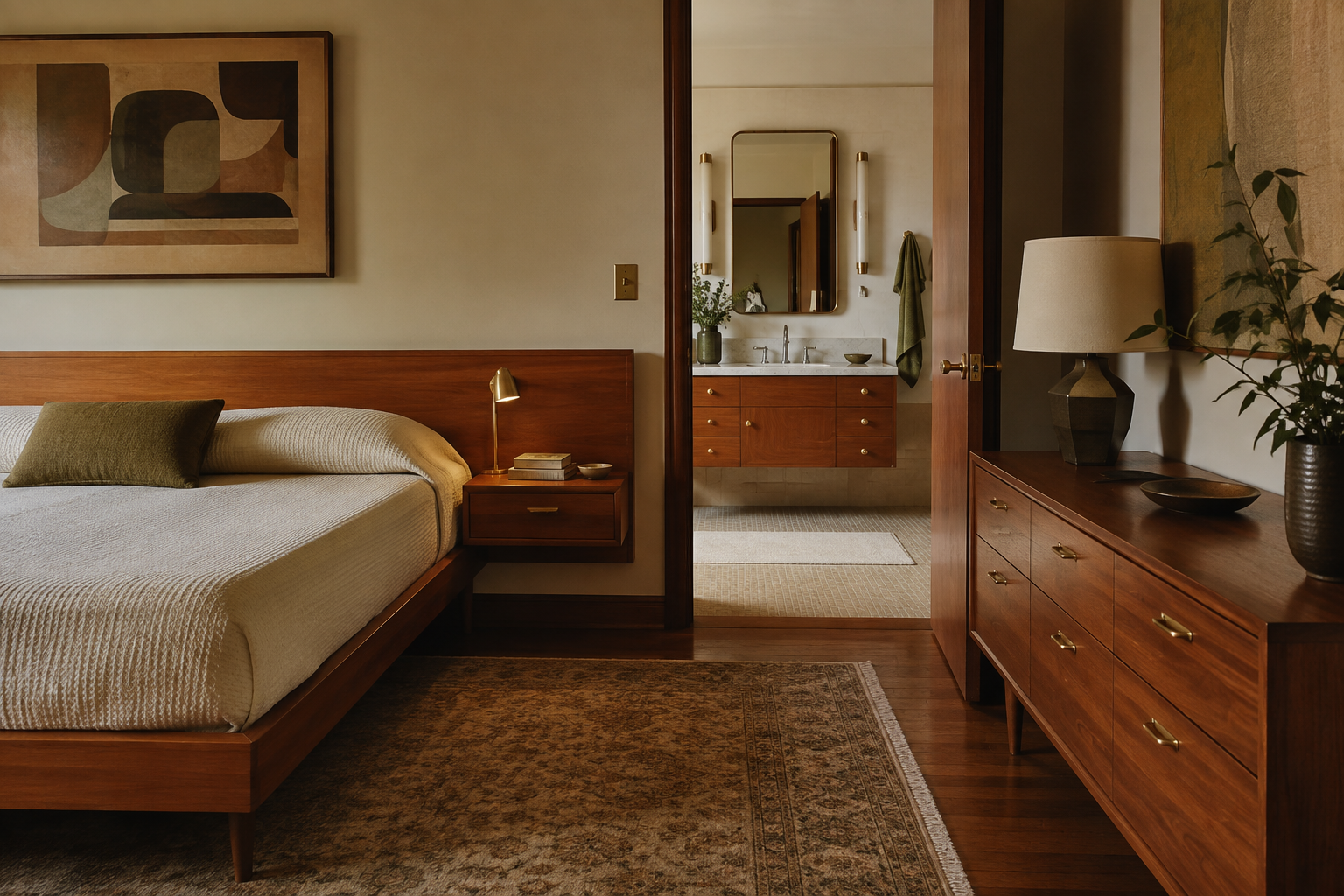
The mid-century modern bedroom is built from a short list of rules the era itself wrote down: a low bed treated as architecture, one wood carried through the room, legs that show the floor, lighting chosen as sculpture, and restraint everywhere else. The thirteen ideas below are those rules in working order — each one names the design language it comes from and the pieces that speak it, because the difference between a mid-century bedroom and a beige room with one teak dresser is fluency, not budget. The furniture canon behind everything here is documented piece by piece in our guide to iconic mid-century modern beds; this page is about the room those beds were drawn for.
The Room the Era Rebuilt
The mid-century bedroom was argued into existence before it was furnished. George Nelson and Henry Wright’s 1945 book Tomorrow’s House told postwar homeowners to stop treating the bedroom as a container for inherited furniture and start designing it as a place where living happens — storage built into the walls, surfaces cleared, the bed low and unceremonious. The industry followed: built-in storage entered the American plan, casegoods dropped toward the floor, and manufacturers from Herman Miller to Broyhill drew bedroom lines to match the new horizontal houses. One consequence still shapes vintage shopping today — the era’s beds were overwhelmingly twin and full, because the queen barely existed when the canon was drawn. Every idea below descends from that rebuild.
1. Start With the Bed, and Keep It Low
The bed decides whether the room is mid-century before a single accessory arrives: a platform or slim-rail frame, headboard doing real work, the whole silhouette held low and horizontal. Height is the tell — the era’s frames hug the floor because the houses they furnished ran long and low, and a tall upholstered hotel bed defeats every other choice in the room. The thirteen documented designs that define the type, from Nelson’s Thin Edge to the Case Study platform, are covered in the beds guide, licensed reissues and spotting details included.
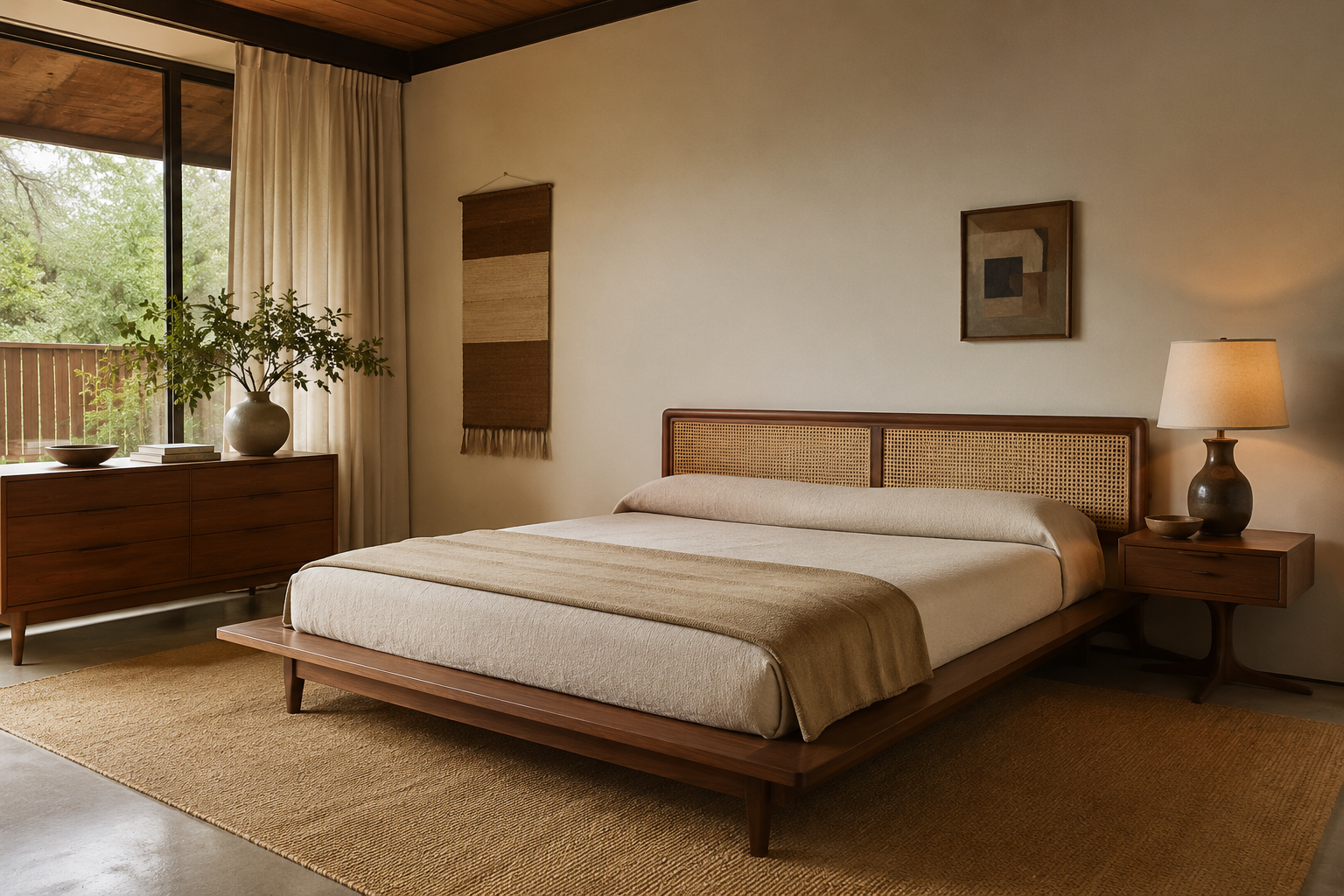
2. Commit to One Wood
Walnut or teak, chosen once and carried through bed, dresser, and nightstands — the era’s rooms read as compositions because the wood repeats. Mixing three finishes produces the furniture-store look no mid-century room ever had. Walnut runs a far wider range than buyers expect, from pale chocolate to near-black, and matching pieces across that range is its own skill — our primer on walnut color maps it — while teak reads lighter, oranger, and more Danish. Either works; the commitment is the point.
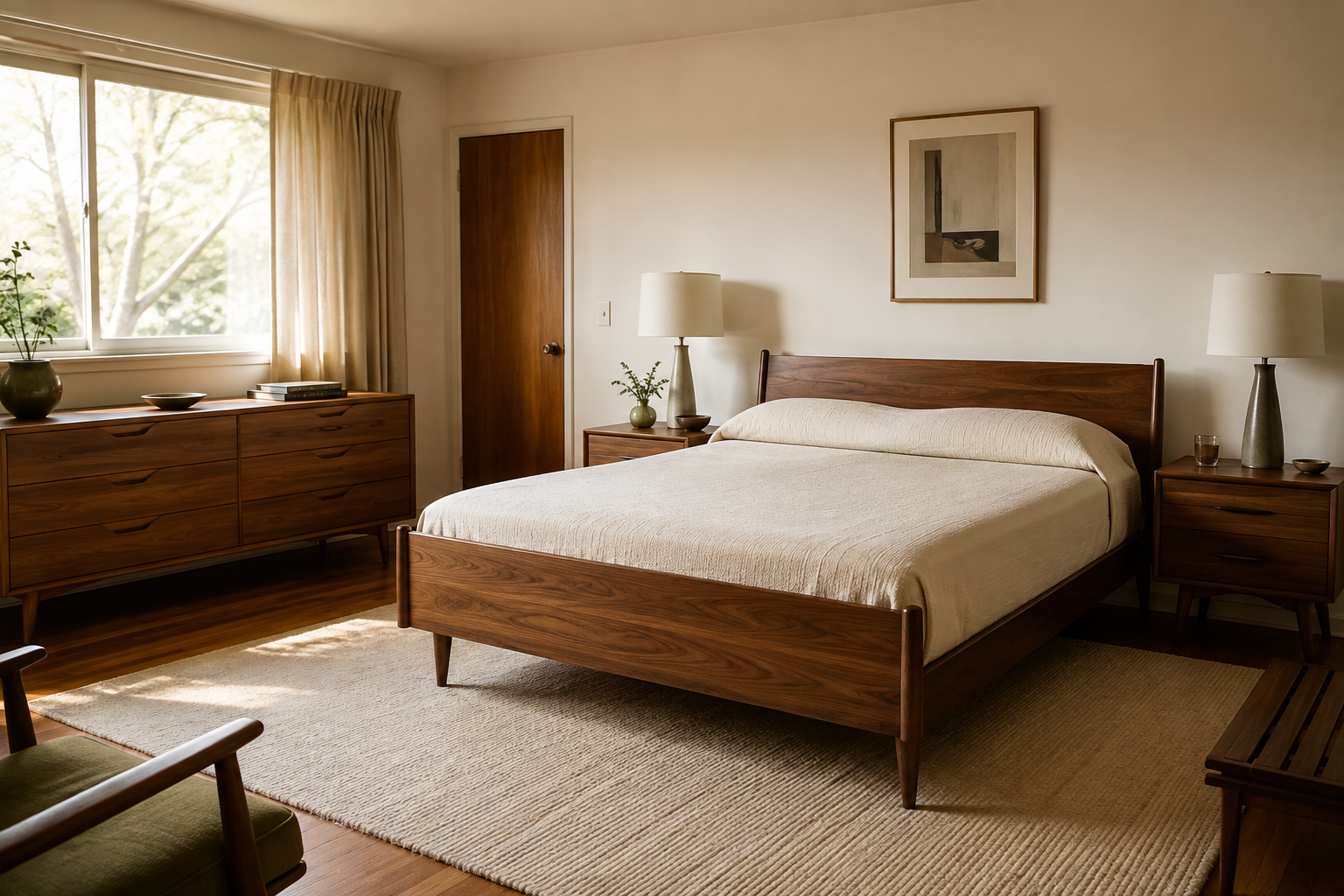
3. Show the Floor
Tapered legs, splayed a few degrees, thinning as they drop — and beneath them, visible floor. The era lifted its casegoods on legs so light passes under everything, which is why a modest mid-century room feels larger than a bigger room furnished to the baseboards. The rule extends to the bed: a frame on legs or a recessed plinth beats a skirt-to-carpet box on every count the style keeps score on.
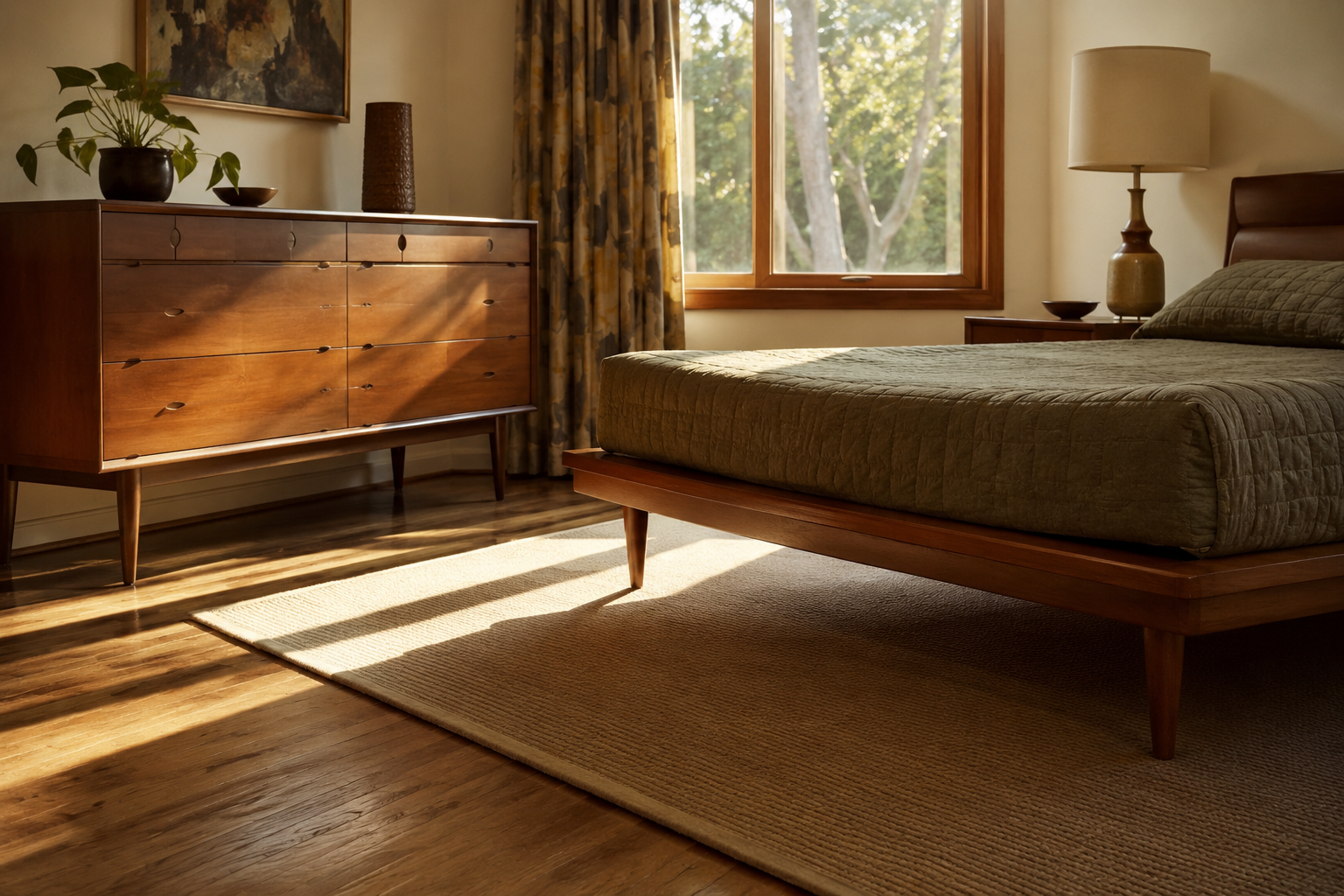
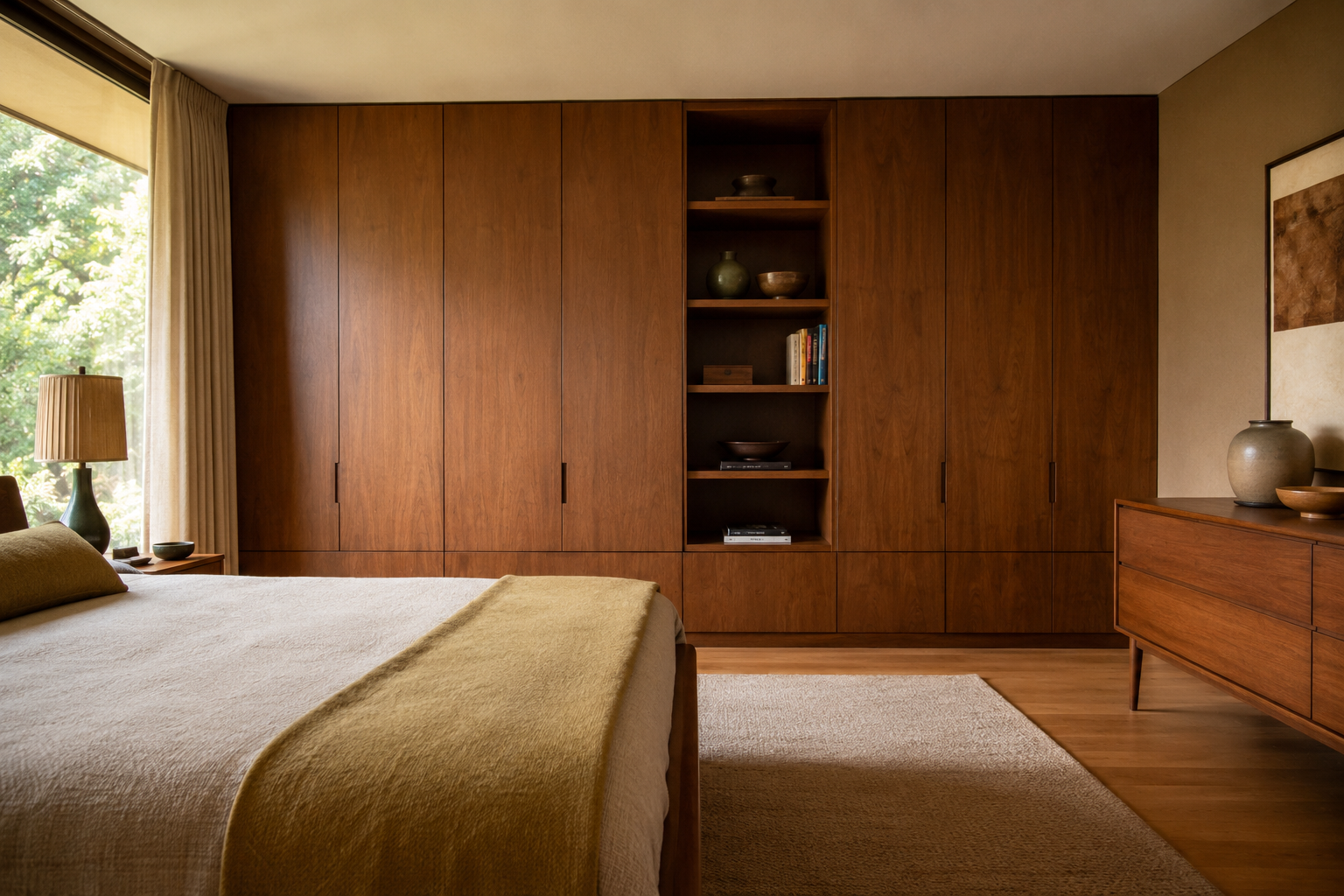
4. Build the Storage In
Nelson and Wright’s Tomorrow’s House introduced readers to the storage wall — closets, drawers, and shelving absorbed into the room’s architecture — and the idea remains the cleanest answer to the bedroom’s oldest problem. Where a true built-in is out of reach, the era’s modular lines made the case goods do it: long low dressers, stacking wardrobe units, headboards with cabinets absorbed into them, a trick Edward Wormley perfected at Dunbar decades before the mass market caught up. Clutter is the one material mid-century rooms refuse.
5. Light With Sculpture
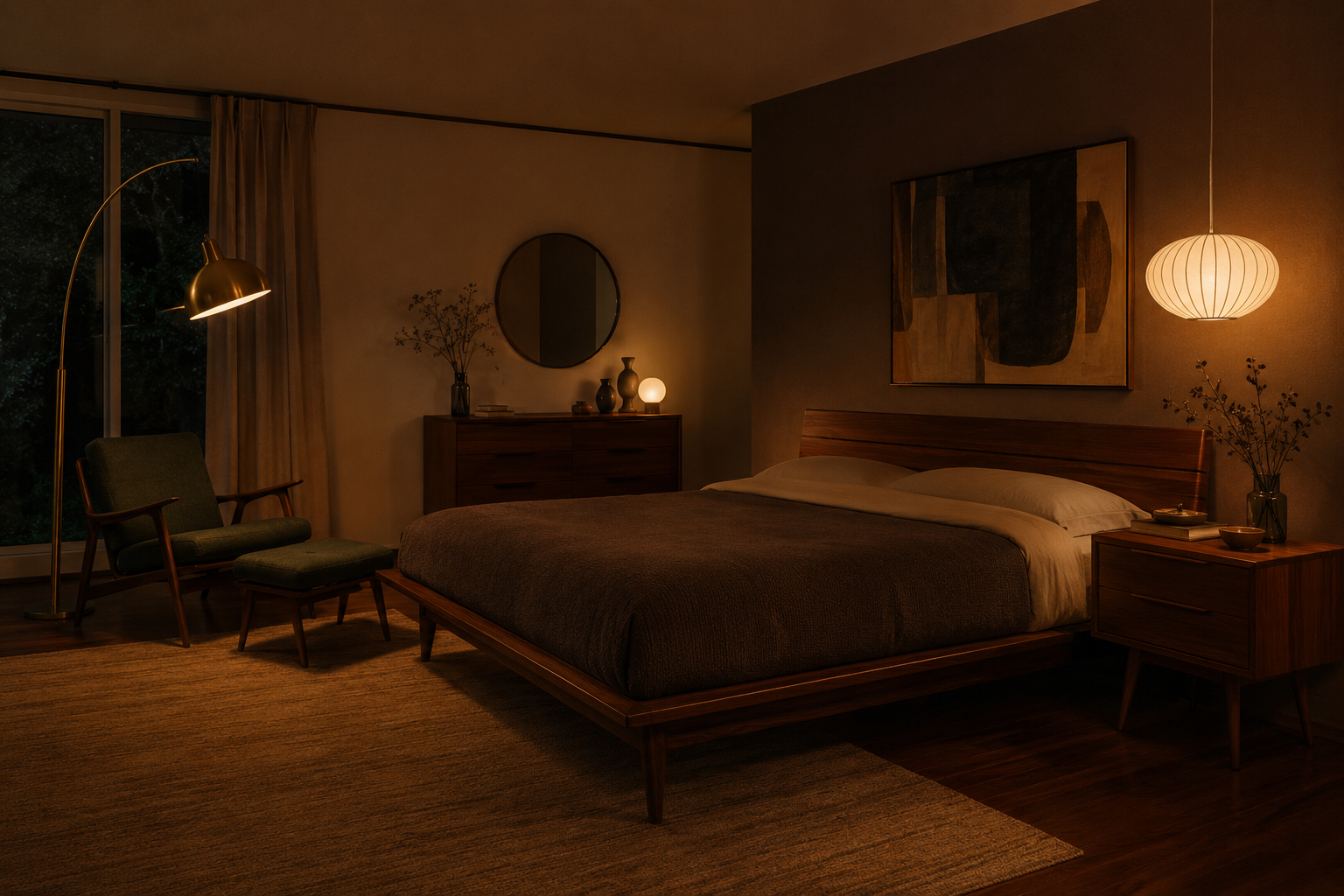
Mid-century lighting is chosen the way art is chosen, and three families do most of the work: the paper-and-plastic glow of Nelson’s bubble lamps over a corner or bedside, the atomic sputnik as the ceiling statement, and the arc or gooseneck floor lamp reaching over a reading chair — a family we shop in our roundup of the mid-century floor lamp designs worth the name. One sculptural fixture per zone, dimmed warm, outperforms any quantity of recessed cans, which the era did not have and the style does not want.
6. One Starburst, Singular
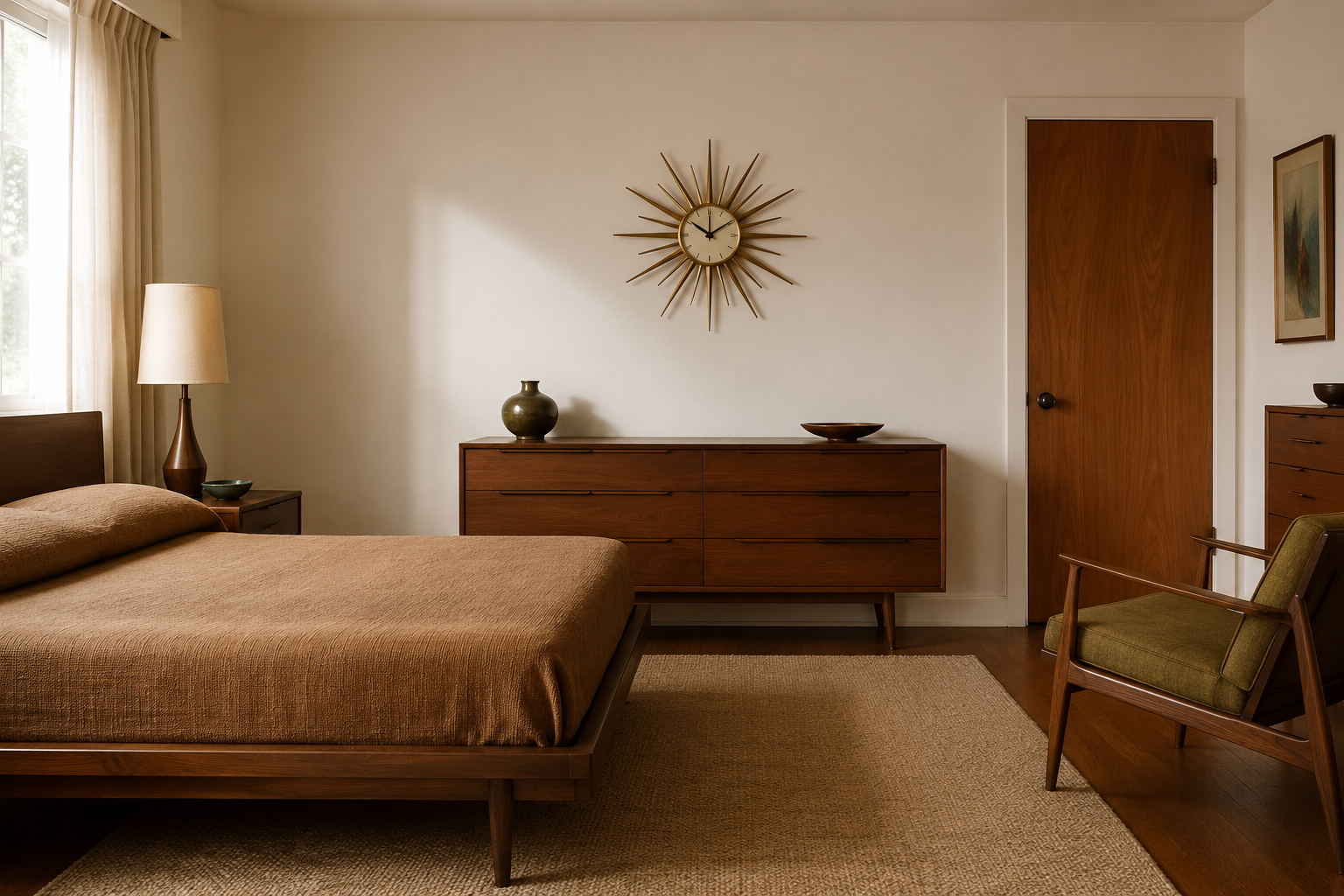
The starburst — clock, mirror, or light — is the era’s exclamation mark, an atomic-age motif that reads instantly and dates gracefully when used once. George Nelson’s studio made the defining clocks of the family, and a single one above a dresser carries a whole room’s worth of period signal. The plural is the mistake: two starbursts read as a theme party, and the era’s own rooms deployed the motif the way its architects used a single bold house number — once, and with confidence.
7. Pattern With a Pedigree
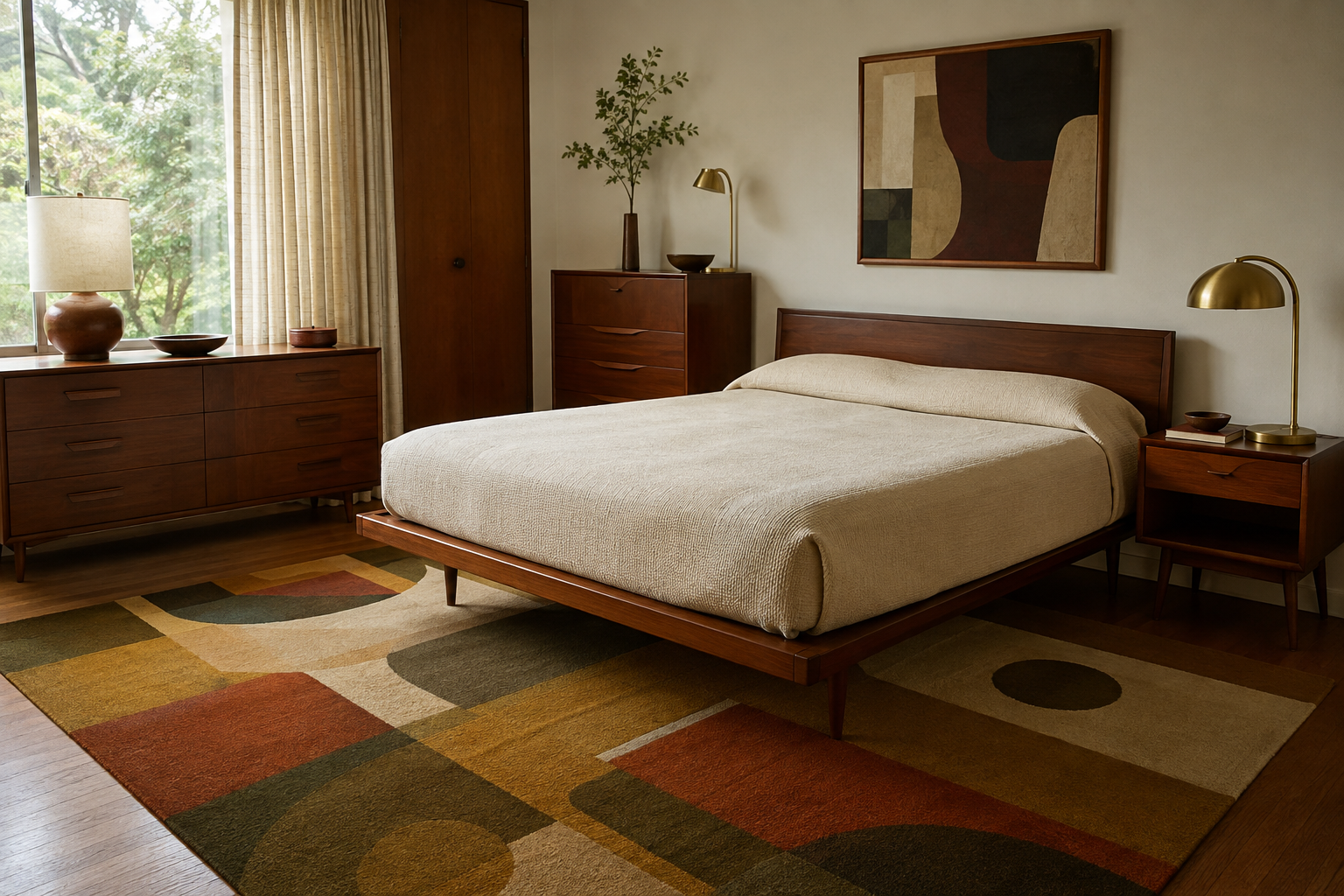
The era’s textiles were designed, not printed at random — Alexander Girard’s tenure directing Herman Miller’s textile division set the standard: abstract geometry, saturated color, wit held in a grid. In practice: one patterned element at scale (a rug, a blanket at the foot, one wall of paper) against calm bedding, with the pattern’s colors drawn from the room’s wood and accent. Pattern on pattern was not the period’s move in the bedroom, whatever the living room got away with.
8. Earth Base, One Bold Accent
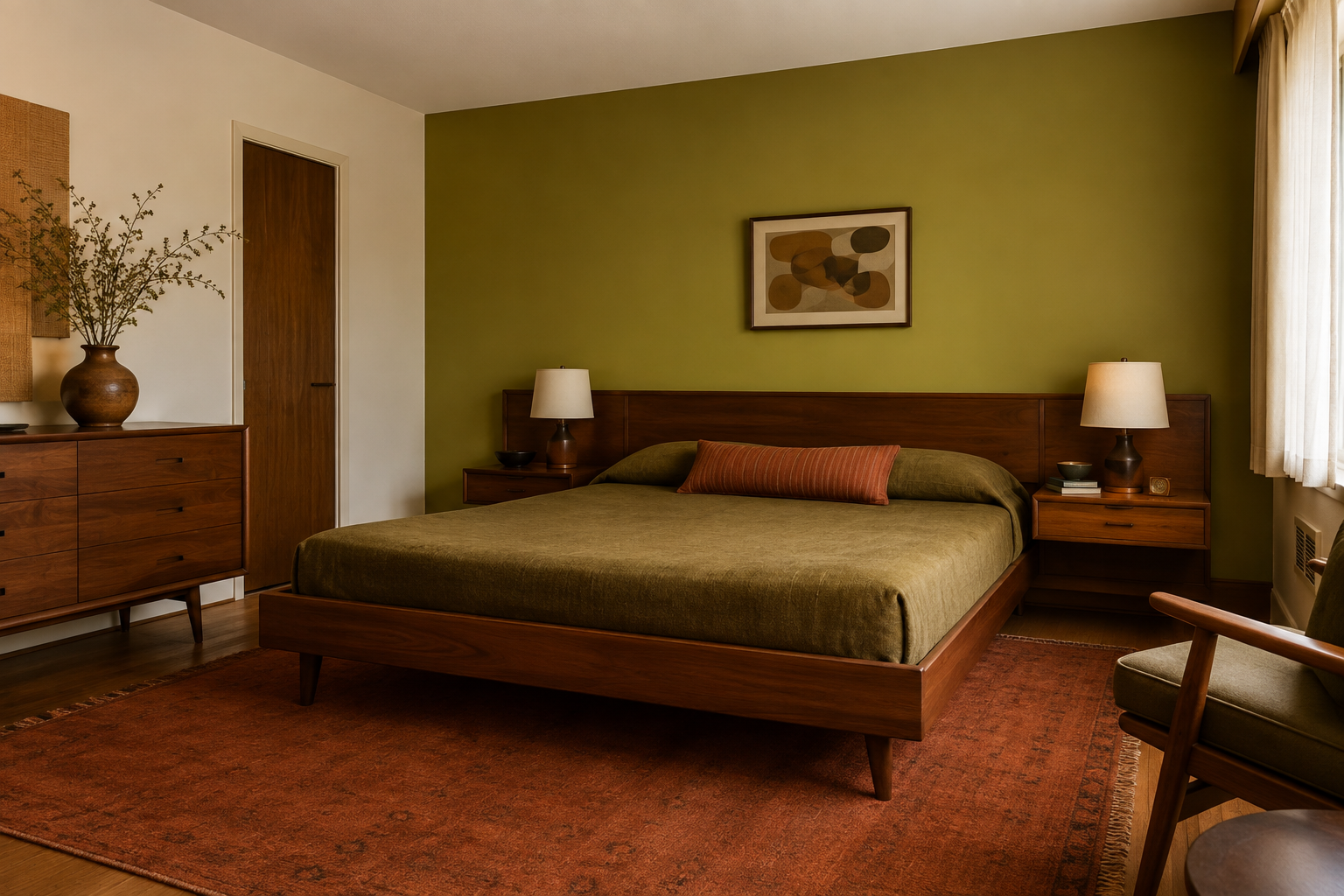
The reliable mid-century bedroom palette is earth and wood — cream, ochre, olive, rust, brown — with a single saturated accent doing the talking: mustard, burnt orange, teal, or a chartreuse wall behind the bed. The all-primary-colors version of the style belongs to playrooms and to misremembering; the bedrooms of the period ran warm and low-contrast, and the accent earns its force precisely because everything around it declines to compete.
9. Mix Honest Materials
The era’s signature is materials used as themselves: wood grain visible, leather that creases, cane and paper cord, wool and jute, steel and glass unapologetic about being steel and glass. A bedroom gains the period’s texture by layering these honestly — a cane headboard against plaster, a wool throw on leather, brass beside walnut — and loses it the moment materials impersonate each other.
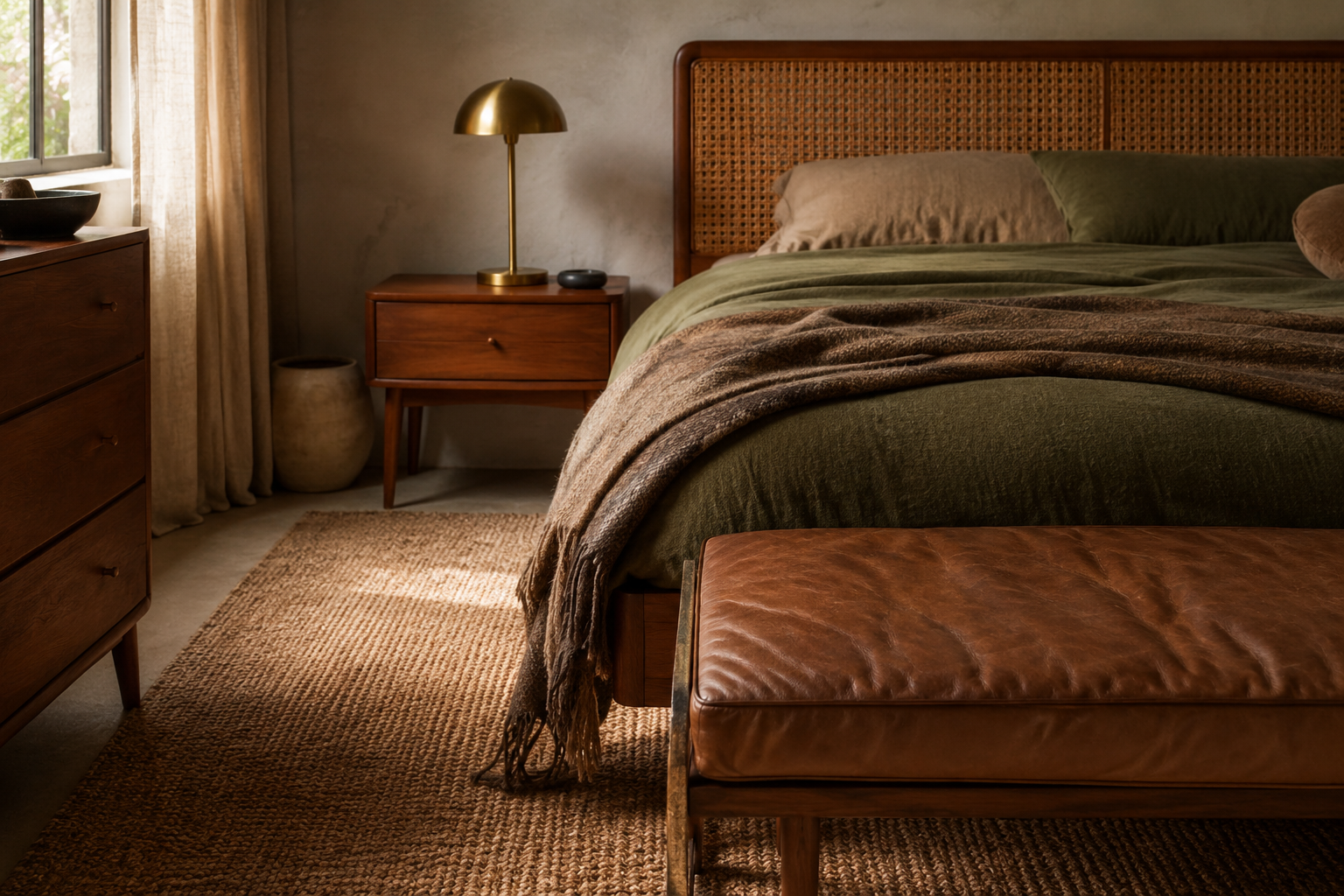
10. Put a Bench at the Foot
The platform bench — Nelson’s slatted version is the archetype — finishes the bed the way a base finishes a lamp: seating for dressing, a landing for the day’s clothes, a horizontal line that extends the bed’s geometry. It is the highest-value square meter in the mid-century bedroom, and it beats both the blanket-box and the nothing that usually stands there.
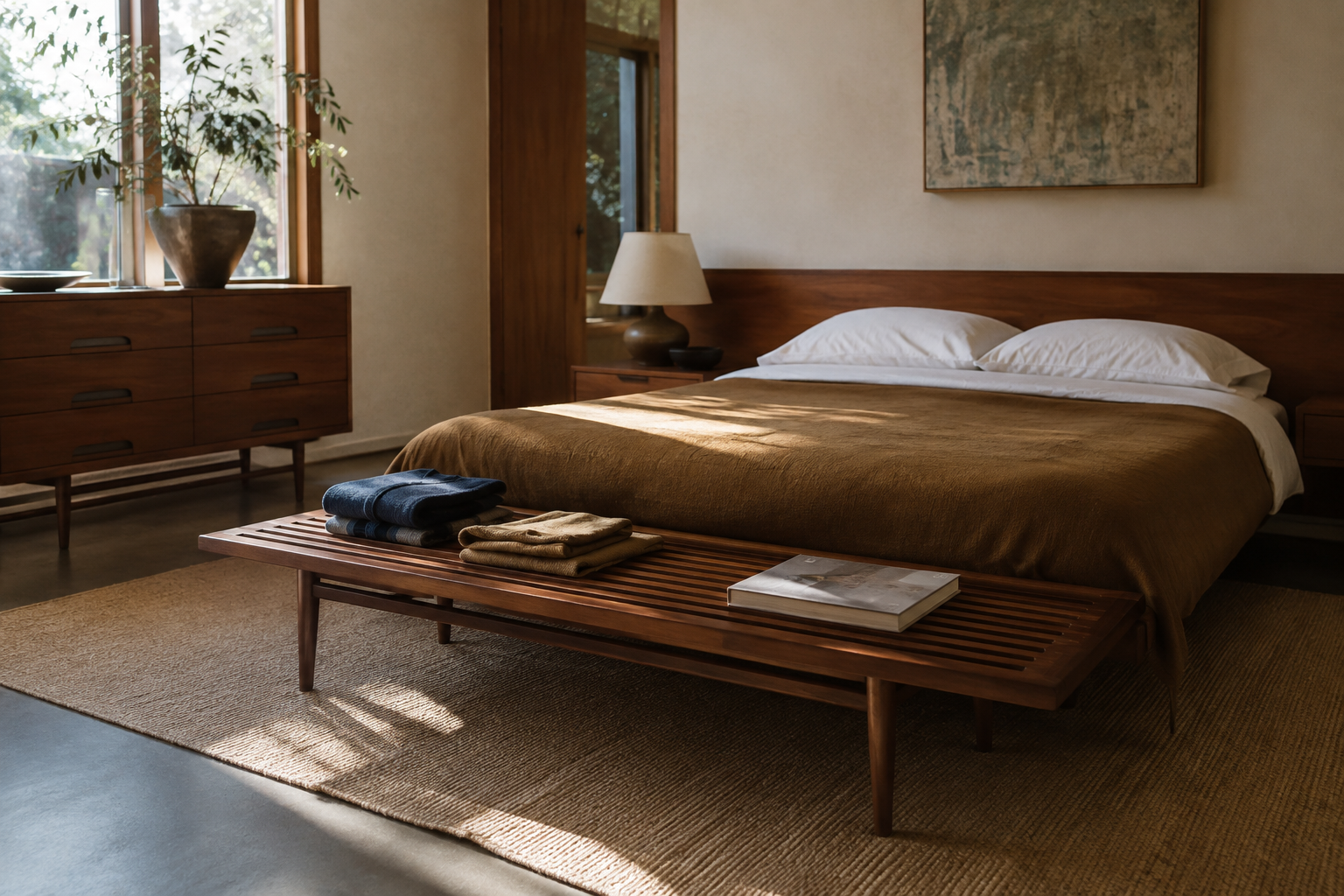
11. The Accent Wall, the Era’s Way
The period’s accent walls were material more often than paint: walnut paneling, grasscloth, a brick or block wall left honest. Paint works when it commits — a full chartreuse, olive, or teal wall behind the headboard, edge to edge — but the half-measure feature wall in safe gray belongs to another decade entirely. Whichever route, the bed centers on it: the accent wall exists to frame the room’s architecture, and in this room the bed is the architecture.
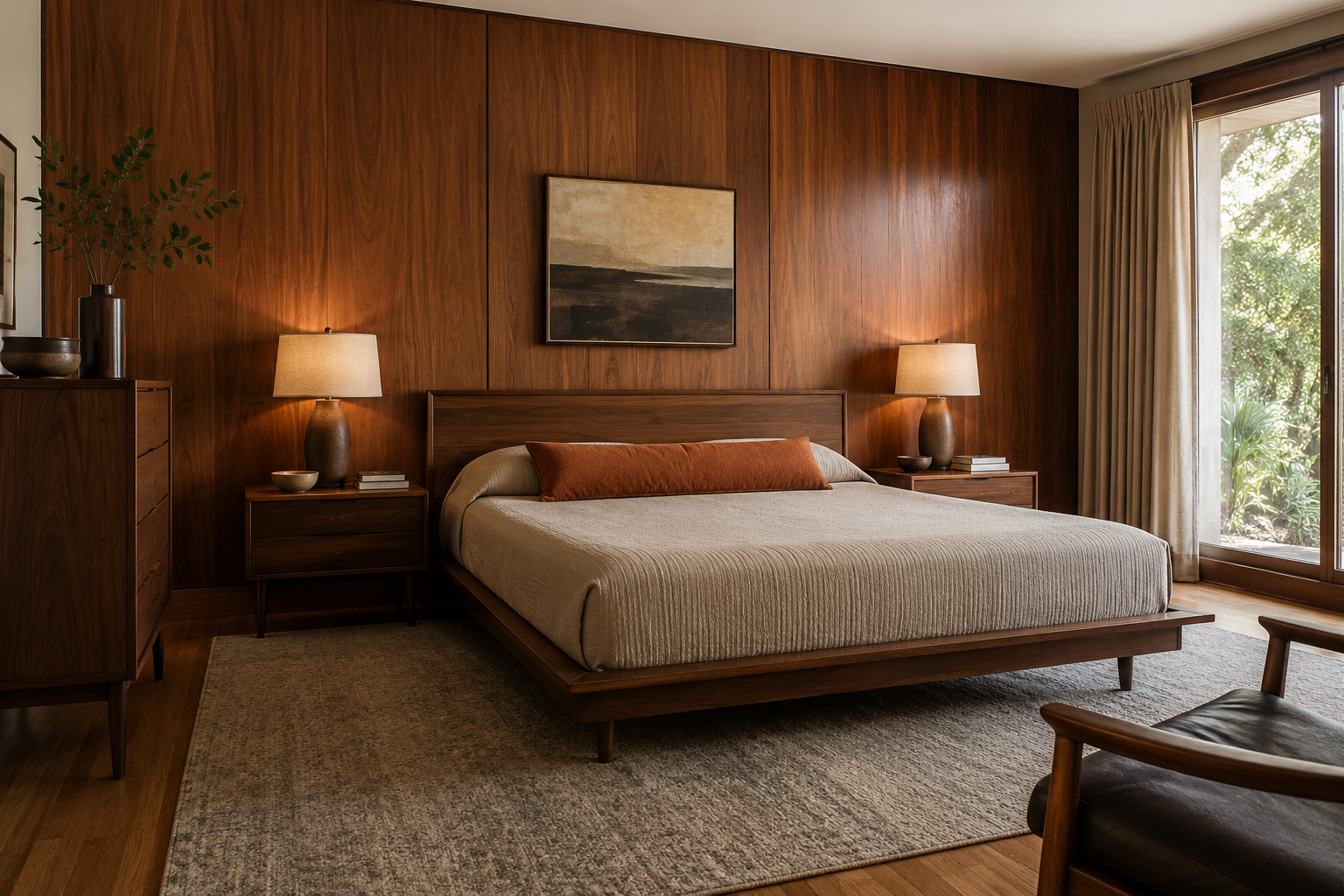
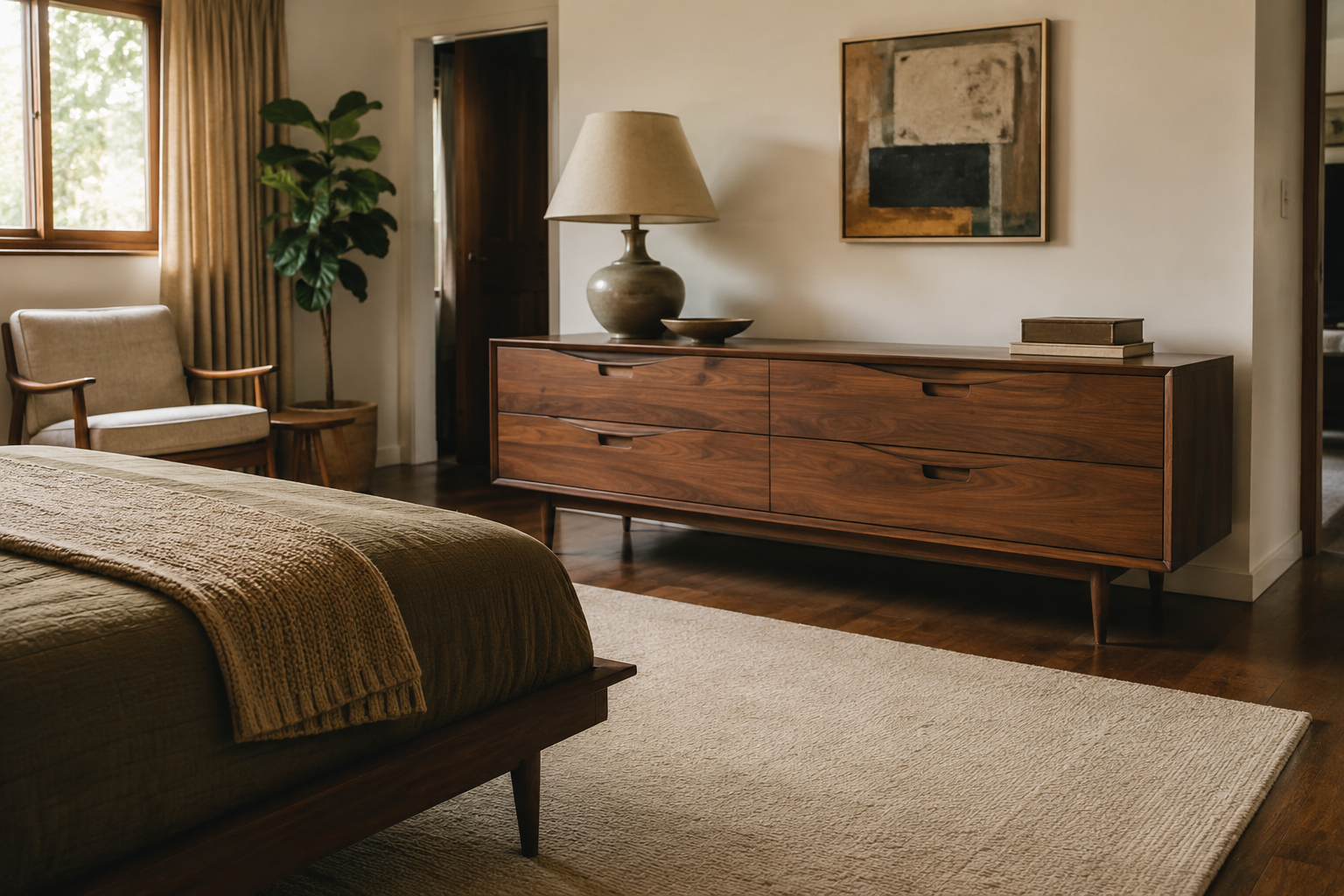
12. The Dresser as a Horizontal Line
Choose the dresser the way the era did — long, low, credenza-proportioned, its drawers a clean band of grain with sculpted or recessed pulls — and place it where its line answers the bed’s. The vertical highboy reads Colonial no matter its hardware; the low six-drawer reads 1958 from across the room. This is also where the vintage market is kindest: production-line dressers from the volume makers survive in quantity and cost a fraction of the marquee names while speaking the same language.
13. Carry It Into the Bath
The strongest mid-century suites no longer stop at the bedroom door: the same walnut, the same restraint, and the same horizontal discipline now run into the ensuite, a migration we document across our guides to mid-century modern bathroom vanities and the bathroom that surrounds them. Match the wood tone across the threshold, keep the metals consistent — brass or black, not both — and the bedroom-and-bath read as one composition, which is precisely how the era’s architects drew their houses, as the residences in our tour of mid-century homes show room by room.
What makes a bedroom “mid-century modern”?
A low platform or slim-frame bed, one wood carried through the case goods (walnut or teak leading), tapered legs with visible floor beneath, sculptural lighting, minimal ornament, and a warm earth palette with a single bold accent. The style is a system, and three elements speaking it read more convincingly than ten pieces shouting it.
What colors work in a mid-century bedroom?
Earth tones as the base — cream, ochre, olive, rust, warm gray — with wood as the dominant “color” and one saturated accent: mustard, burnt orange, teal, or chartreuse. Keep contrast low and warmth high; the era’s bedrooms were calm rooms with one loud sentence in them.
Does mid-century modern work in a small bedroom?
Unusually well. The style’s legs-and-visible-floor rule, low sightlines, and built-in storage discipline were developed for compact postwar houses, so its space illusions are native rather than adapted. A floating or leggy bed, one low dresser, and a wall-mounted light instead of nightstand lamps recover more visual space than any paint trick.
Do I need designer furniture to get the look?
No. The volume manufacturers of the era — Lane, Kent Coffey, Bassett, American of Martinsville, Stanley and their peers — produced bedroom suites in the same language at production prices, and marked examples survive in quantity. The beds guide’s rule applies here: a labeled volume-tier piece beats an unmarked piece with a designer story.
Is the mid-century bedroom going out of style?
The look built on the era’s principles — one wood, low lines, honest materials — has stayed current for seventy years and shows no signal of leaving; what dates is the theme-party version with five starbursts and slogan pillows. Follow the restraint rules above and the room ages the way the furniture has.
Resources
Architecture Lab — Mid-Century Homes
George Nelson & Henry Wright — Tomorrow’s House (Simon & Schuster, 1945)
Herman Miller — Nelson, Girard and Eames Design Archives
Architecture Lab — 13 Iconic Mid-Century Modern Beds
Architecture Lab — Walnut Color, Explained
Architecture Lab — 13 Mid-Century Modern Bathroom Vanities

